
|
|
By Lone_Sentry_Admin, on January 22nd, 2011%
The U.S. intelligence articles from Tactical and Technical Trends, No. 34, September 1943 have been added to the main Lone Sentry website:
By Lone_Sentry_Admin, on November 23rd, 2010%
When the Allied forces first encountered the Tiger II in Normandy in the summer of 1944, the panzer was briefly referred to as the “Pantiger”. The Associated Press picked up the name “Pantiger” in their article on August 19th:
Germans have thrown a huge new, heavily armored tank into action on both the Russian and northern French fronts in an effort to stem the Allied advances, but first reports denied it was a “super weapon.”
One of the new monsters weighing over 65 tons and with six inch armor plate—an inch and a half thicker than anything the enemy yet has put into action—was taken by the British on the Orne river front. The tank was a victim of a mechanical breakdown and never had fired a shot in battle.
Christened the “Pantiger” by its captors, the tank combines the best features of the Nazi Tiger and Panther tanks, which weigh 45 tons each. It is 23 feet long and over 11 feet wide, has an extra wheel on each side of its tracks and a huge, clumsy looking turret.
The name “Pantiger” was still being used as late as the publication of Tactical and Technical Trends, October 1944.
PANTIGER, A REDESIGNED TIGER, NEWEST ENEMY HEAVY TANK
A new 67-ton German heavy tank—referred to variously as Pantiger and Tiger II—has been employed against the Allies this summer in France. Actually a redesigned Tiger (Pz. Kpfw. VI), it mounts the 8.8-cm Kw. K. 43 gun. On the basis of a preliminary report, the general appearance of the new tank is that of a scaled-up Pz. Kpfw. V (Panther) on the wide Tiger tracks. It conforms to normal German tank practice insofar as the design, lay-out, welding, and interlocking of the main plates are concerned. All sides are sloping. The gun is larger than the Panther gun, and longer than the ordinary Tiger gun. Armor is also thicker than that on either the Panther or the Tiger. The turret is of new design, with bent side plates. In all respects the new tank is larger than the standard Tiger.

By Lone_Sentry_Admin, on October 12th, 2010%
The following intelligence report on an unusual German remote-controlled machine-gun position encountered by U.S. troops in Normandy was published in the Intelligence Bulletin, Vol. III, No. 4, December 1944.
GERMAN MACHINE-GUN TRICK
A U.S. staff sergeant, who served as an observer for a mortar section in the Normandy campaign, reports an unusual German method of firing a machine gun by remote control. Although this method has not been reported by other U.S. soldiers, and although no concrete evidence as to its effectiveness can be presented, the idea is noted here for what it may be worth as a sample of the German soldier’s ingenuity.
 German Machine-gun Trick. A close-up of the machine gun, with, its pulleys. Riflemen-observers whistle signals to the gunner, to indicate Allied approach via point A. The gunner zeroes knot A, which trains the muzzle on point A. The cord arrangement for firing is not shown here.
The sergeant tells of inspecting a captured German machine-gun emplacement, which had been prepared in the highly novel manner illustrated in the figure. A rope had been attached to the butt end of the gun. This rope ran through pulleys set up on each side of the rear of the gun, so that movement of the rope would aim the gun in any lateral direction. The gun then was zeroed at certain positions in the field of fire, and these positions were marked by knots in the rope. Thus the gunner could aim the gun, and, by moving the rope back and forth, spray an area with bullets from a position out of the line of fire when the gun was attacked. The gun was fired by a trigger-and-cord arrangement not shown in the original field sketches.
The German machine-gun crew consisted of a gunner and two or three riflemen who served as observers and who reported to the gunner the particular point on the which the gun should be trained.
This machine-gun position appears impractical at best, and may be an incorrect report. The Germans however did produce a special periscopic aiming and firing apparatus for the MG34 and MG42 machine guns. U.S. ordnance reported on this device as the “Deckungszielgerät für le. 34 u. 42 Dezetgerät: Undercover Aiming and Firing Apparatus.”

By Lone_Sentry_Admin, on October 6th, 2010%
These Tiger I and Tiger II armor thickness diagrams were included in a confidential SHAEF intelligence publication on German tanks in October 1944:
PzKpfw “Tiger” – Model E Armour Arrangement

PzKpfw “Tiger” – Model B Armour Thickness

By Lone_Sentry_Admin, on October 1st, 2010%
The following U.S. intelligence reports on Japanese suicide boats were published in Enemy on Luzon: An Intelligence Summary:
NAVY SUICIDE CRASH BOATS:
Japanese suicide crash boats manned by Naval personnel were found in a tunnel on Corregidor. The boats were loaded on small carts which were mounted on rails running from the tunnel to the beach where they were to be launched.
The Navy Suicide Crash Boat was 16 feet 8 inches long and had a beam of 5 feet 8 inches. The hull was plywood construction throughout and was powered by an automotive type, 6-cylinder, in-line, gasoline engine. The explosive charge was built into the hull of the boat. This last feature was the main difference between the Army and Navy suicide boats.
The Type 98 explosive charge weighed 640 pounds and was located below the deck forward of the cockpit. The charge could be fired by three methods: 1) electrically on impact; 2) electrically by closing a switch; and 3) by use of a pull igniter.
From the disposal point of view, the boat was dangerous to anyone unfamiliar with the circuit and switch details. It would also have been simple to rig this boat as a booby trap either electrically or through the pull igniter.
The boat carried a big charge that would be effective against ships. The only defense that a ship had was, as in the case of the suicide plane, accurate gunfire.
ARMY SUICIDE CRASH BOAT:
Japanese suicide boats, to be manned by Army personnel, were recovered at Lingayen Gulf, Luzon. These craft were the principal weapon of the Japanese Gyoro (“fishing”) battalions.
The army suicide boat was made of plywood with a length of 18½ feet and a beam of 5 feet 10 inches. It was decked with a forward hatch leading to the engine and has a cockpit aft. The boat was powered with a 6-cylinder Chevrolet automotive engine, about 85 horsepower. The maximum speed of the craft was estimated at 35 knots. The fuel capacity was about 56 gallons.
The two 120 kg depth charges were mounted on racks abreast of the cockpit. The charges could be either dropped close aboard or released when the boat crashed into the ship. At least one attack of the former type was made, resulting in damage to a merchant ship during the Luzon campaign.
Although parts of the release mechanism were not available, the operation is believed to have been as follows: the charges were fitted in the racks and held by an arrangement of slings and bars. Rods fitted to extend beyond the bow would be driven back releasing the charges during a collision with another ship. However, the coxwain could place a crossbar forward to release the charges.
By Lone_Sentry_Admin, on September 26th, 2010%
The U.S. military intelligence articles from Tactical and Technical Trends, No. 12, November 1942 have been added to the main website:
By Lone_Sentry_Admin, on September 19th, 2010%
The following article was printed in the December 1945 issue of C.I.C. (Combat Information Center) published by the U.S. Office of the Chief of Naval Operations.

The long, violent history of this war saw the rise of many new or radically improved weapons, from the magnetic mine in the early days to the “personnel-controlled bomb” (suicide plane) of recent fame. The story of Allied countermeasures to the threat of Axis weapons is in many cases as dramatic as the weapons themselves.
 German planes carried the radio-guided missiles under their wings.
For instance, take the case of the German radio-controlled bomb. As early as 1941 British Intelligence began receiving reports that the Germans were developing a bomb which could be remotely controlled from a parent aircraft. Development and operational use, however, are two different things, and it was not until August, 1943, that the Luftwaffe was ready to unveil it. A group of corvettes on anti-submarine patrol in the Bay of Biscay were attacked by what was identified as a remotely controlled bomb—a missile resembling a small fighter plane—capable of radical maneuvering both in azimuth and elevation. The parent aircraft were DO217 twin-engined bombers. One of the corvettes was sunk, another damaged. Later in August further highly successful attacks were made against shipping in the Mediterranean and Bay of Biscay. The bomb (designated HS293) was released by the parent plane at altitudes of 3000-5000 feet and ranges of three to five miles from the target. The missile was jet-assisted shortly after its release; its speed, variously estimated at the time, is now known to have been about 325 knots. The controlling operator in the plane was able to follow the bomb visually by observing a light in the tail.
During and immediately following the Salerno landings the German guided missile program moved into high gear. The enemy introduced another type of controlled missile, the FX, a radio-corrected 4400 pound bomb of tremendous power and accuracy, as anyone present in Salerno Gulf at that time will testify. The Luftwaffe caught units of the Italian Fleet racing to reach Allied ports and scored heavily with both HS293 and FX bombs. They attacked Allied shipping in Salerno Gulf, sinking and damaging several British and United States warships, large and small. It was estimated that nearly 50% of the bombs launched were hits or damaging near misses.
At that time radio control was suspected (on the basis of prisoner-of-war reports) but was by no means confirmed. The control hand was supposed to lie in the 20 Mc region, and desperate, hastily improvised jamming effort was concentrated in this band, which seemed to improve morale without affecting the accuracy of the missiles.
Continue reading How Radio-Controlled Bombs Were Jammed
By Lone_Sentry_Admin, on September 19th, 2010%
The following U.S. intelligence report on Japanese spin-stabilized rockets and launchers was published in Enemy on Luzon: An Intelligence Summary:
ARMY 20-CM SPIN STABILIZED ROCKET AND TYPE 4 LAUNCHER:
Several of these projectiles, the first Army rockets recovered, and the Type 4 launcher, were used against our troops in the Manila area and east of Manila. The date of manufacture, late 1944, emphasized the trend toward increased use of rockets by the enemy.
In general appearance the launcher was similar to a large trench mortar. It incorporated traversing mechanism in the bipod and employed standard mortar fire-control devices. The tube, 20.3-cm inside diameter and 75 and 5/8 inches long, was open at both ends and contained a hinged opening for insertion of the rocket. It was fired with a 25-foot lanyard attached to a pull igniter.
 Army 20-cm SS Rocket and Type 4 Launcher
The explosive head was a thin-walled tube containing nose fuze, booster and filling of cast TNT. The motor threaded onto the explosive head and was equipped with six nozzles canted 25 degrees. The propellant was ballistite ignited by a black powder charge located just forward of the igniter, which screwed into the motor base plate. Projectile and motor had a combined weight of approximately 185 pounds.
 Army 20-cm SS Rocket and Type 4 Launcher (Firing)
The rocket was stable in flight, exploded high order, and had an approximate range of 3,200 yards at 800 mils.
Continue reading Japanese Rockets and Launchers
By Lone_Sentry_Admin, on September 8th, 2010%
The following U.S. intelligence report on the Japanese Type 98 halftrack personnel carrier and prime mover was published in Enemy on Luzon: An Intelligence Summary:
A Japanese combination personnel carrier and prime mover was recovered near Manila, Luzon.
The vehicle was without armor or armament of any kind. It had a folding canvas top and four wide seats providing seating capacity for approximately 16 persons. Storage compartments for equipment and luggage were provided under the seats. The vehicle was equipped with a large winch and towing pintle in the rear.
 Halftrack Personnel Carrier and Prime Mover
The engine, a 6-cylinder, in-line, water-cooled diesel type, was connected to a four-speed forward, one-speed reverse, spur-gear transmission. The chassis layout was similar to the German standard half-track, while the suspension and steering followed the Opel truck half-track conversion. The front transverse leaf spring, independent wheel suspension was an original and effective feature. The vehicle was 18 feet 3 inches long, 6 feet 4 inches wide, 7 feet 10 inches high, had a ground clearance of 13 inches, 110 horsepower, and weighed approximately 6 tons.
Performance tests indicated a maximum speed of 25 miles per hour, an estimated radius of action of 125 miles, and proved that the vehicle could manipulate a trench 3 feet wide, a vertical wall 18 inches high, a 50% slope, and a stream 3 feet deep. Ample power and cross-country mobility were provided to allow it to fulfill the functions of a prime mover and personnel carrier.
By Lone_Sentry_Admin, on September 7th, 2010%
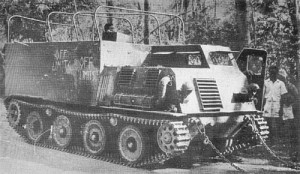
The Japanese produced a limited number of the innovative Type 1 Ho-Ki, fully-tracked armored personnel carriers. The Ho-Ki APC was developed in 1941, but full-scale production did not start until 1944. A limited number of Ho-Ki were deployed with Japanese reinforcements to the Philippines in 1944, and several Ho-Ki were captured by the U.S. on Leyte and Luzon.
From Enemy on Luzon: An Intelligence Summary:
Although not encountered before our return to the Philippines, several of these vehicles were captured there by U.S. forces. One was recovered on Leyte, and at least four were found on Luzon.
 Full Track Personnel Carrier
The vehicle was full tracked, armored, and powered by a six cylinder air-cooled Diesel engine. The bogie wheels and suspension were similar to those of the Type 95 Light Tank, but the track was both longer and wider than that of the tank. This carrier, 15 feet 9 inches long overall and 6 feet 8 inches wide, was protected with ¼-inch armor on all sides and rear, but was open at the top except for the driver’s compartment. There were doors at the rear and one on each side to permit personnel to leave the carrier rapidly. The driver’s compartment was on the left front of the body and was equipped with metal vision slits for driving under fire. The vehicle had four speeds forward in addition to high and low range transfer case and was equipped with a spring-mounted towing pintle.
Being much lighter than the Type 95 Light Tank, employing an engine of similar power, and having roughly the same track contact, the vehicle gave excellent cross-country performance. The addition of the transfer case increased the range and power as compared with a light tank. U.S. combat troops found these vehicles to be highly satisfactory artillery prime movers.
Continue reading Japanese Type 1 Ho-Ki Armored Personnel Carrier
|
|
Recent Comments