
Tips from bomber gunners to prevent guns and gunners from freezing during missions from a special edition of Army Talks, “Stars over the Reich,” published for the officers and men of the Eighth Air Force.
WORDS FROM THE WING WISE
These tips on preventing frozen guns and gunners come from gunners who were on operations last winter.
How to Keep Your Guns from Freezing
Thorough cleaning before and after every mission is point number one. Remove all moisture and powder deposits, especially from the bolt recesses. Firing pin port and receiver (especially extractor switch recess and front barrel bearing) should be thoroughly cleaned, dried and then properly oiled with AXS 777 (new specification number—2-120). Leave only a light film of oil. And keep oil cans tightly closed to keep out dust and foreign matter.
A canvas bag will keep recoiling parts dry while they’re being carried to the plane.
Charge your gun just before or just after take-off (whichever is your Group’s policy). If your gun freezes when unloaded you’re stuck. If it’s loaded the recoil will loosen any frozen parts.
Test-fire at bombing altitude. If you can charge the gun but it won’t fire, hold the trigger back while the parts slam forward into battery—this sometimes loosens frosted parts. Only charge the gun when you have to; it lets cold moist air in to the recoiling parts. If the extractor switch is frozen, charging may result in an out-of-battery stoppage.
How to Keep Yourself from Freezing
Use the correct equipment and wear clothing as it says on the posters. Clothing should fit loosely, as air insulates, and your blood circulates better.
Keep dry. If your feet get wet, change your socks before take-off. Don’t Work around the plane in too heavy clothing before take-off, as sweat increases the danger of frostbite.
Pre-flight your heated suit. The connection in the plane may be out of order. Only turn your heated-suit rheostat up far enough so you are just warm enough to keep you from being miserable. Be sure to have fleece-lined clothing in case the suit goes permanently out of order. If it does, keep moving the parts of your body that don’t have heat, flexing the muscles, wiggling your fingers and toes. And it’s a good idea to have extra heated gloves and cords.
Wear mufflers or bath towels around your knees, neck and anywhere else that gets cold. Goggles and canvas or wool hoods are available, and they sure are handy if the plexiglass is broken near you.
If you have to take off your heated glove at altitude don’t remove the glove liner. Don’t leave any part of your body exposed for more than a few seconds. Remember, at 40 below zero you may freeze a hand badly enough to lose a finger before you feel any pain or realize anything’s wrong.
Color photograph of the B-17 Flying Fortress “Idiots’ Delight” of Eighth Air Force in England. The original caption states the M/Sgt is Penrose A. Bingham of Reading, Pennsylvania. The B-17 “Idiots’ Delight” served with the 332nd Bomb Squadron, 94th Bomb Group and later with the 710th Bomb Squadron, 447th Bomb Group. (U.S. Air Force Photograph.)
B-17 Flying Fortress "Idiots' Delight" (U.S. Air Force Photo.)
Summary of Tail Warning Radar AN/APS-13 from Radar Observers’ Bombardment Information File, July 1945.
Tail Warning Radar AN/APS-13
Radio Set AN/APS-13 is a lightweight radar set which gives an airplane pilot, or any other aircrew member who can see or hear it, a visible and audible warning that a hostile airplane is behind or approaching from the rear.
The usable range of this set is from 200 to 800 yards, and within an area extending up to 30° on both sides of the airplane and from 45° above it to 45° below it. The set doesn’t work above 50,000 feet or below 3100 feet. Ground reflections determine the lower limit.
The main units include the antenna, transmitter-receiver, indicator light with brilliance control; warning bell, ON-OFF switch, and test switch. The set operates on 27.5 volts, which is the primary aircraft power supply.
Operation
1. Turn the power switch ON.
2. Wait at least three minutes for the tubes to warm up, then hold the test switch up. If the indicator lights and the warning bell rings, the equipment is operating properly. You can adjust the intensity of the indicator light with the rheostat.
3. You must set the GAIN CONTROL correctly. Adjust the screwdriver control on the front panel of the transmitter-receiver so that the receiver sensitivity is well below the level at which the tube noise can trigger the relay and give a false warning. If you reduce the sensitivity too far, however, it won’t detect aircraft within the required range. Have a competent radio technician check this before you start out on a combat mission.
Caution: The warning bell must be where the pilot can hear it clearly but where crew members cannot hear it; they might mistake it for the bailout signal.
Another entry from the Bombardiers’ Information File, War Department, March 1945:
B-29 REMOTE CONTROL TURRET SYSTEM
The 4 turrets and tail mount of the B-29 all operate by remote control. The gunners sit at sighting stations inside the fuselage and manipulate their gunsights. Computers, connected to the sights, automatically figure deflections for any fighter within range.
A system of control transfer enables gunners to take over control of more than one turret for a single gunsight. For every turret there is a gunner who has first call. The nose gunner is given first call on the upper and lower forward turrets. This affords him the greatest possible fire power with which to meet a frontal attack.
If he doesn’t need the lower turret, he can let one of the side gunners take it over. For instance, he might be using the upper turret to shoot at an enemy coming in high, while at the same time another hostile plane may be coming in low. In such a case, he would give one of the side gunners control of the lower forward turret. Similarly, he can release control of the upper forward turret to the top gunner.
In the nose sighting station there are 3 units of gunnery equipment that are of concern to you, the bombardier:
1. Control box with the necessary switches for operating the turrets and gunsight.
2. Gunsight and controlling equipment.
3. Transfer switches.
An auxiliary switch on the control box starts the compressor motors that operate the gun chargers. A computer standby switch turned to the IN position cuts the computing mechanism into the forward turret circuits.
To operate both forward turrets, turn both transfer switches to IN and press down on the action switch. The guns in both turrets then follow your gunsight and fire when you press the trigger.
To give up control of one turret, use the transfer switches. When the upper forward turret switch is OUT, the top gunner has control of the upper turret. When the lower forward turret switch is OUT, one of the side gunners takes over the lower turret.
If you take your hand off the action switch, control of both turrets passes automatically to top and side gunners regardless of transfer switch settings.
Warning — Always sound a warning over the interphone before you give up control of either or both turrets. If you don’t, the gunner who takes over may have his finger on the trigger and the guns will spray bullets into your own formation as they swing into line with his sight.
It is your duty to stow the lower forward turret when it is not in use. Run the turret around so that the guns point aft; then turn off the designated switches. The guns will automatically stow at the correct elevation.
A friction adjustment gives the gun sight just the right touch. You will find there is only one right setting for you. Set the sight so that you can track smoothly. Once you have started tracking, don’t change your grip on the hand wheels. Don’t jerk your point of aim. Move it smoothly and don’t fire until you’re on the target.
Cool the guns at every opportunity. If you fire as much as 50 rounds within a short period, look for a chance to move the guns into the slipstream of the airplane—and hold them there.
From Bombardiers’ Information File, War Department, March 1945:
The bombardier is concerned primarily with those gun turrets he is most likely to operate. He is almost always responsible for control of the nose turrets in heavy and very heavy aircraft.
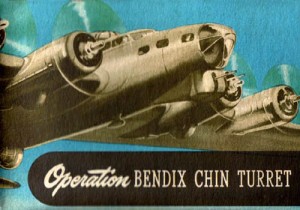
BENDIX CHIN TURRET (B-17)
The chin turret of the B-17 operates electrically by remote control from the bombardier’s seat directly above it. It moves 86° to either side in azimuth, 26° above and 46° below horizontal in elevation. It uses the N-8 or N-6A optical gunsight. The bombardier’s seat remains stationary; as he turns the gunsight, the guns swing around beneath. The bombardier’s control unit, housing the gunsight, pivots out from its stowed position on his right and locks in place in front of him.
EMERSON NOSE TURRET (B-24)
The nose turret of the B-24 is an all-electric turret which uses the N-8 or N-6A optical gunsight. It moves in azimuth about 75° either side of the airplane’s center line, and in elevation from 50° below horizontal to 60° above. It has 2 speeds, normal tracking and high. It contains armor plate, and bulletproof glass plate which moves with the guns.
From the Pilot’s Manual for Boeing B-17 Flying Fortress:
ABANDONING AIRPLANE IN FLIGHT.
a. ESCAPE DOORS AND HATCHES. – All doors and hatches are quickly releasable. The side gunner’s windows slide forward to open. Bomb doors may be opened by either of two emergency release handles, one at the left of the pilot and the other at the forward end of the catwalk in the bomb bay.
b. SIGNAL.
(1) Stand by to abandon: one long ring (approximately 6 seconds).
(2) Abandon airplane: three short rings (approximately 2 seconds each).
c. SWITCHES. – The situation will determine whether fuel and electrical systems should be turned off prior to abandoning the airplane. Under normal conditions outside of combat zones, the master ignition switch battery switches and fuel shut-off valve switches should be turned off.
Emergency procedures for a forced landing at sea from the Pilot’s Manual for Boeing B-17 Flying Fortress:
FORCED DESCENT AT SEA
1. As complete evacuation of the airplane should not take over 30 seconds, preflight practice drills should be participated in by all crews who are to make a flight over water, or whose operations are generally over water.
2. A complete and careful inspection of emergency equipment should be made before each long over water flight. Check life rafts, emergency kit bags (provisions), and emergency radio equipment. The kit bags and radio are stored aft of the radio compartment.
3. When it becomes evident that the airplane is to be forced down at sea due to lack of fuel, or that an altitude of at least 1,000 feet cannot be maintained, the pilot gives warning over the interphone. WARNING! This command must, if possible, be given while the fuel supply is still sufficient for 15 minutes of flight. The chances for a successful landing are much greater, if power is used.
4. Each crew member will acknowledge the command over the interphone.
5. The bombardier after acknowledging the command, will jettison bombs, or bomb bay tanks if more than half full, and close the bomb bay doors. If there is not sufficient time to release the bombs and close the bomb bay doors, ascertain that the bombs are “SAFE” and leave the doors closed.
6. The navigator will determine the position and inform both the pilot and the radio operator. He will take with him the instruments necessary to make simple computation while on life rafts.
7. The radio operator will jettison the hatch cover. Then, when directed by the pilot, he will send an appropriate distress signal and position. After completing this duty, he will bring the emergency radio set into the radio compartment.
8. The side gunners will jettison the side guns as they make very dangerous battering rams. If there are no side gunners, this duty should be given to other crew members before flight.
9. A crew member appointed before flight will take the emergency kit bags to the radio compartment.
10. After completing his individual duties, each member goes to the radio compartment which is the crash station for all but the pilot and copilot.
11. The pilot will direct the copilot to cut the two inboard engines, if the two outboard engines are functioning satisfactorily, and to feather their propellers.
12. Both the pilot and the copilot will strap themselves in their seats. If the side windows are to be used as exits, slide windows open, then close, insuring freedom of operation. Leave them closed until after the impact. CAUTION! Place axe handy in event of jamming.
13. Be sure all emergency equipment is in the radio compartment. Throw overboard any equipment that might come loose.
14. Remove cushions from seats for head protection and take crash positions. Do not take a position in the center of the compartment as ball turret upper structure makes this unsafe. Brace head against solid structure, if possible. Do not leave these positions until plane has come to rest as there will probably be more than one shock.
15. All members should have life vests on, parachutes removed, and should have on all extra clothing to be worn on rafts. At night, turn off all bright internal lights and use only the amber lamps.
16. The pilot should attempt to set the airplane down in a trough, which is usually cross wind. The two outboard engines are used for control and to flatten the approach. The landing gear should be up, the flaps lowered medium, and the ignition switches cut a foot or so above the water.
17. The water should be touched at about 90 mph. Come in as level as possible.
18. As soon as the airplane has come to rest the predesignated member will pull the life raft handles.
Don’t roll or loop your B-17 bomber. Important pilot restrictions for the B-17 Flying Fortress from the Pilot’s Manual for Boeing B-17 Flying Fortress:
DON’T lower flaps at speeds in excess of 147 mph!
DON’T dive in excess of 270 mph (with modified elevators).
WARNING: Some airplanes are restricted to 220-mph maximum diving speed, pending modification of the elevators. See warning placard in airplane.
DON’T exceed 46 inches Hg manifold pressure!
DON’T exceed 30 inches Hg below 2100 rpm!
DON’T stall the airplane! (except for training purposes.)
DON’T spin!
DON’T roll!
DON’T loop!
DON’T attempt inverted flight!
DON’T fly the airplane at maximum gross weight (64,500 pounds) UNLESS auxiliary wing tanks are full!
CAUTION: All power settings given in this section are for use with 100 octane fuel only. See appendix III for restrictions to be observed when using 91 octane fuel.
Pilot and crew in front of the B-24 Liberator “Sherazade” of the 425th Bomb Squadron, 308th Bomb Group, Fourteenth Air Force in China in WWII. The bomber markings list ten missions with three Japanese fighters shot down and one boat sunk. (U.S. Air Force Photo)
Recent Comments