
|
|
By Lone_Sentry_Admin, on November 23rd, 2011%
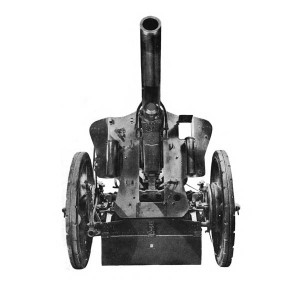
Three views of the German 105-mm howitzer (10.5 cm leFH 18, leichte FeldHaubitze) from the U.S. War Department technical manual TM E9-325A: German 105-mm Howitzer Materiel, June 1944.
 German 105-mm Howitzer and Carriage, Firing Position
Continue reading German 105-mm Howitzer
By Lone_Sentry_Admin, on May 7th, 2011%
A photograph of a destroyed German self-propelled 37-mm antiaircraft gun mounted on a halftrack, along with a late-model RSO towing an antitank gun. Source: Light, Intense, and Accurate, Headquarters, 65th Fighter Wing, August 1945.

By Lone_Sentry_Admin, on January 29th, 2011%
The following report on the German Mauser C96 “Broomhandle” automatic pistol was published in Foreign Military Weapons and Equipment, Vol. III, Infantry Weapons, Pamphlet No. 30-7-4, Department of the Army, 1954.
7.63-mm Mauser Pistol M1932 (7.63-mm MAUSER SCHNELLFEUER PISTOLE MODEL 1932)

This Mauser pistol was first manufactured in 1896. An intermediate between a pistol and a machine carbine, it was the first successful military automatic pistol developed and, except for minor modifications in 1912 and 1932, has retained its original features.
Originally designed and produced for police use, it was widely used as an unofficial substitute arm by the German military forces during World War I. After World War I, it was largely replaced by the Luger M’08 and the later Walther designs. It was widely used in Russia during the 1917 Revolution and is still found in substantial numbers throughout the Orient and Central Europe. The weapon has been manufactured by Spain, China, and Switzerland. It is unique in design in that: (1) All parts are fitted together or dovetailed and only one screw (in the pistol grip) is used; (2) it has a slotted attachment on the pistol grip, which can be used to attach a wooden stock; (3) it has a folding-leaf rear sight graduated from 100 to 1,000 meters. The magazine is solidly attached to the receiver, and the weapon is loaded from the top by means of metal clips in the same manner as a bolt-action rifle.
RECOGNITION FEATURES

Continue reading 7.63-mm Mauser Pistol M1932
By Lone_Sentry_Admin, on January 22nd, 2011%
From Japanese Electronics, OPNAV-16-VP101, Photographic Intelligence Report 1, Air Intelligence Group, Division of Naval Intelligence, Office of the Chief of Naval Operations, Navy Department, January 1945:
German Radar Summary
Examples of German Radar are included here to cover the possibility that the Japanese may have access to German equipment and technicians.
The Germans employ several types of land based installations covering the functions of Air Search, Fire Control, and Coast Watching.
These types are quite well standardized and are much more efficient than those the Japanese are known to have.
There is now some photographic evidence of German Radar equipment in use by the Japanese. Also, it is knowrn that many other types of German electronics equipment are being used.
The following table represents the latest list of German Radar types with salient information concerning each.
GERMAN LAND BASED RADAR| Name | Size of Screen* | Top of Screen Above Ground | Frequency | Range in Nautical Miles | Use | | LIMBER FREYA | 20′x 16′ IFF – 16¼ x 3½’ | 26¾’ 30′ with IFF | 116-146 MCS. | 75 | A.S. | | POLE FREYA | 20′x 16′ IFF – 16¼ x 3½’ or 20′ x 8′ | 32′, 35′ or 40′ with IFF | 116-146 MCS. | 100 | A.S. | | GIRDER CHIMNEY | 19½’ x 97½ | 115′ | 120-130 MCS. | 110 | A.S. | | CYLINDRICAL CHIMNEY | 60′ x 97½ IFF .22′ High | 110½’ | 120-130 MCS. | 160 | A.S. | | GEMA COASTWATCHER | 20′ x 8′ | 25′ | 370-390 MCS. | Depends on elevation (ASL) of site | C.W. |
| LARGE COASTWATCHER | 35′ x 34′ | 40′ | 70-90 MCS. | 60-75 | C.W. | | SMALL HOARDING | 63¾’ x 44¾’ | 50′ | | | C.W. | | LARGE HOARDING | 98′ x 36½’ | 50′ | 120-130 MCS. | 100-115 | C.W. | | SMALL WURZBURG | 10′ Diameter | 12½’ in Vertical Position | 550-580 MCS. | 25 | F.C. | | GIANT WURZBURG | 24′ Diameter | 27′ in Vertical Position | 470-580 MCS. | 40 | G.C.I., A.S. & C.W. | * – Width (Horizontal Dimension) Given First A.S. – Air Search F.C. – A/A Fire Control C.W. – Coast Watching G.C.I. – Ground Control Intercept
Drawings of all of the basic German Radar types are included on this page. Best known popular names are used for the designation of each type. It will be noted that these designs are quite well standardized for each particular use, and identification is easier because of this fact.
In most cases, this German equipment is superior to that now in use by the Japanese. A constant watch for German type designs of Radar in Japanese held territory is therefore in order.

By Lone_Sentry_Admin, on January 5th, 2011%
Report on the German “Small Wurzburg” radar from U.S. Naval Intelligence report Japanese Electronics, March 1945:
The “Small Wurzburg” or “Bowlfire” was first designed in 1936, and is one of the most efficient Radars. It is primarily for A.A. fire control but has been used for A/C reporting, searchlight control, and as a standby for Ground Control of A/C. In general, it is a mobile Radar, mounted on a four-wheeled trailer with outriggers for levelling. Some sets are emplaced, however, and the wheels removed.
Search is by mechanical rotation of the apparatus for bearing and by elevation of the reflector bowl for height measurement.
The diameter of the paraboloid reflector is 10 feet, the top of which is but 12½ feet above the ground. A cupboard, housing the radar equipment, and an operators seat are attached to the rear and side of the reflector.

There are several types of Small Wurzburgs; among them Types “A”, “C”, and “D” are most used and are quite similar. Type “D” is found with limber mounting and may be without wheels or even set in concrete.
For transport, the paraboloid can be split, by hinges, and turned down in two halves.
Type F.M.G. 41-T is a modification of the Small Wurzburg which incorporates a scoop-like form for cutting out ground echoes.
The practical range of the Small Wurzburg is not more than 25 nautical miles but it has a high degree of accuracy for Fire Control purposes.
By Lone_Sentry_Admin, on December 21st, 2010%
Statistical analysis of Luftwaffe air attacks on ground targets in the Third U.S. Army from Antiaircraft Artillery: A Brief History of Operations in Europe, 1 August 1944 to 8 May, 1945, Third United States Army.
German Air Tactics Against Ground Targets in the Third U.S. Army Area
1. Prior to the allied landings of the continent, 6 June 1944, a great deal already was known of the tactics of the German Air Force in attacking ground targets. Attacks of appreciable size had occurred in Italy and Sicily and along the North African coast, and some time had been devoted to their study. Targets of opportunity in forward areas received 63% of attacks, highways and bridges received but 4% of attention, and ports and harbors, airfields and ammunition dumps received 33%, 55% of attacks were by dive-bombing, 20% level-bombing, 10% strafing, 12% unknown, and 3% reconnaissance flights. Bombers made much use of cloud cover and the blinding effect of the bright sun in making their approaches to the target areas. In brief, strong, close-in defenses of all vital objectives seemed dictated by past Luftwaffe performances, with forward zones of divisions, and roads and bridges being of prime importance. An adequate alert status and an efficient warning system were necessary to guard against surprise.
2. Experiences in Italy were, to a certain extent, repeated during the course of Third U.S. Army’s operations on the continent from 1 August 1944 to 8 May 1945. Thus, during periods of rapid and threatening advance, armored spearheads were continually attacked by large numbers of low-flying aircraft which attempted to blunt their thrusts. As rivers were reached, emphasis turned to attacks upon the bridges and crowded bridge areas. It the air effort was particularly large, much of it spilled over into troop and artillery areas of infantry divisions following the armor. Little if any air activity was encountered behind corps rear boundaries during such times. Sole large-scale exception to this was during the initial break-through drive of Third U.S. Army’s VIII Corps down the Cotentin Peninsula. During that period, from 1 August to 12 August 1944, the GAF made a frenzied effort that struck night and day not only at the spearheading armor and motorized infantry, but at bridges, road defiles, dams and antiaircraft behind them up and down the historic Avranches supply route Thus, targets were chosen because of their vital importance, and merely vulnerable targets, such as supply dumps, airfields, and the like were left almost untouched.
3. During periods of comparatively little forward movement, such as occurred along the Moselle River in France, there were few attacks made but, weather permitting, reconnaissance was flown almost daily over division and corps zones while some nuisance strafing and bombing of artillery positions occurred.
Continue reading German Air Tactics Against Ground Targets
By Lone_Sentry_Admin, on December 18th, 2010%
New 1/35th scale resin figure announcements from Mantis Miniatures. All figures sculpted by L. Borget and box art painted by A. Miniszewski.
Continue reading New Mantis Miniatures Figures
By Lone_Sentry_Admin, on November 26th, 2010%
A warning about the dangers of the WWII German “Butterfly Bomb” (Sprengbombe Dickwandig 2 kg or SD2) from Booby Traps, Bureau of Naval Personnel, Navy Department, Washington D.C., 1944.
German “Butterfly Bomb”
The “butterfly bomb” is the German’s favorite bomb against personnel on beaches, in camps, and against airfields. It is small and light, and can be dropped in great numbers from airplanes. One plane can carry several hundred of these deadly little devices with no trouble at all. As each bomb descends, the fist-sized iron ball full of explosives swings free at the bottom of a rod about the size of a lead pencil. The unfolded fins on the top of the pencil-rod are whirling in the air and turning the rod, thus arming the bomb.
Some “butterfly bombs” explode in the air just above ground, some on hitting the ground, and some incorporate delayed action (about 8 to 30 minutes) which makes everything just dandy for the persons who have to come out after the raid to fight fires. See figs. 8 and 9. That should be enough, but the end is not yet. Part of the crop of “butterflies” will not go off at all until someone disturbs them—picks them up, treads on the wings, or the like. Often the bodies of the bombs will have buried themselves in the soft earth. The only part visible will be the brightly colored (green and red, or green and yellow) upturned wings, like the lovely discarded shells of some crabs or lobsters. What a memento for the office desk back home—but pick it up and you won’t get back home!
As an example of how the “butterfly” can let you down: One night last spring in North Africa the Germans raided a forward area of ours where there happened to be a P.O.W. (prisoner of war) cage full of Germans we had captured that day. Jerry dropped hundreds of “butterfly bombs” and one of them drifted into the P.O.W., settling to earth without going off. Naturally the German prisoners were greatly relieved and shied clear of their own infernal machine. But next morning was a different story. Three of our allied soldiers guarding the P.O.W. came across the little yellow wings, and the pencil rod, and the iron ball.
 Figure 8. Danger lurks for the inquisitive in the form of the German anti-personnel bomb known as the "butterfly." Here is one of these bombs, lying as you might find it in the field.
“A-ha!” said one of the guards to his pals. “Something new has been added.”
And while the other two held onto the little iron ball, he tried to unscrew the yellow wings, and up went all three—the German prisoners, watching from a distance, were delighted.
 Figure 9. "Butterfly" in tree. Stay away from this kind of a situation. The bomb may explode through a time device or as a result of any disturbing pressure.
By Lone_Sentry_Admin, on November 18th, 2010%
Two photographs of German transport on the Russian Front during Operation Barbarossa from the website’s photo collection.
Cars lead a column of supply trucks past a destroyed bridge:
 © LoneSentry.com Collection
Wehrmacht staff cars behind a truck of the 3rd Waffen SS Division Totenkopf:
 © LoneSentry.com Collection
Source: LoneSentry.com Collection.
By Lone_Sentry_Admin, on November 17th, 2010%
|
|
Recent Comments