
Erco Ball Turret

Illustrations and performance details of the Erco 250SH Ball Turret mounted in the PB4Y Privateer from Aircrewman’s Gunnery Manual, Aviation Training Division, Office of the Chief of Naval Operations, U.S. Navy, 1944.

Erco Ball Turret

Erco Ball Turret
ERCO 250SH-2, 2A or 3

The Erco Ball Turret is the bow installation in the Navy PB4Y-1 and PB4Y-2 airplanes. It serves a double purpose in taking care of any bow attacks on the Liberator besides being used for strafing, in anti-submarine warfare. Inasmuch as this turret is of the ball type, the gunner moves with his guns and sight in elevation and azimuth as he moves his control handles. It is a relative of the Martin 250SH Bow Turret of the PBM-3 airplanes and has many points of similarity in design and action.

There are several models which for the most part are the same—the Erco 250SH-2 or 2A used in the bow position of the PB4Y-1 airplane and the Erco 250SH-3 used in PB4Y-2 airplane.

Erco Ball Turret -- PB4Y Privateer Nose Turret
Facts and Figures

POWER: The Erco 250SH operates hydraulically on pressure built up by a hydraulic pump driven by a constant speed electric motor.

SIGHT: Its sight is the standard Navy Mk 9 reflector sight, fully described in the introduction of this section.

ELEVATION: From the horizontal position the turret ball, and consequently the guns, may be depressed a maximum of 70° and elevated a maximum of 85°.

AZIMUTH: This type of turret is capable of revolving 360° in azimuth, but for the installation in the bow of the PB4Y-1 or PB4Y-2 airplanes, its motion is restricted to 80° either side of the center line of the plane.

ARMOR: The armor plate of the turret consists of three parts to protect the gunner from enemy fire and flak: (1) 1½” laminated bullet proof glass to protect his face. (2) ½” armor plate in front to protect the gunner’s body, no matter where his guns are pointed. (3) ¼” armor plate bolted to the floor to protect his feet.

STOWING: The stowing position is 0° azimuth and 0° elevation, guns pointing straight forward.


Bendix Chin Turret

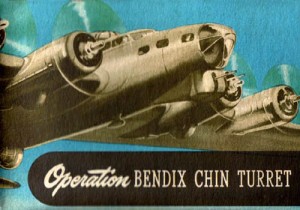
Bendix manual on the Operation and Maintenance of the Bendix Chin Turret for the B-17 Flying Fortress:


Operation of the Bendix Chin Turret

GENERAL SPECIFICATIONS

Armament
Two Caliber .50 M-2 machine guns.
Ammunition Capacity 450 rounds per gun.

Speed of Turret
Slow speed (tracking) ¼° per second to 12° per second.
High speed (slewing, with high speed button depressed) ¼° per second to 33° per second.

Weights
Turret Complete (no guns or ammunition) 438 lbs.
Ammunition 33 lbs. per 100 rounds.
Guns 65 lbs. each.

Gear Drive
Speed Reducer ratio 25-1.
Azimuth gear ratio 50-1.
Elevation gear ratio 42-1.
Azimuth gear train reduction 1250-1.
Elevation gear train reduction 1050-1.

Electrical Requirements
24 Volt D.C.
Peak starting current motor amplidynes 1280 amps.
Maximum current draw running full load 92 amps.
Maximum current draw running no load 40 amps.

Drawing of B-17 Flying Fortress

GENERAL DESCRIPTION
BENDIX CHIN TURRET

The Bendix Chin Turret Model “D” is an electrically driven power turret, mounting two caliber, .50 M-2 Machine Guns, equipped with recoil absorbing mechanism, firing solenoids, and manual gun chargers.

The turret is designed to be mounted in the Bombardier’s Compartment and to be operated by the Bombardier to protect the forward approaches to the ship. The guns rotate 172° in azimuth (86° to the left and to the right of forward) and swing from 26° above horizontal to 46° below horizontal. Switch limits are adjustable. The turret is mounted at floor level in the Bombardier’s Compartment. The guns extend below the fuselage at the nose of the ship. The lower assembly, with the exception of the gun barrels which protrude through covered slots, is enclosed in an aluminum, movable housing to minimize wind resistance. Plexiglass windshields seal the space at the floor of the ship around the turret.

B-17 Bomber Chin Turret

Continue reading Bendix Chin Turret

Erco Tear Drop Turret

Illustrations and performance details of the Erco 250TH Tear Drop Turrets mounted in the PB4Y-2 Privateer from Aircrewman’s Gunnery Manual, Aviation Training Division, Office of the Chief of Naval Operations, U.S. Navy, 1944.

Erco Tear Drop Gun Turret - Erco 250th - U.S. Navy Consolidated PB4Y-2 Privateer

ERCO TEAR DROP TURRET
ERCO 250TH-1 AND 2

The Erco 250TH Turrets have the approximate shape of a tear drop. They are installed in the waist positions on either side of the PB4Y-2 airplane—the Erco 250TH-1 on the starboard side and the Erco 250TH-2 on the port side. With their wide cone of fire they protect the plane from beam or belly attacks, besides offering a considerable area of protection from above. In operation they are somewhat similar to a ball type turret inasmuch as the gunner moves with his guns and sight in the direction he moves his control handles.

Erco Teardrop Gun Turrets Navy Consolidated PB4Y-2 Privateer

Facts and Figures

POWER: The Erco Tear Drop operates hydraulically on pressure built up by a hydraulic pump driven by a constant speed electric motor.

SIGHT: Its sight is a standard Navy Mk 9 reflector sight fully described in the introduction to this section.

ELEVATION: Both turrets can raise their guns 55° above horizontal in elevation and depress them 95° below horizontal.

AZIMUTH: In azimuth, the Erco Tear Drop turret allows the guns a movement of 135°, 55° towards the bow from the beam and 80° towards the tail of the airplane from the beam.

ARMOR: The armor plate in the turret protects the gunner from fire in any direction he turns his guns. It consists of three groups: (1) 1 1/2″ thick bullet-proof glass in front of his face, (2) 5/16″ armor plate in front of his body, and (3) 5/16″ armor plate under his feet.

STOWING: The stowing position is 0° elevation with guns pointed in the extreme aft position in azimuth (80° aft of the beam).


B-29 Remote Control Turret System

Another entry from the Bombardiers’ Information File, War Department, March 1945:

B-29 REMOTE CONTROL TURRET SYSTEM

The 4 turrets and tail mount of the B-29 all operate by remote control. The gunners sit at sighting stations inside the fuselage and manipulate their gunsights. Computers, connected to the sights, automatically figure deflections for any fighter within range.

B-29 Superfortress Remote Gun Turrets

A system of control transfer enables gunners to take over control of more than one turret for a single gunsight. For every turret there is a gunner who has first call. The nose gunner is given first call on the upper and lower forward turrets. This affords him the greatest possible fire power with which to meet a frontal attack.

If he doesn’t need the lower turret, he can let one of the side gunners take it over. For instance, he might be using the upper turret to shoot at an enemy coming in high, while at the same time another hostile plane may be coming in low. In such a case, he would give one of the side gunners control of the lower forward turret. Similarly, he can release control of the upper forward turret to the top gunner.

In the nose sighting station there are 3 units of gunnery equipment that are of concern to you, the bombardier:

1. Control box with the necessary switches for operating the turrets and gunsight.

2. Gunsight and controlling equipment.

3. Transfer switches.

An auxiliary switch on the control box starts the compressor motors that operate the gun chargers. A computer standby switch turned to the IN position cuts the computing mechanism into the forward turret circuits.

B-29 Superfortress Bombardier Gunsight for Remote-Control Turrets

To operate both forward turrets, turn both transfer switches to IN and press down on the action switch. The guns in both turrets then follow your gunsight and fire when you press the trigger.

To give up control of one turret, use the transfer switches. When the upper forward turret switch is OUT, the top gunner has control of the upper turret. When the lower forward turret switch is OUT, one of the side gunners takes over the lower turret.

If you take your hand off the action switch, control of both turrets passes automatically to top and side gunners regardless of transfer switch settings.

Warning — Always sound a warning over the interphone before you give up control of either or both turrets. If you don’t, the gunner who takes over may have his finger on the trigger and the guns will spray bullets into your own formation as they swing into line with his sight.

It is your duty to stow the lower forward turret when it is not in use. Run the turret around so that the guns point aft; then turn off the designated switches. The guns will automatically stow at the correct elevation.

A friction adjustment gives the gun sight just the right touch. You will find there is only one right setting for you. Set the sight so that you can track smoothly. Once you have started tracking, don’t change your grip on the hand wheels. Don’t jerk your point of aim. Move it smoothly and don’t fire until you’re on the target.

Cool the guns at every opportunity. If you fire as much as 50 rounds within a short period, look for a chance to move the guns into the slipstream of the airplane—and hold them there.


Bombardier Chin and Nose Turrets

From Bombardiers’ Information File, War Department, March 1945:

B-17 Chin Turret and B-24 Nose Turret - Bombardier Turrets

The bombardier is concerned primarily with those gun turrets he is most likely to operate. He is almost always responsible for control of the nose turrets in heavy and very heavy aircraft.

BENDIX CHIN TURRET (B-17)

The chin turret of the B-17 operates electrically by remote control from the bombardier’s seat directly above it. It moves 86° to either side in azimuth, 26° above and 46° below horizontal in elevation. It uses the N-8 or N-6A optical gunsight. The bombardier’s seat remains stationary; as he turns the gunsight, the guns swing around beneath. The bombardier’s control unit, housing the gunsight, pivots out from its stowed position on his right and locks in place in front of him.

EMERSON NOSE TURRET (B-24)

The nose turret of the B-24 is an all-electric turret which uses the N-8 or N-6A optical gunsight. It moves in azimuth about 75° either side of the airplane’s center line, and in elevation from 50° below horizontal to 60° above. It has 2 speeds, normal tracking and high. It contains armor plate, and bulletproof glass plate which moves with the guns.


Grumman Ball Turret

Illustrations of the Grumman Ball Turret 150SE-1 and 150SE-2 mounted in the TBF Avenger from Aircrewman’s Gunnery Manual, Aviation Training Division, Office of the Chief of Naval Operations, U.S. Navy, 1944.

Grumman Ball Turret - TBF Avenger

Grumman .50 Caliber Ball Turret from TBF Avenger
 

Beja Tiger Turret

Photo P30 (see “Tiger Grave at Beja” and “Video of sPzAbt. 501 Tigers in Tunisia“) shows a slightly better view of the detached Tiger turret in the ditch at the front of the column.