
Bazooka Operation in Hot & Cold Climates

Operating instructions for the Bazooka in tropical and arctic climates from TM 9-294: 2.36-inch A.T. Rocket Launcher M1A1, War Department Technical Manual, Sept. 27, 1943.

Section X: OPERATION UNDER UNUSUAL CONDITIONS

32. GENERAL.

a. When operating under unusual conditions such as tropical or arctic climates, severe dust or sand conditions, and near salt water, it is essential that all the precautions listed below should be observed.

33. ARCTIC CLIMATES.

a. In temperatures below freezing, and particularly in arctic climates, all operating parts should he kept absolutely free of moisture. The bore of the launcher should be cleaned daily and oiled as described in paragraph 16. The batteries should be removed from the launcher and kept warm until just before firing. Carrying the batteries in inner pockets will keep them sufficiently warm. Immediately upon bringing indoors, the launcher should be cleaned on the outside and inside with a dry clean cloth. Remove the grips and clean and dry the contacts. After it has reached room temperature, clean and dry the launcher again, and oil the bore. Rockets should not be fired at temperatures below zero F.

34. TROPICAL CLIMATES.

a. Tropical Climates. In tropical climates where temperature and humidity are high, or where salt air is present, and during rainy seasons, the launcher should be thoroughly inspected and cleaned daily. The bore should be oiled a little more liberally than prescribed in paragraph 16. Wood parts should be inspected to see that swelling due to moisture does not bind working parts. If this does occur, shave off only enough wood to relieve binding. A light coat of OIL, linseed, raw, type A applied at least every month and well rubbed in with the heel of the hand, will help to keep moisture out. Allow oil to soak in for a few hours and then, wipe and polish the wood with a dry clean wiping cloth. Do not fire rockets at temperatures above 120 F.

NOTE: Care should be taken to see that linseed oil does not get onto electric contacts as it will gum when dry.

b. Hot Dry Climates. In hot dry climates, where sand and dust are apt to get into the bore, the launcher including the bore should be wiped clean daily or more often if necessary. Oiling of the bore should be done very sparingly and only in the event that atmospheric conditions cause rusting of the bore surface. In such climates, wood parts are apt to dry out and shrink, and a more frequent application of OIL, linseed, raw, type A, will help keep wood in condition. During sand or dust storms the breech and muzzle should be kept covered. Do not fire rockets at temperatures above 120 F.


Jeep Trailer

Two detail views of the WWII jeep cargo trailer from ORD 8 SNL G-529: Spare Parts and Equipment for Trailer, ¼-Ton Payload, 2-Wheel, Cargo, 1942-42 (American Bantam T-3 and Willys MBT), Headquarters, Army Service Forces, July 1945.

Jeep Cargo Trailer

FIGURE A—TRAILER, 1/4-TON PAYLOAD, 2-WHEEL, CARGO, 1942-43, AMERICAN BANTAM T-3 AND WILLYS MBT THREE QUARTER RIGHT REAR VIEW

Jeep Trailer Bantam Willys

FIGURE B—TRAILER, 1/4-TON PAYLOAD, 2-WHEEL, CARGO, 1942-43, AMERICAN BANTAM T-3 AND WILLYS MBT THREE QUARTER RIGHT FRONT VIEW


Sure, You Can See the Skipper

Sure, You Can See the Skipper
Source: U.S. Navy, Bureau of Naval Personnel Information Bulletin, (“All Hands Magazine”), October 1944.
 

A-26 Crash Landing Procedure

Instructions for crash landing procedures for the Douglas A-26 Invader from the Pilot Training Manual for the A-26 Invader, Headquarters, AAF, Office of Flying Safety.

CRASH LANDING

Douglas A-26 Invader Crash Landing Procedure

Pilot

1. Call crew. “Prepare for crash landing.” (Have crew acknowledge.)

2. Switch on emergency IFF radio transmitter.

3. Release parachute by unbuckling.

4. Tighten safety belt and lock shoulder harness.

5. Salvo bombs. Close bomb bay doors.

6. Make a normal approach. Use up to 3/4 flaps. Always make a wheels-up landing.

7. Slide seat back but still keep rudder control. (Place cushion between chest and control column.)

8. Call rear gunner and warn of “final impact.”

9. Have bombardier pull emergency lever to release cockpit hatch when airplane is just off the ground.

10. Mixture controls to IDLE CUT-OFF.

11. Turn battery and master ignition switches to OFF.

12. Tank selector valves to OFF.

13. Exit through upper hatch opening.

Continue reading A-26 Crash Landing Procedure

Air Ground Liaison Panel Codes

A diagram showing some typical layouts of ground-to-air signal panels from the U.S. War Department’s Handbook for Combat Air Intelligence Officers, Army Air Forces Air Intelligence School, Harrisburg, Pennsylvania, March 1944.

Air Ground Liaison Panel Code
 

German 105-mm Howitzer

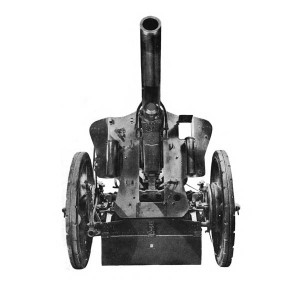
Three views of the German 105-mm howitzer (10.5 cm leFH 18, leichte FeldHaubitze) from the U.S. War Department technical manual TM E9-325A: German 105-mm Howitzer Materiel, June 1944.

German 105-mm Howitzer and Carriage, Firing Position

German 105-mm Howitzer and Carriage, Firing Position

Continue reading German 105-mm Howitzer

II Corps Lessons Learned

The commander of II Corps published the following comments concerning the combat lessons learned during the advance from the Garigliano River to Rome in Italy in 1943-1944:

HEADQUARTERS II CORPS

In the Field
16 June 1944

Subject: Lessons Learned.
To: Divisions and Separate Unit Commanders, II Corps.

1. A detailed analysis of lessons learned during the II Corps advance from the GARIGLIANO to ROME is being made. This study will be published at an early date. Rather than wait for the publication of the detailed compilation, I wish to give you my comments now so they can be acted upon during the present training period.

a. Towns must be taken from deep flank and rear.

b. The usual practice of battering towns with air and artillery serves little purpose and is extremely wasteful of ammunition and time.

c. The delay caused as by small enemy detachments is out of all proportion to the numbers and means at our disposal. Among other errors committed is our failure to leave roads soon enough and to make a wide enough envelopment or by-pass.

d. The combined use of armored and infantry units has been too cautious. The over-emphasis placed on fire power of tanks during the period when weather and terrain conditions prevented full use of armor has not been overcome and mobility has not been restored to its proper importance in the employment of tanks. Too often a column of tanks has remained inactive on a road, held up by a single SP or AT gun. The time lost waiting for infantry to arrive, deploy and attack the gun could have been reduced 50% or more by a rapid deployment and movement of the tanks or by a wide envelopment which would in most cases have resulted in the capture or destruction of the gun. Likewise, relatively large groups of infantry have been long delayed by a small enemy group with a machine gun or two astride a rod. Again, the time wasted waiting for the arrival and action of tanks could have been materially reduced by early and wide deployment.

e. Not enough use has been made of Air OP’s for reconnaissance purposes. Inasmuch as artillery targets have been relatively few during this pursuit phase, there should have been constant Cub air reconnaissance available to all leading elements.

f. In the long run, speed was made over the high ground, not over the roads or flat lands.

g. Too often commanders of all echelons waited for orders. The rapid advance made the maintenance of communications difficult and resulted in instructions being issued and received based on out of date information. Under such conditions commanders must act on their own responsibility, initiative and judgment. Inactivity is inexcusable.

2. We must be prepared mentally and tactically for a change in the character of combat when we next go into the line for we may encounter strong and bitter resistance. At some date or place the German may seek to make a stand but our constant pressure should greatly hamper him from getting set. The main bodies following our mobile advance detachments must be kept so in hand that they can be employed rapidly in accordance with simple and prepared plans.

3. Speed, not haste, is still the great factor.

GEOFFREY KEYES
Major General, U.S.A., Commanding.


Signals Intelligence in Operation Torch

The following report on Allied signal intelligence during Operation Torch and the campaign in North Africa is reproduced from “Intelligence Lessons from North Africa, Operation Torch” by the Office of Assistant Chief of Staff, G-2, Allied Force Headquarters, March 1943.

C. SIGNALS INTELLIGENCE (Y).

20. Any review of the lessons learnt in this campaign in the functioning of Signals Intelligence (British: Wireless Intelligence, generally known as Y) can be divided into three parts:

a. Before landing,
b. After landing and
c. General.

It is proposed to consider the subject under these three heads.

21. Before Landing.

The outstanding lesson learnt was the need for dispatching complete units in the first follow up and not dividing them into roughly two halves between convoys 2 .and 3. This precaution had been taken to avoid the risk of the total loss of the unit, but it is now seen that by dividing the unit or units among several ships of the same convoy the same insurance against total loss is achieved. The advantages are that in the early stages of any campaign the maximum amount of Y cover is necessary as no other day to day source of intelligence exists, and also that the enemy being less security minded when his plans are interfered with, more is given away, all of which may be of exceeding value as the campaign develops. Considerable pressure would have to be exercised on the branch responsible for loading tables, but the advantages of a complete Y unit to the formation commander are such that the highest priority for its inclusion entire should be obtainable.

22. After Landing.

a. Assignment.

As 5 Corps did not land in the first follow up, the Corps Y unit (B-type Section) was attached to 78 Div H.Q. This arrangement worked extremely well, and the smallness of the Div I Staff was compensated by one of the I.O.’s of the Section estimating the value of Y intelligence in terms of I(a). Whenever the same problem arises, it is recommended that the Corps B-type Section be attached to the senior Division acting in quasi Corps role until such time as Corps H.Q. have landed. This is preferable to keeping the unit back until Corps H.Q. have landed partly for the reasons mentioned in para. 21 and partly because no Y unit can produce intelligence the moment it sets up house. This is due to the necessity for sorting the traffic heard (since all major wireless bands are full of’ traffic, much of which can be, heard even when the transmitter is many hundreds of miles away). The two mobile D/F trucks now part of every B-type Section have a considerable part to play in this preliminary sorting process.

b. B-type Section (1942).

The revised B-type Section (1942) is an undoubted improvement on the 1941 edition. This has only been partly evident so far, as the Section with 5 Corps is on the old establishment as regards personnel and transport but on the new one as regards equipment. Had the Section been completely on the new establishment it would undoubtedly have produced more; if not better, results. The strain on too few operators coping with increased sets has resulted in a certain amount of: sickness-due to overkeenness on their part.

c. Communications.

The need for adequate communications facilities between all Sections of the Y Service cannot sufficiently be stressed. Y must be provided with its own W/T communications as quite apart from the need for passing intelligence (in high grade cypher) it cannot function properly unless technical information is continually passing between all its units and I(s) at higher levels. The normal Signals channels can sometimes cope with the intelligence side, rarely with the technical information which is often required in the form of “question and answer”.

A further point is that communication should be authorized from the start with G.H.Q. of adjacent theater or theaters. Owing to special cyphers for Y intelligence issued to this H.Q. not being made available to G.H.Q. Middle East, much valuable assistance from Mideast in the early stages could not be received.

d. Siting of Units.

The siting of Y units provided many difficulties owing to the mountainous nature of the ground. Not until recently has a general move forward of higher formations taken place so that the problem has constantly been where to site units so that they fulfill their two main functions

(1) of taking the traffic required.

(2) of passing it in shortest time to the Intelligence Branch of the formation to which assigned.

The only general answer possible is that units may have to be sited near a lower formation than is customary, reporting over their own links to the higher formation to which they belong. (The alternative of a Signal Center does not work well in practice as the lines are usually overloaded no matter what priority is assigned to Y units.)

23. General.

The following points of a more general application are grouped together for convenience though not necessarily inter-related.

a. Inclusion of ‘veterans’.

An immense advantage would accrue in any future operation by the inclusion of personnel from units with battle experience on the strength of new units first coming out. Experience counts more in Y work than is generally realized. A judicious interlarding with Mideast personnel in units fresh from home would have been of great value in this operation.

b. I a Training for I.O.’s.

Y I.O.’s trained in U.K. need to be more Ia minded. A detailed Order of Battle knowledge is an invaluable asset to any I.O. and more stress on this might be laid. It is also necessary for the Y I.O. to know what is, and is not, important to Ia so that his choice of information to pass back immediately may be right. So much of the intelligence produced by Y is ‘scrappy’ (due to difficulties of reception, new or only partially broken codes and the like) that the selection of the right ‘straw’ to indicate the wind is not always apparent. It is recommended therefore: that all I.O.’s in Y should at some period — preferably after being Y trained — serve an attachment of some weeks duration at Ia of a formation, preferably Corps or Division.

c. Intelligence School.

Soon after the start of any operation such as this provision should be made at G.H.Q. for a small “Intelligence School” to read all logs from Y units in the theater, to produce wireless network diagrams from them to check callsigns serial and row changes and generally to be responsible for the longer term W/T I. Sections in the field have little opportunity for more then short term W/T I and in times of battle practically none at all. Investigation into map reference systems, code systems, and the like cannot be undertaken locally but must be done centrally. This is a very real need and should be catered for in any future operation. This party should normally arrive simultaneously with the Army A-type Section.

d. Pool of Reinforcements.

An adequate pool of reinforcements should be drawn up and included in all future operations. In this theater only two W/T I Other Ranks were provided and were absorbed soon after landing leaving no reinforcements whatsoever. On the Signals side the scale is also too low and requires reconsideration. Any loss of personnel through enemy action or sickness is immediately reflected in the operational output of the unit. The ideal solution would be the dispatch of one complete B-type Section over and above those assigned to Corps. This unit could then relieve Corps Sections in rotation either in whole or in part and provide all grades of reinforcements as required.

e. American Y Units.

All the above remarks have been confined to British units as the participation of complete American units in this theater has not yet materialized. The American Section with British W/T I personnel has acquitted itself well in spite of many handicaps due to faults inherent in the general organization of American field Y units. This subject is one however which needs to be investigated at a higher level and a joint American-British Committee might well at some later stage be charged with examining the problem in the light of British experience and American difficulties.

24. Conclusion.

In the main the plans made, the training of the units and the results achieved have been entirely satisfactory. The improvements suggested above are chiefly concerned with detail and should without undue difficulty be capable of realization.

25. I.S. Staff at Army H.Q.

It is considered that only one I(s) Staff Officer is needed at Army H.Q. until the arrival of the A-type Section.

26. Water Trailer for A-type Special Wireless Section.

A-type Special Wireless Section has a strength of 54 all ranks and only sixteen 2-gallon containers to hold drinking water. For technical reasons, the section is often sited in remote areas where the problem of obtaining drinking water is great.

It is considered that a water trailer is essential for the section.


Introduction to the Bazooka

Introduction to the “bazooka” (2.36-inch AT Rocket Launcher M1A1) from the technical manual TM 9-294: 2.36-inch A.T. Rocket Launcher M1A1, War Department Technical Manual, September, 1943.

I. INTRODUCTION

1. SCOPE.

a. This manual is published for the information and guidance of personnel charged with the operation and maintenance of the 2.36-inch AT Rocket Launcher M1A1. It contains information required by the using arms to identify, use, care, and preserve the materiel and the ammunition used therewith. In addition, it contains information required by ordnance personnel for the maintenance and repair of the materiel.

2. CHARACTERISTICS (figs. 1 and 2).

a. The 2.36-inch AT Rocket Launcher M1A1 is an electrically operated weapon of the open tube type. It is fired from the shoulder in the standing, kneeling, sitting, or prone positions. It is used to launch high-explosive rockets against tanks, armored vehicles, pill boxes, and emplacements. The rockets weigh approximately 3½ pounds and are capable of penetrating heavy armor at angles of impact up to 30 degrees. The weapon can be aimed up to distances of 300 yards. Greater ranges may be obtained by estimating the angle of elevation. The maximum range is 700 yards.

Figure 1 -- 2.36-Inch AT Rocket Launcher M1A1 -- Left Side View

Figure 1 -- 2.36-Inch AT Rocket Launcher M1A1 -- Left Side View

Figure 2 -- 2.36-Inch AT Rocket Launcher M1A1 -- Right Side View

Figure 2 -- 2.36-Inch AT Rocket Launcher M1A1 -- Right Side View

Continue reading Introduction to the Bazooka

Organization of the Japanese Air Force

Organization of the WWII Japanese Army Air Service and Naval Air Service from the U.S. War Department’s Handbook for Combat Air Intelligence Officers, Army Air Forces Air Intelligence School, Harrisburg, Pennsylvania, March 1944.

3. ORGANIZATION.

a. General.

(1) Owing to the excellence of Japanese counterintelligence during the years in which they were building their air strength, and owing to the difficulty of the Japanese language, Allied information about the organization of the Japanese Air Services is scanty and possibly inaccurate. (Charts C and D give the latest information available about the organization of both the Army and Naval Air Services.)

Japanese Army Air Service

Continue reading Organization of the Japanese Air Force