
|
|
By Lone_Sentry_Admin, on February 5th, 2012%
The following report on the German StG 44 (Sturmgewehr 44) assault rifle was published in Foreign Military Weapons and Equipment, Vol. III, Infantry Weapons, Pamphlet No. 30-7-4, Department of the Army, 1954.
7.92-mm Submachine Gun MP-44 (STURMGEWEHR M44)

The German MP44 was developed in 1942 to provide an intermediate weapon between the rifle and the submachine gun. The standard 7.92-mm rifle cartridge was shortened and bottle-necked to take a 120-grain boattail bullet. With this cartridge the weapon provided better ballistic characteristics than those available with the standard German 9-mm submachine guns. It also had provisions for full automatic fire and thus a greater firepower capability.
Ease of mass production was achieved by the extensive use of steel stampings. The receiver, frame, gas cylinder, and barrel jacket are all made from stampings. The parts of the trigger mechanism are riveted in place; therefore, the trigger assembly cannot be disassembled, although a complete trigger mechanism can be quickly inserted into the weapon.
Despite its cheap construction, it is a very serviceable weapon. The various models of this weapon, including the MP43, MP43/1, and the MP44, were all designated the STURMGEWEHR 44 in 1944. They differ only in minor detail. Ballistically, they are identical.
This weapon can be recognized by: (1) The stamped receiver and barrel jacket; (2) the prominent front sight base; (3) the curved, stamped magazine; (4) the gas cylinder on top of the barrel; and (5) the short, bulky buttstock.
Large numbers of these weapons were captured by the Soviets during World War II, and many probably are still held in reserve stocks.
RECOGNITION FEATURES

Continue reading Sturmgewehr 44 Assault Rifle
By Lone_Sentry_Admin, on November 24th, 2011%
Organization of the WWII German Luftwaffe from the U.S. War Department’s Handbook for Combat Air Intelligence Officers, Army Air Forces Air Intelligence School, Harrisburg, Pennsylvania, March 1944.
2. ORGANIZATION.
a. General.
(1) The German Air Force (Luftwaffe) is one of three branches of the German Armed Forces (Wehrmacht) and is organized and administered independently of the Army and the Navy.
(2) The Luftwaffe itself is divided into three parts: air, air signal, and antiaircraft artillery. Included in the Luftwaffe are parachute and airborne troops, air engineers, air medical corps, air police, and certain special air divisions used as regular fighting troops.
(3) Organized on a territorial rather than a functional basis and with operational and administrative commands separated, the GAF achieved a mobility and flexibility which was largely responsible for its initial success. (Organization of the GAF is shown on Chart B.)

Continue reading Organization of the Luftwaffe
By Lone_Sentry_Admin, on November 23rd, 2011%
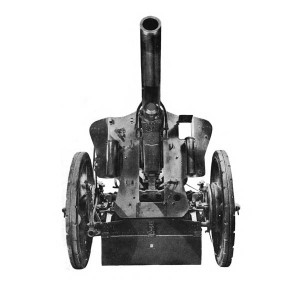
Three views of the German 105-mm howitzer (10.5 cm leFH 18, leichte FeldHaubitze) from the U.S. War Department technical manual TM E9-325A: German 105-mm Howitzer Materiel, June 1944.
 German 105-mm Howitzer and Carriage, Firing Position
Continue reading German 105-mm Howitzer
By Lone_Sentry_Admin, on August 13th, 2011%
“The Flying Bomb” from C.I.C. (Combat Information Center), U.S. Office of the Chief of Naval Operations, August 1944.

the flying bomb
The pilotless airborne bomb which was first used by the Germans on June 13, has been officially designated as the “Flying Bomb”. (Newspapers have referred to it also as “Doodle Bug” and as “Buzz Bomb”.)
This weapon, known to the Germans as V-1, appears to be one answer to Allied air supremacy in the Channel area. While the inaccuracy of the missiles as used to date is such as to make it impossible to assign specific military targets as objectives, approximately 35 percent of the bombs have landed in the London area causing considerable damage to non-military installations.
The bomb, as may be seen from the illustration, is of relatively simple construction and apparently designed for mass production.
From an examination of fragments and parts of unexploded bombs recovered in England, it has been possible to determine the method of operation. The bomb is originally launched from an inclined ramp on the mainland, by means not yet determined, at an initial speed of approximately 270 miles per hour and continues under the drive of the jet propulsion motor which operates as a result of the increased pressure developed on the forward side of the air intake grill by the high speed of the missile.
A clockwork mechanism which precesses the gyro normally under control of the magnetic compass allows the bomb to be put into a turn within three minutes after launching. The maximum duration of the turn is one minute and corresponds to about 40° in azimuth. After being put on course by this method, the missile flies in a straight line under control of the magnetic compass which precesses a gyro controlling a servo motor actuated by air pressure from two high pressure air bottles located in the fuselage. The gyro is further precessed by a barometric capsule which can be preset for any desired altitude up to 10,000 feet. A small two-bladed propeller, 10 centimeters long, mounted on a shaft geared to a veeder counter, registering to 9999, constitutes an air log. By pre-setting the counter, which is turned backwards during flight, the electrical fuse can be armed, the radio transmitter turned off, and the detonators in the tail assembly exploded. The radio transmitter, which appears in approximately one out of every twenty missiles, is provided in order that shore D/F stations may obtain fixes on the bomb for the purpose of correcting errors in flight. A prisoner of war has reported that the fix must be obtained and telephoned to the control central within ten seconds in order to insure sufficient accuracy. The detonators in the tail assembly operate at a pre-determined time prior to the end of the flight, shutting off the fuel supply and causing the elevators to operate and put the plane in a dive. At the same time, two small spoilers of different sizes are projected from the surfaces of the elevators presumably causing the plane to spin in.
Some instances have been reported in which the plane glided in to the target after the motor had stopped instead of diving. Later reports have indicated that some of the bombs circle before going into a dive. The exact reason for this is not known. but it is assumed that it is for the purpose of obtaining a fix as a check on the accuracy of the flight.
Countermeasures to date have consisted of:
a. Bombing launching sites.
b. Destruction of missiles by fighter planes.
c. Destruction of missiles by antiaircraft fire.
d. Use of barrage balloons.
On one instance a fighter pilot who had run out of ammunition succeeded in crashing a bomb by tipping it over with his wing tips.
A summary of the results of the flying bomb attacks on England (as excerpted from Prime Minister Churchill’s address of July 6th) appears in “German Flying Bombs” in the July 12, 1944 issue of The O.N.I. Weekly.
By Lone_Sentry_Admin, on January 22nd, 2011%
From Japanese Electronics, OPNAV-16-VP101, Photographic Intelligence Report 1, Air Intelligence Group, Division of Naval Intelligence, Office of the Chief of Naval Operations, Navy Department, January 1945:
German Radar Summary
Examples of German Radar are included here to cover the possibility that the Japanese may have access to German equipment and technicians.
The Germans employ several types of land based installations covering the functions of Air Search, Fire Control, and Coast Watching.
These types are quite well standardized and are much more efficient than those the Japanese are known to have.
There is now some photographic evidence of German Radar equipment in use by the Japanese. Also, it is knowrn that many other types of German electronics equipment are being used.
The following table represents the latest list of German Radar types with salient information concerning each.
GERMAN LAND BASED RADAR| Name | Size of Screen* | Top of Screen Above Ground | Frequency | Range in Nautical Miles | Use | | LIMBER FREYA | 20′x 16′ IFF – 16¼ x 3½’ | 26¾’ 30′ with IFF | 116-146 MCS. | 75 | A.S. | | POLE FREYA | 20′x 16′ IFF – 16¼ x 3½’ or 20′ x 8′ | 32′, 35′ or 40′ with IFF | 116-146 MCS. | 100 | A.S. | | GIRDER CHIMNEY | 19½’ x 97½ | 115′ | 120-130 MCS. | 110 | A.S. | | CYLINDRICAL CHIMNEY | 60′ x 97½ IFF .22′ High | 110½’ | 120-130 MCS. | 160 | A.S. | | GEMA COASTWATCHER | 20′ x 8′ | 25′ | 370-390 MCS. | Depends on elevation (ASL) of site | C.W. |
| LARGE COASTWATCHER | 35′ x 34′ | 40′ | 70-90 MCS. | 60-75 | C.W. | | SMALL HOARDING | 63¾’ x 44¾’ | 50′ | | | C.W. | | LARGE HOARDING | 98′ x 36½’ | 50′ | 120-130 MCS. | 100-115 | C.W. | | SMALL WURZBURG | 10′ Diameter | 12½’ in Vertical Position | 550-580 MCS. | 25 | F.C. | | GIANT WURZBURG | 24′ Diameter | 27′ in Vertical Position | 470-580 MCS. | 40 | G.C.I., A.S. & C.W. | * – Width (Horizontal Dimension) Given First A.S. – Air Search F.C. – A/A Fire Control C.W. – Coast Watching G.C.I. – Ground Control Intercept
Drawings of all of the basic German Radar types are included on this page. Best known popular names are used for the designation of each type. It will be noted that these designs are quite well standardized for each particular use, and identification is easier because of this fact.
In most cases, this German equipment is superior to that now in use by the Japanese. A constant watch for German type designs of Radar in Japanese held territory is therefore in order.

By Lone_Sentry_Admin, on January 22nd, 2011%
The U.S. intelligence articles from Tactical and Technical Trends, No. 34, September 1943 have been added to the main Lone Sentry website:
By Lone_Sentry_Admin, on January 21st, 2011%

BETIO ISLAND, TARAWA ATOLL. This 98 cm. searchlight truck represents standard equipment that has also been taken on Saipan, Peleliu, Lae-New Guinea, and Little Kiska Island. Small size and ease of movement make this light practically impossible to detect. Power for operation of the light is supplied by a built-in generator run by the truck engine. On Little Kiska, the searchlight truck was dug in, camouflaged with nets, and gave the appearance of a small building; on Saipan trucks were housed in underground concrete garages.
Source: Japanese Electronics, Photographic Intelligence Report 1, Office of the Chief of Naval Operations, Navy Department, March 1945.
By Lone_Sentry_Admin, on January 20th, 2011%
Analysis of captured German and Italian equipment, particularly newly encountered panzers such as the Tiger tank in Tunisia, remained a priority for Allied intelligence and ordnance teams throughout WWII. The following brief summary of these efforts is taken from “Intelligence Lessons from North Africa, Operation Torch” by the Office of Assistant Chief of Staff, G-2, Allied Force Headquarters, March 1943.
Captured Material
The problem of getting back captured material is a difficult one as fighting units do not have the technical ability to decide what should be sent back and are usually too busy to make the necessary arrangements. In Tunisia, the situation is further complicated as most captured equipment is at once handed over to the French to make up shortages.
The War Department is shortly sending out a team of ordnance personnel trained in the examination of enemy material, to work under the Intelligence Branch at Allied Force Headquarters. It is proposed to have a portion of this team well forward, to be sent to any part of the line where active operations are taking place. They will be responsible for discovering what material has been captured and for ensuring that it is evacuated to the rear as early as possible. The remainder of the team will be at Allied Force Headquarters under the Technical Intelligence officer to arrange for photographs, measurements and dispatch to U.K. or U.S.
It is recommended that similar teams be organized in future for British expeditions with transport including at least one 30 cwt. truck for the removal of material.
By Lone_Sentry_Admin, on January 5th, 2011%
Report on the German “Small Wurzburg” radar from U.S. Naval Intelligence report Japanese Electronics, March 1945:
The “Small Wurzburg” or “Bowlfire” was first designed in 1936, and is one of the most efficient Radars. It is primarily for A.A. fire control but has been used for A/C reporting, searchlight control, and as a standby for Ground Control of A/C. In general, it is a mobile Radar, mounted on a four-wheeled trailer with outriggers for levelling. Some sets are emplaced, however, and the wheels removed.
Search is by mechanical rotation of the apparatus for bearing and by elevation of the reflector bowl for height measurement.
The diameter of the paraboloid reflector is 10 feet, the top of which is but 12½ feet above the ground. A cupboard, housing the radar equipment, and an operators seat are attached to the rear and side of the reflector.

There are several types of Small Wurzburgs; among them Types “A”, “C”, and “D” are most used and are quite similar. Type “D” is found with limber mounting and may be without wheels or even set in concrete.
For transport, the paraboloid can be split, by hinges, and turned down in two halves.
Type F.M.G. 41-T is a modification of the Small Wurzburg which incorporates a scoop-like form for cutting out ground echoes.
The practical range of the Small Wurzburg is not more than 25 nautical miles but it has a high degree of accuracy for Fire Control purposes.
By Lone_Sentry_Admin, on November 23rd, 2010%
When the Allied forces first encountered the Tiger II in Normandy in the summer of 1944, the panzer was briefly referred to as the “Pantiger”. The Associated Press picked up the name “Pantiger” in their article on August 19th:
Germans have thrown a huge new, heavily armored tank into action on both the Russian and northern French fronts in an effort to stem the Allied advances, but first reports denied it was a “super weapon.”
One of the new monsters weighing over 65 tons and with six inch armor plate—an inch and a half thicker than anything the enemy yet has put into action—was taken by the British on the Orne river front. The tank was a victim of a mechanical breakdown and never had fired a shot in battle.
Christened the “Pantiger” by its captors, the tank combines the best features of the Nazi Tiger and Panther tanks, which weigh 45 tons each. It is 23 feet long and over 11 feet wide, has an extra wheel on each side of its tracks and a huge, clumsy looking turret.
The name “Pantiger” was still being used as late as the publication of Tactical and Technical Trends, October 1944.
PANTIGER, A REDESIGNED TIGER, NEWEST ENEMY HEAVY TANK
A new 67-ton German heavy tank—referred to variously as Pantiger and Tiger II—has been employed against the Allies this summer in France. Actually a redesigned Tiger (Pz. Kpfw. VI), it mounts the 8.8-cm Kw. K. 43 gun. On the basis of a preliminary report, the general appearance of the new tank is that of a scaled-up Pz. Kpfw. V (Panther) on the wide Tiger tracks. It conforms to normal German tank practice insofar as the design, lay-out, welding, and interlocking of the main plates are concerned. All sides are sloping. The gun is larger than the Panther gun, and longer than the ordinary Tiger gun. Armor is also thicker than that on either the Panther or the Tiger. The turret is of new design, with bent side plates. In all respects the new tank is larger than the standard Tiger.

|
|
Recent Comments