
|
|
By Lone_Sentry_Admin, on March 9th, 2012%
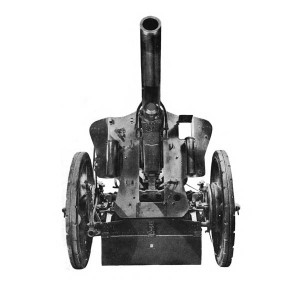
Description of the WWII Japanese Model 88 (1928) 75-mm Antiaircraft Gun from Japanese Field Artillery, Special Series No. 25, Military Intelligence Division, U.S. War Department, Washington, D.C., October 15, 1944.
Model 88 (1928) 75-mm AA Gun.
Model 88 (1928) 75-mm AA gun is the standard Japanese mobile antiaircraft artillery weapon. It has been encountered more generally in U.S. campaigns against the Japanese than any other artillery weapon. It has a high velocity which makes it suitable for use against ground targets, especially armor. It has been used both in defense of airfields against ground attack and in a dual-purpose role as an antiaircraft and coast-defense gun. For antitank purposes it has the advantage of all-round traverse and the disadvantage of limited mobility. It thus can be quite effective when fired from ambush against tanks, but it cannot shoot and run.
Continue reading Japanese Model 88 75-mm AA Gun
By Lone_Sentry_Admin, on March 3rd, 2012%
Weapons diagram from the German Fw 190 D-9 Flugzeug-Handbuch, November 1944:
I. Beschreibung der Schußwaffenanlage der Baureihe D-9
A. Allgemeines

Abb. 1: Gesamtbild der Schußwaffenanlage
By Lone_Sentry_Admin, on February 11th, 2012%
Tips from bomber gunners to prevent guns and gunners from freezing during missions from a special edition of Army Talks, “Stars over the Reich,” published for the officers and men of the Eighth Air Force.
WORDS FROM THE WING WISE
These tips on preventing frozen guns and gunners come from gunners who were on operations last winter.
How to Keep Your Guns from Freezing
Thorough cleaning before and after every mission is point number one. Remove all moisture and powder deposits, especially from the bolt recesses. Firing pin port and receiver (especially extractor switch recess and front barrel bearing) should be thoroughly cleaned, dried and then properly oiled with AXS 777 (new specification number—2-120). Leave only a light film of oil. And keep oil cans tightly closed to keep out dust and foreign matter.

A canvas bag will keep recoiling parts dry while they’re being carried to the plane.
Charge your gun just before or just after take-off (whichever is your Group’s policy). If your gun freezes when unloaded you’re stuck. If it’s loaded the recoil will loosen any frozen parts.
Test-fire at bombing altitude. If you can charge the gun but it won’t fire, hold the trigger back while the parts slam forward into battery—this sometimes loosens frosted parts. Only charge the gun when you have to; it lets cold moist air in to the recoiling parts. If the extractor switch is frozen, charging may result in an out-of-battery stoppage.
How to Keep Yourself from Freezing
Use the correct equipment and wear clothing as it says on the posters. Clothing should fit loosely, as air insulates, and your blood circulates better.
Keep dry. If your feet get wet, change your socks before take-off. Don’t Work around the plane in too heavy clothing before take-off, as sweat increases the danger of frostbite.
Pre-flight your heated suit. The connection in the plane may be out of order. Only turn your heated-suit rheostat up far enough so you are just warm enough to keep you from being miserable. Be sure to have fleece-lined clothing in case the suit goes permanently out of order. If it does, keep moving the parts of your body that don’t have heat, flexing the muscles, wiggling your fingers and toes. And it’s a good idea to have extra heated gloves and cords.
Wear mufflers or bath towels around your knees, neck and anywhere else that gets cold. Goggles and canvas or wool hoods are available, and they sure are handy if the plexiglass is broken near you.
If you have to take off your heated glove at altitude don’t remove the glove liner. Don’t leave any part of your body exposed for more than a few seconds. Remember, at 40 below zero you may freeze a hand badly enough to lose a finger before you feel any pain or realize anything’s wrong.
By Lone_Sentry_Admin, on February 9th, 2012%
Data pertaining to the 155-mm gun M2, the carriage M1 or M1A1, the 155-mm gun mount M13 (T14), and the limbers M2 and M5. All data from the WWII U.S. War Department Technical Manual TM 9-350: 155-mm Gun M2; Carriage M1 and M1A1, Gun Mount M13; Heavy Carriage Limber M2 and M5; and Firing Platform M1, May 1945.
TABULATED DATA.
a. Data pertaining to 155-mm gun M2.
(1) GENERAL.
| Weight of gun (complete with breech mechanism) |
|
9,595 lb |
| Weight of tube assembly (barrel) |
|
9,190 lb |
| Length of tube |
|
277.37 in. |
| Length of bore |
|
cal. .45 |
| Length of rifling |
|
230.57 in. |
| Powder pressure (normal pressure with maximum charge in a new gun) lb per square in |
|
40,000 |
| Type of breecblock |
|
Interrupted screw |
| Weight of breech mechanism |
|
405 lb |
| Type of firing mechanism |
|
continuous pull percussion hammer |
(2) PERFORMANCE.
| Muzzle velocity (average velocity with a new gun in feet per second): |
|
|
| Shell AP (Maximum zone charge) |
|
2,745 fps |
| Shell HE (Maximum zone charge) |
|
2,800 fps |
| Range: (Maximum) |
|
|
| AP Shell |
|
24,075 yd |
| HE Shell |
|
25,715 yd |
| Rate of fire: |
|
|
| Normal |
|
round 1 (per 2 minutes) |
Continue reading 155-mm Gun M2
By Lone_Sentry_Admin, on February 8th, 2012%
Instructions for loading the 37-mm gun and carriage on railroad cars from the WWII technical manual TM 9-235 37-mm AA Gun Materiel, U.S. War Department, January, 1944.
LOADING MATERIEL ON RAILROAD CAR.
a. General. All loading and blocking instructions as specified herein are minimum, and are in accordance with the Association of American Railroads, “Rules Governing the Loading of Commodities on Open Top Cars,” special supplement, revised, 1, March 1943.
b. Instructions.
(1) INSPECTION. Railroad cars must be inspected to see that they are suitable to carry loads to destination. Floors must be sound and all loose nails or other projections not an integral part of the car should be removed.
(2) RAMPS. Permanent ramps should be used for loading the materiel when available, but when such ramps are not available, improvised ramps may be constructed of rail ties and other available lumber.
(3) HANDLING.
(a) Cars loaded in accordance with specifications given herein must not be handled in hump switching.
(b) Cars must not be cut off while in motion and must be coupled carefully, and all unnecessary shocks avoided.
(c) Cars must be placed in yards or sidings so that they will be subjected to as little handling as possible. Separate track or tracks, when available, must be designated at terminals, classifications, or receiving yards, for such cars, and cars must be coupled at all times during such holding and hand brakes set.
(4) PLACARDING. Materiel not moving in combat service must be placarded, “DO NOT HUMP.”
(5) CLEARING LIMITS. The height and width of load must be within the clearance limits of the railroads over which it is to be moved. Army and railroad officials must check all clearances prior to each move.
Continue reading Loading 37-mm AA Guns on Railroad Cars
By Lone_Sentry_Admin, on October 9th, 2011%
Instruction for demolition of the 155-mm gun M2 from the WWII U.S. War Department Technical Manual TM 9-350: 155-mm Gun M2; Carriage M1 and M1A1, Gun Mount M13; Heavy Carriage Limber M2 and M5; and Firing Platform M1, May 1945.
DEMOLITION TO PREVENT ENEMY USE
34. GENERAL.
a. The destruction of the materiel, subject to capture or abandonment in the combat zone, will be undertaken by the using arm only on authority delegated by the division or higher commander as a command function when such action is deemed necessary as a final resort to keep the materiel from reaching enemy hands.
b. Adequate destruction of artillery materiel means damaging it in such a way that the enemy cannot restore it to usable condition in the combat zone either by repair or by cannibalization. Adequate destruction requires that:
(1) Enough parts essential to the operation of the materiel must be damaged.
(2) Parts must be damaged beyond repair in the combat zone.
(3) The same parts must be destroyed on all materiel, so that the enemy cannot make up one operating unit by assembling parts from several partly destroyed units.
c. The tube and breech are the most vital parts of any piece of artillery. These are the first things to damage. After the tube and breech in importance come the recoil mechanism, sighting and fire control equipment, carriage, tires, gun book, and firing tables.
35. METHODS.
a. General.
(1) The destruction procedures outlined are arranged in order of effectiveness. Destruction should be accomplished by method No. 1, if possible. If method No. 1 cannot be used, destruction should be accomplished by one of the other methods outlined, in the priority shown.
(2) Whichever method is used, the sequence outlined must be followed. Uniformity of destruction will then be obtained, whether or not the method is carried to completion.
(3) Certain of the methods outlined require special tools and materials, such as nitrostarch and incendiary grenades, which may not be items of issue normally. The issue of such special tools and material, the vehicles for which issued, and the conditions under which destruction will be effected are command decisions in each case, according to the tactical situation.
(4) SIGHTS. Detach all optical sights. If evacuation is possible, carry the sights; if evacuation is not possible, thoroughly smash the sights.
b. Method No. 1 — destruction of tube, breech, and recoil mechanism.
(1) Open drain plug on recoil mechanism, allowing recoil fluid to drain. It is not necessary to wait for the recoil fluid to drain completely before firing the cannon in step (4), below.
(2) Place an armed (safety pin removed) antitank grenade M9A1, HE, or armed (safety pin removed) antitank rocket M6 in the tube with the nose end toward the rear. The grenade or rocket must be centered in the tube, using a wooden adapter. An alternate for the wooden adapter is the use of waste.
(3) Insert an unfuzed HE complete round or HE shell with propelling charge into the cannon and close the breech. Base-detonating HE shell cannot be used in this method.
(4) Fire the cannon, using a lanyard at least 100 feet long. The person firing should be under cover to the rear of the piece and approximately 20 degrees off the line of fire. Elapsed time: Approximately 2 to 3 minutes.
(5) The danger zone is approximately 500 yards.
c. Method No. 2.
(1) Insert TNT blocks in the bore, near the muzzle and in the chamber of the cannon. Close the breechblock as far as possible without damaging the safety fuse. Plug the muzzle tightly with earth to a distance of approximately 3 calibers from muzzle. Detonate the TNT charges simultaneously. Thirty to fifty half-pound blocks will be needed for effective demolition. If it is not possible to plug the bore, a larger number of TNT blocks will be needed for effective demolition.
(2) Ram an HE shell (without base fuze) into the forcing cone and place TNT blocks behind it, as specified above. Close the breechblock and detonate the TNT charge. A sufficient length of safety fuse should be used to permit personnel to reach safety zone or cover. The fuse may be routed through the primer hole in the spindle.
(3) Attention is invited to the fact that, for the larger calibers, the number of blocks to be used is an estimate not proved by tests.
d. Method No. 3.
(1) Place unfuzed incendiary grenades M14, on their sides, one on top of another, in the chamber. Close the breech. Equip another incendiary grenade with a 15-second safety fuse, ignite, and toss it in the muzzle. Quickly elevate the cannon to its maximum elevation. Elapsed time: 3 to 5 minutes. Six to eight grenades per cannon are required.
(2) The metal from the grenades will fuse with the interior of the breechblock, making it impossible to open the breech.
e. Method No. 4.
(1) Fire adjacent guns at each other at point-blank range, using HE or AP shells. Two or more direct hits from a weapon of the same caliber, on a vital spot such as the breech mechanism, recoil mechanism, or tube should adequately destroy the artillery piece. Fire from cover. Danger space is from 200 to 250 yards.
(2) Destroy the last gun and carriage by the best means available.
(3) Danger from cannibalization is inherent in this method.
f. Ammunition. Instructions for demolition of ammunition are contained in TM 9-1901.
By Lone_Sentry_Admin, on April 29th, 2011%
Two views of the U.S. 155-mm Gun on Gun Motor Carriage M40 from TM 9-350, the Technical Manual on the 155-mm Gun M2 printed in 1945.
 155-mm Gun on Gun Mount M13 on Gun Motor Carriage M40 -- Side View
 155-mm Gun on Gun Mount M13 on Gun Motor Carriage M40 -- Rear View
By Lone_Sentry_Admin, on January 15th, 2011%
Illustrations and performance details of the Erco 250SH Ball Turret mounted in the PB4Y Privateer from Aircrewman’s Gunnery Manual, Aviation Training Division, Office of the Chief of Naval Operations, U.S. Navy, 1944.

Erco Ball Turret ERCO 250SH-2, 2A or 3
The Erco Ball Turret is the bow installation in the Navy PB4Y-1 and PB4Y-2 airplanes. It serves a double purpose in taking care of any bow attacks on the Liberator besides being used for strafing, in anti-submarine warfare. Inasmuch as this turret is of the ball type, the gunner moves with his guns and sight in elevation and azimuth as he moves his control handles. It is a relative of the Martin 250SH Bow Turret of the PBM-3 airplanes and has many points of similarity in design and action.
There are several models which for the most part are the same—the Erco 250SH-2 or 2A used in the bow position of the PB4Y-1 airplane and the Erco 250SH-3 used in PB4Y-2 airplane.

Facts and Figures
POWER: The Erco 250SH operates hydraulically on pressure built up by a hydraulic pump driven by a constant speed electric motor.
SIGHT: Its sight is the standard Navy Mk 9 reflector sight, fully described in the introduction of this section.
ELEVATION: From the horizontal position the turret ball, and consequently the guns, may be depressed a maximum of 70° and elevated a maximum of 85°.
AZIMUTH: This type of turret is capable of revolving 360° in azimuth, but for the installation in the bow of the PB4Y-1 or PB4Y-2 airplanes, its motion is restricted to 80° either side of the center line of the plane.
ARMOR: The armor plate of the turret consists of three parts to protect the gunner from enemy fire and flak: (1) 1½” laminated bullet proof glass to protect his face. (2) ½” armor plate in front to protect the gunner’s body, no matter where his guns are pointed. (3) ¼” armor plate bolted to the floor to protect his feet.
STOWING: The stowing position is 0° azimuth and 0° elevation, guns pointing straight forward.
By Lone_Sentry_Admin, on December 31st, 2010%
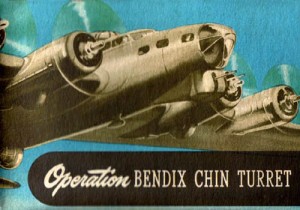
Bendix manual on the Operation and Maintenance of the Bendix Chin Turret for the B-17 Flying Fortress:
GENERAL SPECIFICATIONS
Armament Two Caliber .50 M-2 machine guns. Ammunition Capacity 450 rounds per gun.
Speed of Turret Slow speed (tracking) ¼° per second to 12° per second. High speed (slewing, with high speed button depressed) ¼° per second to 33° per second.
Weights Turret Complete (no guns or ammunition) 438 lbs. Ammunition 33 lbs. per 100 rounds. Guns 65 lbs. each.
Gear Drive Speed Reducer ratio 25-1. Azimuth gear ratio 50-1. Elevation gear ratio 42-1. Azimuth gear train reduction 1250-1. Elevation gear train reduction 1050-1.
Electrical Requirements 24 Volt D.C. Peak starting current motor amplidynes 1280 amps. Maximum current draw running full load 92 amps. Maximum current draw running no load 40 amps.

GENERAL DESCRIPTION
BENDIX CHIN TURRET
The Bendix Chin Turret Model “D” is an electrically driven power turret, mounting two caliber, .50 M-2 Machine Guns, equipped with recoil absorbing mechanism, firing solenoids, and manual gun chargers.
The turret is designed to be mounted in the Bombardier’s Compartment and to be operated by the Bombardier to protect the forward approaches to the ship. The guns rotate 172° in azimuth (86° to the left and to the right of forward) and swing from 26° above horizontal to 46° below horizontal. Switch limits are adjustable. The turret is mounted at floor level in the Bombardier’s Compartment. The guns extend below the fuselage at the nose of the ship. The lower assembly, with the exception of the gun barrels which protrude through covered slots, is enclosed in an aluminum, movable housing to minimize wind resistance. Plexiglass windshields seal the space at the floor of the ship around the turret.

Continue reading Bendix Chin Turret |
By Lone_Sentry_Admin, on December 5th, 2010%
The following report on the German Gewehr 43 semi-automatic rifle was published in Foreign Military Weapons and Equipment, Vol. III, Infantry Weapons, Pamphlet No. 30-7-4, Department of the Army, 1954.
7.92-mm Model 43 Semi-Automatic Rifle (KARABINER 43 or GEWEHR 43)

This rifle is a semi-automatic, gas-operated, air-cooled, magazine-fed, shoulder weapon. The original designation was the Gewehr 43, but this nomenclature was later changed to Karabiner 43.
It is a simplified and improved development of the 41M and 41W, earlier World War II German models. The major changes are that the M43: (1) Uses principally forgings and stampings rather than machined parts; (2) is lighter and better balanced; (3) employs a better system of gas operation, a gas vent and gas piston being used rather than a gas trap assembly and long piston rod; and (4) does not have a bayonet stud for use of a bayonet.
Continue reading Gewehr 43
|
|
Recent Comments