
Operating instructions for the Bazooka in tropical and arctic climates from TM 9-294: 2.36-inch A.T. Rocket Launcher M1A1, War Department Technical Manual, Sept. 27, 1943.
Section X: OPERATION UNDER UNUSUAL CONDITIONS
32. GENERAL.
a. When operating under unusual conditions such as tropical or arctic climates, severe dust or sand conditions, and near salt water, it is essential that all the precautions listed below should be observed.
33. ARCTIC CLIMATES.
a. In temperatures below freezing, and particularly in arctic climates, all operating parts should he kept absolutely free of moisture. The bore of the launcher should be cleaned daily and oiled as described in paragraph 16. The batteries should be removed from the launcher and kept warm until just before firing. Carrying the batteries in inner pockets will keep them sufficiently warm. Immediately upon bringing indoors, the launcher should be cleaned on the outside and inside with a dry clean cloth. Remove the grips and clean and dry the contacts. After it has reached room temperature, clean and dry the launcher again, and oil the bore. Rockets should not be fired at temperatures below zero F.
34. TROPICAL CLIMATES.
a. Tropical Climates. In tropical climates where temperature and humidity are high, or where salt air is present, and during rainy seasons, the launcher should be thoroughly inspected and cleaned daily. The bore should be oiled a little more liberally than prescribed in paragraph 16. Wood parts should be inspected to see that swelling due to moisture does not bind working parts. If this does occur, shave off only enough wood to relieve binding. A light coat of OIL, linseed, raw, type A applied at least every month and well rubbed in with the heel of the hand, will help to keep moisture out. Allow oil to soak in for a few hours and then, wipe and polish the wood with a dry clean wiping cloth. Do not fire rockets at temperatures above 120 F.
NOTE: Care should be taken to see that linseed oil does not get onto electric contacts as it will gum when dry.
b. Hot Dry Climates. In hot dry climates, where sand and dust are apt to get into the bore, the launcher including the bore should be wiped clean daily or more often if necessary. Oiling of the bore should be done very sparingly and only in the event that atmospheric conditions cause rusting of the bore surface. In such climates, wood parts are apt to dry out and shrink, and a more frequent application of OIL, linseed, raw, type A, will help keep wood in condition. During sand or dust storms the breech and muzzle should be kept covered. Do not fire rockets at temperatures above 120 F.
The following report on the German StG 44 (Sturmgewehr 44) assault rifle was published in Foreign Military Weapons and Equipment, Vol. III, Infantry Weapons, Pamphlet No. 30-7-4, Department of the Army, 1954.
7.92-mm Submachine Gun MP-44 (STURMGEWEHR M44)
The German MP44 was developed in 1942 to provide an intermediate weapon between the rifle and the submachine gun. The standard 7.92-mm rifle cartridge was shortened and bottle-necked to take a 120-grain boattail bullet. With this cartridge the weapon provided better ballistic characteristics than those available with the standard German 9-mm submachine guns. It also had provisions for full automatic fire and thus a greater firepower capability.
Ease of mass production was achieved by the extensive use of steel stampings. The receiver, frame, gas cylinder, and barrel jacket are all made from stampings. The parts of the trigger mechanism are riveted in place; therefore, the trigger assembly cannot be disassembled, although a complete trigger mechanism can be quickly inserted into the weapon.
Despite its cheap construction, it is a very serviceable weapon. The various models of this weapon, including the MP43, MP43/1, and the MP44, were all designated the STURMGEWEHR 44 in 1944. They differ only in minor detail. Ballistically, they are identical.
This weapon can be recognized by: (1) The stamped receiver and barrel jacket; (2) the prominent front sight base; (3) the curved, stamped magazine; (4) the gas cylinder on top of the barrel; and (5) the short, bulky buttstock.
Large numbers of these weapons were captured by the Soviets during World War II, and many probably are still held in reserve stocks.
During the Battle of the Bulge, the Germans disguised several Panther tanks as U.S. M10 tank destroyers (“Ersatz M10″). Part of the Operation Greif created and commanded by Otto Skorzeny, Panzer Brigade 150 deployed these Panther Ausf. G tanks which had been extensively modified and painted to resemble U.S. M10 tank destroyers.
The history of the bazooka from U.S. Rocket Ordnance: Development and Use in World War II, U.S. Joint Board on Scientific Information Policy, 1946.
Bazooka Versus Tank
Among the now-it-can-be-told weapons of the American rocket family, is the super-bazooka, bigger and better version of the foot-soldier’s famed tank-buster.
By their surrender, the Germans and Japs missed feeling the impact of a rocket which travels at almost twice the speed and carries double the explosive payload of the standard bazooka projectile; which has an effective range of as much as 700 yards, instead of the 200 to 300 yards of the regular bazooka; and which can function safely through a considerably wider temperature range, thus affording greatly increased protection against the dangers of motor explosion and blast. Though the super-bazooka retains the 2.36-inch diameter of the original bazooka, and is fired from the same launcher, it is propelled by a larger motor, and its heavier explosive charge can penetrate thicker armor plate.
Another development of the original bazooka-still secret at the war’s end-is a super-powered rocket of 3.5 inches in diameter with greatly increased power to penetrate armor plate and reinforced concrete.
The super-bazooka was the joint product of Section H, which produced the design for the motor, and Division 8 of NDRC, which developed the far more powerful head. The 3.5-inch rocket was designed by the Army Ordnance Department.
Bazooka Development
To arm United States infantry to fight tanks on more nearly equal terms, the Army Ordnance Department, in early 1941, had under development a rifle grenade, carrying a “shaped charge” of high explosive. A cone-shaped cup hollowed in the front face of the explosive filling focussed the blast energy into a narrow beam of great penetrating power.
These rifle grenades had too much recoil for field use as a shoulder weapon. Recoilless rocket propulsion was suggested, tried, and adopted. Colonel Skinner, then an Ordnance Department major, and Lt. (now Major) E. G. Uhl, with Section H at Indian Head, undertook the development of a suitable rocket motor.
Following unsuccessful attempts to launch these rocket grenades from attachments to the service rifle, it was concluded that a separate launcher would be required.
To protect the gunner from the rocket blast, the launching tube had to be longer than the maximum burning distance of the rocket motor. To be portable and easily aimed from the shoulder, the launcher, and hence the burning distance, had to be short. By the use of a charge of several thin-web tubular grains of solvent extruded powder in a motor about an inch in diameter, the burning distance was made short enough for a 54-inch launcher, soon dubbed “the bazooka.”
Front and rear views of the M55 quad .50 cal. mount and trailer from ORD 7SNL G-220: Organizational Spare Parts and Equipment for Mount, Trailer, Multiple Cal. .50 Machine Gun, M55, Ordnance Supply Catalog, Headquarters, Army Service Forces, June 1945.
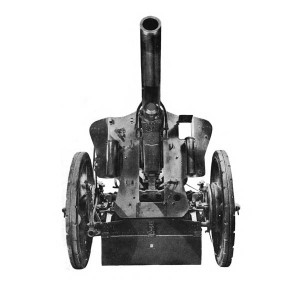
Three views of the German 105-mm howitzer (10.5 cm leFH 18, leichte FeldHaubitze) from the U.S. War Department technical manual TM E9-325A: German 105-mm Howitzer Materiel, June 1944.
German 105-mm Howitzer and Carriage, Firing Position
Side and rear views of the M51 quad .50 cal. mount and trailer from ORD 7 SNL G-217: Organizational Spare Parts and Equipment for Carriage, Multiple Cal. .50 Machine Gun, M51, Ordnance Supply Catalog, Headquarters, Army Service Forces, October 1944. The M51 was composed of the M17 trailer and the M45 multiple .50 cal. mount.
From Japanese Electronics, OPNAV-16-VP101, Photographic Intelligence Report 1, Air Intelligence Group, Division of Naval Intelligence, Office of the Chief of Naval Operations, Navy Department, January 1945:
“Mobile Mattress” Radar
A later, and apparently more efficient, Radar type is the “Mobile Mattress” or “Mark I, Model 2″. The Radar operates at 200 mcs. and is identified by a small screen (14′ x 7′) mounted on a Japanese standard army trailer (type 94).
This Radar is being used more and more for land-based search, either alone or in conjunction with older types. It is frequently seen mounted in emplacements, suggestive of a permanent siting.
Below are reconstructed drawings made from photos of the Kwajalein set.
The shack, antennae, revolving mount and trailer may be separated for shipping purposes.
LOCATION
KWAJALEIN
TYPE
(MK. I, MODEL 2)
“MOBILE MATTRESS”
ANTENNA
14′ x 7′ x 1 2/3′
FREQUENCY
200 MCS
P.R.F.
800 – 1500 PULSE
3 1/2- 12
MAXIMUM RANGE
100 N. MI.
The Mobile Mattress captured at Namur, Kwajalein, was mounted atop the standard concrete power house. Although the set is badly damaged, it is still possible to establish the important recognition features.
Note the similarity in design between this and the Attu type screen. The Mobile screen is much smaller, however.
Several additional views of the “Mobile Mattress” or Mark I, Model 2 are shown for familiarization. This set is very probably the best Japanese Search Radar in general use at present. The frequency is 200 megacycles per second and the maximum range is 100 nautical miles.
Recent Comments