
Demolition of the 155-mm gun M2

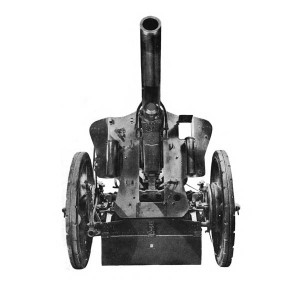
Instruction for demolition of the 155-mm gun M2 from the WWII U.S. War Department Technical Manual TM 9-350: 155-mm Gun M2; Carriage M1 and M1A1, Gun Mount M13; Heavy Carriage Limber M2 and M5; and Firing Platform M1, May 1945.

DEMOLITION TO PREVENT ENEMY USE

34. GENERAL.

a. The destruction of the materiel, subject to capture or abandonment in the combat zone, will be undertaken by the using arm only on authority delegated by the division or higher commander as a command function when such action is deemed necessary as a final resort to keep the materiel from reaching enemy hands.

b. Adequate destruction of artillery materiel means damaging it in such a way that the enemy cannot restore it to usable condition in the combat zone either by repair or by cannibalization. Adequate destruction requires that:

(1) Enough parts essential to the operation of the materiel must be damaged.

(2) Parts must be damaged beyond repair in the combat zone.

(3) The same parts must be destroyed on all materiel, so that the enemy cannot make up one operating unit by assembling parts from several partly destroyed units.

c. The tube and breech are the most vital parts of any piece of artillery. These are the first things to damage. After the tube and breech in importance come the recoil mechanism, sighting and fire control equipment, carriage, tires, gun book, and firing tables.

35. METHODS.

a. General.

(1) The destruction procedures outlined are arranged in order of effectiveness. Destruction should be accomplished by method No. 1, if possible. If method No. 1 cannot be used, destruction should be accomplished by one of the other methods outlined, in the priority shown.

(2) Whichever method is used, the sequence outlined must be followed. Uniformity of destruction will then be obtained, whether or not the method is carried to completion.

(3) Certain of the methods outlined require special tools and materials, such as nitrostarch and incendiary grenades, which may not be items of issue normally. The issue of such special tools and material, the vehicles for which issued, and the conditions under which destruction will be effected are command decisions in each case, according to the tactical situation.

(4) SIGHTS. Detach all optical sights. If evacuation is possible, carry the sights; if evacuation is not possible, thoroughly smash the sights.

b. Method No. 1 — destruction of tube, breech, and recoil mechanism.

(1) Open drain plug on recoil mechanism, allowing recoil fluid to drain. It is not necessary to wait for the recoil fluid to drain completely before firing the cannon in step (4), below.

(2) Place an armed (safety pin removed) antitank grenade M9A1, HE, or armed (safety pin removed) antitank rocket M6 in the tube with the nose end toward the rear. The grenade or rocket must be centered in the tube, using a wooden adapter. An alternate for the wooden adapter is the use of waste.

(3) Insert an unfuzed HE complete round or HE shell with propelling charge into the cannon and close the breech. Base-detonating HE shell cannot be used in this method.

(4) Fire the cannon, using a lanyard at least 100 feet long. The person firing should be under cover to the rear of the piece and approximately 20 degrees off the line of fire. Elapsed time: Approximately 2 to 3 minutes.

(5) The danger zone is approximately 500 yards.

c. Method No. 2.

(1) Insert TNT blocks in the bore, near the muzzle and in the chamber of the cannon. Close the breechblock as far as possible without damaging the safety fuse. Plug the muzzle tightly with earth to a distance of approximately 3 calibers from muzzle. Detonate the TNT charges simultaneously. Thirty to fifty half-pound blocks will be needed for effective demolition. If it is not possible to plug the bore, a larger number of TNT blocks will be needed for effective demolition.

(2) Ram an HE shell (without base fuze) into the forcing cone and place TNT blocks behind it, as specified above. Close the breechblock and detonate the TNT charge. A sufficient length of safety fuse should be used to permit personnel to reach safety zone or cover. The fuse may be routed through the primer hole in the spindle.

(3) Attention is invited to the fact that, for the larger calibers, the number of blocks to be used is an estimate not proved by tests.

d. Method No. 3.

(1) Place unfuzed incendiary grenades M14, on their sides, one on top of another, in the chamber. Close the breech. Equip another incendiary grenade with a 15-second safety fuse, ignite, and toss it in the muzzle. Quickly elevate the cannon to its maximum elevation. Elapsed time: 3 to 5 minutes. Six to eight grenades per cannon are required.

(2) The metal from the grenades will fuse with the interior of the breechblock, making it impossible to open the breech.

e. Method No. 4.

(1) Fire adjacent guns at each other at point-blank range, using HE or AP shells. Two or more direct hits from a weapon of the same caliber, on a vital spot such as the breech mechanism, recoil mechanism, or tube should adequately destroy the artillery piece. Fire from cover. Danger space is from 200 to 250 yards.

(2) Destroy the last gun and carriage by the best means available.

(3) Danger from cannibalization is inherent in this method.

f. Ammunition. Instructions for demolition of ammunition are contained in TM 9-1901.


Give Us More P-38′s

A U.S. Army WWII poster depicting the P-38 Lightning in action against Japanese Zeros in the Pacific.

Give Us More P-38s Poster
 

M51 Multiple Machine Gun Carriage

Side and rear views of the M51 quad .50 cal. mount and trailer from ORD 7 SNL G-217: Organizational Spare Parts and Equipment for Carriage, Multiple Cal. .50 Machine Gun, M51, Ordnance Supply Catalog, Headquarters, Army Service Forces, October 1944. The M51 was composed of the M17 trailer and the M45 multiple .50 cal. mount.

M51 Antiaircraft Multiple Quad .50 cal. MG Trailer

FIGURE 1—CARRIAGE, MULTIPLE CAL. .50 MACHINE GUN, M51—SIDE VIEW

Continue reading M51 Multiple Machine Gun Carriage

Ball Turret Video

Short, but interesting, video of a bomber ball turret from the Stockton Field Aviation Museum firing the .50 cal.’s on a test stand:


“Mobile Mattress” Radar

From Japanese Electronics, OPNAV-16-VP101, Photographic Intelligence Report 1, Air Intelligence Group, Division of Naval Intelligence, Office of the Chief of Naval Operations, Navy Department, January 1945:

“Mobile Mattress” Radar

A later, and apparently more efficient, Radar type is the “Mobile Mattress” or “Mark I, Model 2″. The Radar operates at 200 mcs. and is identified by a small screen (14′ x 7′) mounted on a Japanese standard army trailer (type 94).

This Radar is being used more and more for land-based search, either alone or in conjunction with older types. It is frequently seen mounted in emplacements, suggestive of a permanent siting.

Below are reconstructed drawings made from photos of the Kwajalein set.

The shack, antennae, revolving mount and trailer may be separated for shipping purposes.

Japanese Mobile Mattress Radar and Trailer

Namur, Kwajalein, Marshall Islands

LOCATION    KWAJALEIN
TYPE   (MK. I, MODEL 2)   “MOBILE MATTRESS”
ANTENNA    14′ x 7′ x 1 2/3′
FREQUENCY    200 MCS
P.R.F.   800 – 1500 PULSE   3 1/2- 12
MAXIMUM RANGE    100 N. MI.

The Mobile Mattress captured at Namur, Kwajalein, was mounted atop the standard concrete power house. Although the set is badly damaged, it is still possible to establish the important recognition features.

Note the similarity in design between this and the Attu type screen. The Mobile screen is much smaller, however.

Several additional views of the “Mobile Mattress” or Mark I, Model 2 are shown for familiarization. This set is very probably the best Japanese Search Radar in general use at present. The frequency is 200 megacycles per second and the maximum range is 100 nautical miles.

Japanese Radar of WW2


7.63-mm Mauser Pistol M1932

The following report on the German Mauser C96 “Broomhandle” automatic pistol was published in Foreign Military Weapons and Equipment, Vol. III, Infantry Weapons, Pamphlet No. 30-7-4, Department of the Army, 1954.

7.63-mm Mauser Pistol M1932
(7.63-mm MAUSER SCHNELLFEUER PISTOLE MODEL 1932)

Broomhandle Mauser C96 Pistol

This Mauser pistol was first manufactured in 1896. An intermediate between a pistol and a machine carbine, it was the first successful military automatic pistol developed and, except for minor modifications in 1912 and 1932, has retained its original features.

Originally designed and produced for police use, it was widely used as an unofficial substitute arm by the German military forces during World War I. After World War I, it was largely replaced by the Luger M’08 and the later Walther designs. It was widely used in Russia during the 1917 Revolution and is still found in substantial numbers throughout the Orient and Central Europe. The weapon has been manufactured by Spain, China, and Switzerland. It is unique in design in that: (1) All parts are fitted together or dovetailed and only one screw (in the pistol grip) is used; (2) it has a slotted attachment on the pistol grip, which can be used to attach a wooden stock; (3) it has a folding-leaf rear sight graduated from 100 to 1,000 meters. The magazine is solidly attached to the receiver, and the weapon is loaded from the top by means of metal clips in the same manner as a bolt-action rifle.

RECOGNITION FEATURES

Mauser C96 -- 7.63-mm Mauser Pistol Model 1932

Continue reading 7.63-mm Mauser Pistol M1932

Torpedo Data Computer

Analysis of the torpedo fire control problem and photographs of submarine torpedo data computers from Torpedo Data Computer: Mark 3, Mods. 5 to 12 Inclusive, Ordnance Pamphlet No. 1056, U.S. Navy Department Bureau of Ordnance, Washington, D.C., June 1944:

Torpedo Data Computer

A submarine is equipped with torpedo tubes fwd and aft which are parallel to the longitudinal axis of the ship. When a torpedo is fired it travels in a straight line for a certain distance called the Reach. After it has reached the end of this period of straight line travel, it may be caused to start on a circular course of a definite radius. The length of the circular path is determined by the setting of the gyro in the torpedo and the characteristics of the type of torpedo being used. After travelling in the circular path for a prescribed distance, the torpedo once more assumes a straight path and travels thus until it reaches the target.

The method for controlling the torpedo is by setting the Gyro Angle. It is the function of the Computer to take all of the variable factors into account and determine the value of the Gyro Angle for both fwd and aft torpedoes. The Gyro Angle is continuously generated by the Computer to keep up with the change in the problem due to relative motion of Own Ship and Target.

Submarine Torpedo Aiming and Firing

Continue reading Torpedo Data Computer

M36 Tank Destroyer Armament

Summary of the armament of the M36 “Jackson” tank destroyer from the M36B1 technical manual TM 9-748: 90-mm Gun Motor Carriage M36B1, War Department Technical Manual, U.S. War Department, Washington D.C., January, 1945.

ARMAMENT CHARACTERISTICS

a. The armament on the 90-mm Gun Motor Carriage M36B1 is employed chiefly against enemy tanks and other ground objectives. The 90-mm Gun M3 is mounted in the turret. The turret can be traversed 360 degrees manually or by a hydraulic traversing mechanism. The 90-mm gun can be elevated 30 degrees and depressed 10 degrees.

M36 B1 Gun Motor Carriage

90-mm Gun Motor Carriage M36B1 - Three-quarter Right Front View

b. The cal. .30 machine gun in the front of the gun motor carriage on the right side is elevated and depressed manually, and fired by a conventional trigger. Refer to FM 23-50 for complete information on its operation.

M36 Jackson Tank Destroyer

90-mm Gun Motor Carriage M36B1 - Three-quarter Right Rear View

c. The cal. .50 machine gun is employed chiefly against enemy aircraft and is elevated and traversed manually, and fired by a conventional trigger. The machine gun can be traversed independently of the turret. Refer to FM 23-65 for the complete information on its operation.

Turret .50 Caliber Machine Gun

Cal. .50, HB, Machine Gun - Stowage Position


Navy 20 mm Gun and Mounts

Description of 20 mm guns and mounts deployed on U.S. naval vessels, on merchantmen, and at many shore stations in WWII from Naval Ordnance and Gunnery, NAVPERS 16116, Bureau of Naval Personnel, Training Division, May 1944.

20 MM. GUN AND MOUNTS

7C1. General. The 20 mm. gun assembly, shown in figure 7C1, is an AA machine gun mounted on a pedestal-type. free-swinging mount. The mount is so arranged that the trunnion height can be adjusted for the convenience of the gunner when the gun is used at different angles of fire. The elevation limits are 5° depression and 87° elevation. There are no limits in train.

The gun is designed for automatic firing only and, like other automatic guns, it uses some of the force developed by the explosion of the propellant charge to eject the empty case, cock the gun, reload, and fire the next round. It embodies, however, certain features of gun design which are not found in other automatic and semi-automatic guns. The most important of these are:

1. The gun barrel dues not recoil.

2. The breechblock is never locked against the breech and is actually in motion at the moment the gun is fired.

3. There is no counterrecoil brake, the force of counterrecoil being checked by the explosion of the following round of ammunition.

The 20 mm. fires fixed ammunition which is fed into the gun from a magazine having a capacity of 60 rounds. The cyclic rate is about 450 rounds per minute. When the normal time required to change magazines is considered, the rate will vary between 250 and 320 rounds per minute depending upon the skill of the gun crew. The projectile used is a high-capacity type and is fitted with an impact-type nose fuze. Usually every other projectile or every third projectile in the magazine carries a tracer.

The 20 mm. gun is being used extensively on all classes of naval vessels, on merchantmen, and at many shore stations. It has been designed for and is particularly effective against aircraft targets at ranges up to about 2,000 yards. For this purpose it has almost entirely replaced the caliber .50 machine gun, principally because the heavier 20 mm. projectile with its high-explosive charge causes much more damage than the non-explosive caliber .50 projectile. The gun may also be used against lightly-armored targets.

7C2. Mounts. There are several kinds of pedestal-type, free-swinging mounts in use. The major difference between these mounts is in the method of adjusting the trunnion height. The mechanical mount shown in figure 7C1 is the one which is most widely employed at the present time.

20mm Gun Assembly Mount

Figure 7C1. 20 mm. gun assembly; mechanical mount.

The fixed pedestal is bolted to the deck. The pedestal head, through which the column rises, is so mounted that it can be rotated around the top of the pedestal and locked in any desired position by means of the clamping lever. The column-raising handwheel, mounted on the pedestal head, is used to raise and lower the column. By this means the trunnions can be raised about 15 inches to better position the gun for the gunner when firing at elevated targets.

The trunnion bracket and pivot is free to rotate around the top of the column on ball bearings, and there are no limits to this training motion. This part supports the shield, the cradle spiral spring, and the cradle. The gun is carried in two grooved slides in the cradle, and is held in place by a bolt. The cradle spiral spring, mounted around the left trunnion, as one end attached to the trunnion and the other to the spring case. This spring functions to counterbalance the weight of the gun.

From the above description it is evident that the gunner, strapped to the aft end of the gun, can swing the gun to any position within elevation limits, and that the trunnion height can be adjusted for his convenience and comfort. As the gun is moved in train, the column-raising handwheel can also be moved into position for easier operation.

Two other mounts which are used to a limited extent are shown in figure 7C2. The fixed mount, so called because it does not have an adjustable trunnion height, has a higher pedestal than the mechanical mount. The gunner is provided with a circular stepped platform around the mount to enable him to utilize the full range of elevation and depression available. The elevation limits are the same as for the mechanical mount and there is no limit in train.

U.S. Navy 20mm Gun Mounts

Figure 7C2. 20 mm. gun assemblies; fixed and hydraulic mounts.

The hydraulic mount has a foot-operated hydraulic mechanism to raise and lower the column. The three equally spaced pedals around the pedestal are connected to the hydraulic pump and control valves within the pedestal. Any one of these pedals can be pumped to raise the column or fully depressed when the column is to be lowered. The column can be raised 24 inches, and the gun elevation limits are 15° depression and 90° elevation. There are no limits in train.

7C13. Ammunition. The 20 mm. gun uses fixed ammunition which is designed to give an I.V. of 2,725 f.s., and a maximum horizontal range of about 5,000 yards. The following projectiles are used: (1) high-explosive bursting charge with tracer, (2) high-explosive bursting charge without tracer, (3) blind loaded with tracer, (4) blind loaded and plugged, and (5) incendiary. The high-explosive bursting charge is either tetryl or a high explosive known as pentolite. The tracer charge is effective for about 3¾ seconds duration. It occupies about one-half of the projectile cavity, and hence projectiles with tracers carry approximately one-half as much bursting charge as those without tracers.

The projectiles are equipped with a simple impact-type nose fuze. On impact a closing disk is displaced into the fuze body and an air column within is instantaneously compressed and forced through an inner disk, thus heating the air column. The heated air ignites a small pellet of lead azide which in turn sets off pressed tetryl in a detonator, exploding the burster charge. The 20 mm. projectiles do not have the self-destructive arrangement found in 40 mm. ammunition.

7C14. Magazine. A sectional view of the magazine is shown in figure 7C15. The spring is hand wound from the outside and its tension is indicated on the indicator block. The cartridge feeder, driven by the spring, exerts a pressure on the innermost round and tends to force the cartridges around the spiral guides and out of the magazine mouthpiece. The lips of the magazine mouthpiece are partly closed so that a round can pass through only by being pushed out longitudinally at right angles to the direction of the pressure from within. A gap is cut in the forward end of the mouthpiece to allow the rounds to slide in or out. The magazine has a capacity of 60 rounds; a new-type magazine holds 100 rounds.

20-mm Magazine Ammunition

FIGURE 7C15. 20 mm. magazine.

7C15. Gun sights. Tn the past, fire control of the 20 mm. gun has been primarily by means of tracers, ring sights having been used to get on the target. However, the present tendency is to rely upon the Mark 14 sight, supplemented by spotter’s observations of tracers. At present, then, available sights for this weapon include the following:

1. The Mark 14 sight, a gyroscopic sight mechanism which automatically computes the lead angle necessary for different speeds and motions of the target. The gunner sights on the target through a small window through which luminous crosslines are projected. The crosslines are kept on the target, and, as the gun swings following the target’s movement, the crosslines are offset to give the proper lead angle for the gun.

2. The older cartwheel sight, or peep and ring sight, consists of a rear peep and a forward circular grid, with concentric rings to indicate the amount of lead necessary for different target speeds. This sight enables the gunner to get on the target before opening fire; thereafter, tracer control normally is used. Several types of ring sights have been developed.

7C16. Gun crew. The gun crew for the 20 mm. mechanical mount consists of at least three men (four if the Mark 14 sight is used):

1. The gunner, who is strapped to the shoulder rests on the after end of the gun elevates, trains and fires the gun.

2. The trunnion operator, who raises and lowers the column on which the gun is mounted.

3. The loader, who places loaded magazines on the gun and unships them when they are empty.

4. The range setter, who observes the effects of fire and changes range setting on the Mark 14 sight.

The gun crew may also include ammunition passers, who hand loaded magazines to the loader and take the empty magazines after they are removed from the gun. The number of ammunition passers used depends upon the location of the ready boxes.

20-mm Gun and Operating Crew: U.S. Navy Warships

Figure 7C16. 20 mm. gun and operating crew.

The gun is entirely free-swinging, and thus can be elevated or trained merely by the movement of the gunner’s body. The trunnion operator stands to the left of the gun, faces the gunner, and keeps his back to the shield on the mount. He moves his handwheel around the pedestal of the mount as the gunner swings the gun in train. He watches the gunner’s knees and adjusts the gun height so as to keep the gunner’s knees slightly bent during firing. The loader stands to the right of the gun and, operating the magazine catch lever, removes the spent magazine and replaces it with a filled one. A gun and operating crew is shown in figure 7C16.

7C19. General data.

Caliber20 mm. (.79 inch)
Length of barrel (calibers)72 (approximately)
Limits on elevation (mechanical mount)5° depression and 87° elevation
Arc of trainunlimited
Firing rate (assuming continuous ammunition supply)450 rounds per minute
Firing rate (considering time to change magazines)250-320 rounds per minute
Magazine capacity (rounds)60 (100)
Muzzle velocity (f.s.)2,725
Maximum range (36° elevation)approximately 5,000 yards
Commence firing range (with Mark 14 sight): 
     High elevation1,000 yards
     Horizontal2,000 yards
Weights: 
     Gun141 pounds
     Mount (mechanical)1,578 pounds
     Magazine—loaded63 pounds
     Magazine—unloaded31 pounds
     Round of ammunitionapproximately 0.5 pound


Erco Ball Turret

Illustrations and performance details of the Erco 250SH Ball Turret mounted in the PB4Y Privateer from Aircrewman’s Gunnery Manual, Aviation Training Division, Office of the Chief of Naval Operations, U.S. Navy, 1944.

Erco Ball Turret

Erco Ball Turret
ERCO 250SH-2, 2A or 3

The Erco Ball Turret is the bow installation in the Navy PB4Y-1 and PB4Y-2 airplanes. It serves a double purpose in taking care of any bow attacks on the Liberator besides being used for strafing, in anti-submarine warfare. Inasmuch as this turret is of the ball type, the gunner moves with his guns and sight in elevation and azimuth as he moves his control handles. It is a relative of the Martin 250SH Bow Turret of the PBM-3 airplanes and has many points of similarity in design and action.

There are several models which for the most part are the same—the Erco 250SH-2 or 2A used in the bow position of the PB4Y-1 airplane and the Erco 250SH-3 used in PB4Y-2 airplane.

Erco Ball Turret -- PB4Y Privateer Nose Turret
Facts and Figures

POWER: The Erco 250SH operates hydraulically on pressure built up by a hydraulic pump driven by a constant speed electric motor.

SIGHT: Its sight is the standard Navy Mk 9 reflector sight, fully described in the introduction of this section.

ELEVATION: From the horizontal position the turret ball, and consequently the guns, may be depressed a maximum of 70° and elevated a maximum of 85°.

AZIMUTH: This type of turret is capable of revolving 360° in azimuth, but for the installation in the bow of the PB4Y-1 or PB4Y-2 airplanes, its motion is restricted to 80° either side of the center line of the plane.

ARMOR: The armor plate of the turret consists of three parts to protect the gunner from enemy fire and flak: (1) 1½” laminated bullet proof glass to protect his face. (2) ½” armor plate in front to protect the gunner’s body, no matter where his guns are pointed. (3) ¼” armor plate bolted to the floor to protect his feet.

STOWING: The stowing position is 0° azimuth and 0° elevation, guns pointing straight forward.