
Support the Site:

WWII in HD

German Transport

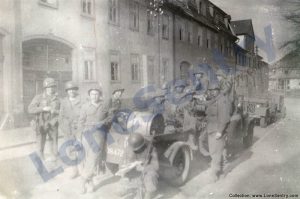
Two photographs of German transport on the Russian Front during Operation Barbarossa from the website’s photo collection.

Cars lead a column of supply trucks past a destroyed bridge:

German Transport WW2 Russian Front

© LoneSentry.com Collection

Wehrmacht staff cars behind a truck of the 3rd Waffen SS Division Totenkopf:

3rd Waffen SS Totenkopf Division Truck

© LoneSentry.com Collection

Source: LoneSentry.com Collection.
 

Panzer Wallpaper for iPad/iPhone

Panzer wallpaper for use as iPad/iPhone backgrounds — U.S. Air Force photographs from WWII showing destroyed German panzers in Europe.

Panther Tank Panzer Wallpaper Apple iPad iPhone Panther Tank Battle of the Bulge Wallpaper German WW2 Flakpanzer IV Panzer Tank Cologne Germany Stug III Assault Gun Wallpaper Tiger Tank iPad Wallpaper World War II iPad Wallpaper - German Army Tank World War 2 Tank iPad Wallpaper

Click on any wallpaper thumbnail to download the large 1024 x 1024 pixel image.

Instructions to save an image as wallpaper on the iPad:
• Step 1: When browsing the Internet in Safari on the iPad, simply press and hold on an image and a menu will appear to save the image in “Saved Photos” on your iPad.
• Step 2: On your iPad home screen or desktop, open “Settings” and then choose “Brightness & Wallpaper.” Touch that to open it, and a “Wallpaper” box will appear. Click on the “Wallpaper” box to select images from your “Saved Photos”.
 

Captured German and Japanese Aircraft

Rare color video of captured German and Japanese aircraft and rockets.


Mistel

Luftwaffe Mistel Ju-88 and Fw-190

U.S. Air Force Photo

A U.S. soldier examines a captured German Mistel aircraft created from a Fw 190 fighter mounted atop a Ju 88 bomber in May 1945. (U.S. Air Force Photo)
 

Captured FW190 Film

Russian training film on the German Focke-Wulf FW190 showing the FW190′s main features, armament, and flight performance:


Luftwaffe Uniforms

German Luftwaffe Uniforms of WWII:

German Luftwaffe WW2 Air Force Uniforms

Air Force Uniforms: Officers and Enlisted Men

German WW2 Paratrooper Fallschirmjaeger Uniform

Air Force Uniforms: Miscellaneous

Source: TM-E 30-451: Handbook on German Military Forces, U.S. War Department, 1943.
 

German Machine-Gun Trick

The following intelligence report on an unusual German remote-controlled machine-gun position encountered by U.S. troops in Normandy was published in the Intelligence Bulletin, Vol. III, No. 4, December 1944.

GERMAN MACHINE-GUN TRICK

A U.S. staff sergeant, who served as an observer for a mortar section in the Normandy campaign, reports an unusual German method of firing a machine gun by remote control. Although this method has not been reported by other U.S. soldiers, and although no concrete evidence as to its effectiveness can be presented, the idea is noted here for what it may be worth as a sample of the German soldier’s ingenuity.

German WW2 Remote-Controlled Machine-Gun Trick

German Machine-gun Trick. A close-up of the machine gun, with, its pulleys. Riflemen-observers whistle signals to the gunner, to indicate Allied approach via point A. The gunner zeroes knot A, which trains the muzzle on point A. The cord arrangement for firing is not shown here.

The sergeant tells of inspecting a captured German machine-gun emplacement, which had been prepared in the highly novel manner illustrated in the figure. A rope had been attached to the butt end of the gun. This rope ran through pulleys set up on each side of the rear of the gun, so that movement of the rope would aim the gun in any lateral direction. The gun then was zeroed at certain positions in the field of fire, and these positions were marked by knots in the rope. Thus the gunner could aim the gun, and, by moving the rope back and forth, spray an area with bullets from a position out of the line of fire when the gun was attacked. The gun was fired by a trigger-and-cord arrangement not shown in the original field sketches.

The German machine-gun crew consisted of a gunner and two or three riflemen who served as observers and who reported to the gunner the particular point on the which the gun should be trained.

This machine-gun position appears impractical at best, and may be an incorrect report. The Germans however did produce a special periscopic aiming and firing apparatus for the MG34 and MG42 machine guns. U.S. ordnance reported on this device as the “Deckungszielgerät für le. 34 u. 42 Dezetgerät: Undercover Aiming and Firing Apparatus.”
Deckungszielgerät für le. 34 u. 42 Dezetgerät: WWII Undercover Aiming and Firing Apparatus for MG34 and MG42
 

Erkennungsmarke (German Dog Tag)

From Handbook on German Army Identification, U.S. Military Intelligence Training Center, Camp Ritchie, Maryland, 1943:

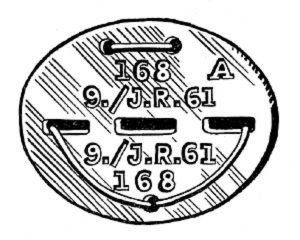
German identification tag (Erkennungsmarke).

a. It is believed that every German officer and soldier carries an identification tag, which is usually worn around the neck. The tag is made of zinc, is oval in shape, and measures about 2 by 2¾ inches. It is divided into an upper and a lower part by perforations. Each half bears identical markings.

b. When a man is killed, the lower half of the tag is broken offand sent back to Germany and the upper half is buried with the body. Identification tags captured up to the present bear only the unit, subunit, and a number. This number is also inscribed on the first page of the pay book (Soldbuch). The tag also bears a letter or two letters indicating to which blood group he belongs (A, B, AB, or O). The identification tag seldom shows the unit in which the man concerned is now serving unless he has lost the original disk issued to him on being assigned to a depot unit and his present unit has issued a replacement. The tag may record the existence of a previously unidentified unit.

c. A report should always be made of the entries on the tags.

WWII Wehrmacht Erkennungsmarke - German Dog Tag Disc

A captured identification tag of the old type. 168 is the personal number. 9th Company of the 61st Infantry Regiment. Blood group "A".

WW2 Erkennungsmarke - German Dog Tag Disc

8 is the personal number. Stb. means Staff. 7 Pz. Abw. means 7th Division Antitank Battalion. Blood group "O".

German Soldat Dogtag, Erkennungsmarke WW2 Wehrmacht

83 is the personal number. 1st Company of 111th Infantry Regiment (formerly of 87th Infantry Regiment). Blood group "O".

WWII Erkennungsmarke - German Dog Tag Disc

The new type identification tag, five-digit serial number indicates field post number which is that of the messing unit. 36 is the personal number.


Car in a Truck in a Railcar

German rail transport destroyed by Allied bombing raids in the railyards at Littorio, Italy. In an unusual combination, the Germans loaded a small car in the back of a truck which was then loaded in the railcar in the foreground.

Car in Truck in Railroad Car: Littorio, Italy

U.S. Air Force Photograph.


How Radio-Controlled Bombs Were Jammed

The following article was printed in the December 1945 issue of C.I.C. (Combat Information Center) published by the U.S. Office of the Chief of Naval Operations.

How Radio-Controlled Bombs Were Jammed

The long, violent history of this war saw the rise of many new or radically improved weapons, from the magnetic mine in the early days to the “personnel-controlled bomb” (suicide plane) of recent fame. The story of Allied countermeasures to the threat of Axis weapons is in many cases as dramatic as the weapons themselves.

Henschel Hs 293 Missile

German planes carried the radio-guided missiles under their wings.

For instance, take the case of the German radio-controlled bomb. As early as 1941 British Intelligence began receiving reports that the Germans were developing a bomb which could be remotely controlled from a parent aircraft. Development and operational use, however, are two different things, and it was not until August, 1943, that the Luftwaffe was ready to unveil it. A group of corvettes on anti-submarine patrol in the Bay of Biscay were attacked by what was identified as a remotely controlled bomb—a missile resembling a small fighter plane—capable of radical maneuvering both in azimuth and elevation. The parent aircraft were DO217 twin-engined bombers. One of the corvettes was sunk, another damaged. Later in August further highly successful attacks were made against shipping in the Mediterranean and Bay of Biscay. The bomb (designated HS293) was released by the parent plane at altitudes of 3000-5000 feet and ranges of three to five miles from the target. The missile was jet-assisted shortly after its release; its speed, variously estimated at the time, is now known to have been about 325 knots. The controlling operator in the plane was able to follow the bomb visually by observing a light in the tail.

During and immediately following the Salerno landings the German guided missile program moved into high gear. The enemy introduced another type of controlled missile, the FX, a radio-corrected 4400 pound bomb of tremendous power and accuracy, as anyone present in Salerno Gulf at that time will testify. The Luftwaffe caught units of the Italian Fleet racing to reach Allied ports and scored heavily with both HS293 and FX bombs. They attacked Allied shipping in Salerno Gulf, sinking and damaging several British and United States warships, large and small. It was estimated that nearly 50% of the bombs launched were hits or damaging near misses.

At that time radio control was suspected (on the basis of prisoner-of-war reports) but was by no means confirmed. The control hand was supposed to lie in the 20 Mc region, and desperate, hastily improvised jamming effort was concentrated in this band, which seemed to improve morale without affecting the accuracy of the missiles.

Continue reading How Radio-Controlled Bombs Were Jammed