
|
|
By Lone_Sentry_Admin, on January 15th, 2011%
The following correspondent’s report from the UP (United Press) describes the fighting at Hunt’s Gap in Tunisia in February-March 1943. Compare this account of the battle to the German commander Oberst. Rudolf Lang’s account and British observer Howard Marshall’s account.
BRITISH BOMBER SCORES AGAINST 6 GERMAN TANKS
Northern Tunisia Fighters Receiving Allied Air Support
BY EDWARD W. BEATTIE
ON THE NORTHERN TUNISIAN FRONT, March 1.—(UP)—There were six enemy tanks—big boys, probably Mark VI’s—massed north of the Mateur-Beja road when a bomber went in and dropped two bombs squarely into the middle of them.
British soldiers threw their helmets into the air and cheered. And well they might, for troops in this area never before had such air support as they are now receiving.
The British bombers caught Rommel’s supply columns in a narrow valley above. Beja Sunday. There was a thick fog lying across the valley and it was not an ideal day for bombing.
But, starting at dawn, the Allied bombers made eight sorties low into the valley and when they got through, the hair-pin road along which the Axis transport was concentrated was pock-marked with bomb craters.
Enemy Immobilized
I talked to the returning pilots and they said most of the enemy vehicles were stationary and some of them immobilized by the fury of the Allied attack.
The Germans threw an attack against Allied lines above Beja Sunday, using about 10 Mark IV tanks. British Churchill tanks rolled out to oppose them and knocked out three and perhaps four of the Mark IV’s. A heavier enemy attack may come, however, because a force of about 30 German tanks was seen just off the Beja road.
Allied air power was thrown against the Germans as early as Saturday, and ground troops then reoccupied two important positions.
The British early Saturday morning took Fort McGregor—named after a young American lieutenant from Brooklyn—south of Medjez-El-Bab. The American garrison of Fort McGregor was withdrawn some time ago.
British Surprise
The Germans took it Friday. Crack German tank forces and other elements penetrated through a dry river bed to the south. The British surprised them with a counterattack, killed 40 and captured 60.
The British reoccupied Tally-Ho corner after the Germans withdrew into the hills east of the Medjez-El-Bab – El-Aroussa road during the night. When darkness came Saturday, the British were mopping up a few remnants halfway along the road.
The attack toward Beja made little progress Saturday, and was heavily bombed and shelled. The Germans sent forces of roughly a battalion (1,000 men) through the hills between the Beja-Mateur and Beja-Medjez-El-Bab road, intending to cut around the latter around over Zarga. By Saturday night, the battalion had not been in contact with the British, although artillery had shelled the Germans heavily.
Germans Use Planes
The Germans have been using their planes liberally to attack Allied positions and shoot up transport behind the front. They attacked Tally-Ho corner three times without much result.
Roughly, it was estimated the Germans threw 13 battalions (13,000 men), with supporting troops of two divisions (perhaps 30,000 men) into the action on the northern front, but paradoxically, fighting was more restricted Saturday than the day before.
Of an estimated 50 German and Italian tanks involved, It was estimated that at least 15 to 20 have been knocked out.
By Lone_Sentry_Admin, on January 12th, 2011%
Introduction of new aircraft insignia by the U.S. Navy and Army in WWII from Bureau of Naval Personnel Information Bulletin, NAVPERS, August 1943:
This is the new airplane insignia adopted by the U.S. Navy and Army after much experimenting. The old insignia, consisting of a white star in a circular field of blue, and also the red dot of Japan and the black cross of Germany, were found to resolve into invisibility at the same distance from the eye. As they came closer, all appeared in the form of a dot. The new marking consists of the white star in the field of blue, with the addition of a white rectangle attached horizontally at the right and left of the circle, plus a red border enclosing the entire device. At a greater distance the new marking will maintain the shape of a long, narrow bar, making confusion with the enemy less likely. Navy and Army planes over the world will switch immediately.
By Lone_Sentry_Admin, on January 4th, 2011%
Marine fighter pilots during the Guadalcanal air battles from Bureau of Naval Personnel Information Bulletin, NAVPERS, August 1943:
In the Tropics: Marine Pilots Paint More Jap Flags

These Marine fighter pilots, as their score board shows, shot down 12 Japanese planes in the 7 April air battle over Guadalcanal. Thirty-nine of 50 enemy bombers were destroyed during their attack on Allied shipping. Allied losses were 6 Wildcats, an Airacobra, a destroyer, a corvette, a tanker. Talking over the victory were Lt. Arthur T. Wood, USMC, Lt. Frank B. Baldwin, USMC, and Lt. W.J. Shocker, USMC. (The Japanese bombers came escorted by 48 Zero fighters to attack United States shipping in the Guadalcanal area, and were successful in sinking a destroyer, a corvette and a tanker, and in damaging a small fuel boat. Referring to the same attack, Tokyo claimed that 1 cruiser, 1 destroyer, and 10 transports were sunk and 37 planes downed at a loss of 6 Jap aircraft.)
By Lone_Sentry_Admin, on January 3rd, 2011%
Douglas A-20 Havocs and Spitfires on a water-covered airfield in Italy during WWII. Despite the weather conditions, the airfield is still ready to be used for bomber and fighter missions against the Axis. (U.S. Air Force Photo)

By Lone_Sentry_Admin, on January 2nd, 2011%
The following XX Bomber Command combat report on Japanese fighter tactics against the B-29 Superfortress appeared in Eastern Air Command Weekly Intelligence Summary, No. 31, March 30, 1945 published by Headquarters Eastern Air Command, Southeast Asia. The report describes a variation of the “12 O’Clock Express” used by one Japanese Oscar pilot.
JAP FIGHTER TACTICS ON B-29 MISSION NO. 41 — SINGAPORE
The following account extracted from XX Bomber Command Summary #9 dated 10 Mar ’45 covering enemy tactics encountered in the B-29 raid against Singapore on 2 Mar ’45, indicates that enemy opposition in this area continued to be’ weak, and that Jap pilots were aggressive in only 26% of the attacks. High frontals were favored and a variation in the “12 O’Clock Express” was noted (see sketch). Zeke 52′s armament was reported as probably increased.
Enemy opposition was rated as weak, as on the three previous missions to Singapore, and Jap pilots did not appear to be aggressive; 45% of the enemy tactics were broken off between 250-500 yds, with only 26% pressing to within distances less than 250 yds. Encounters against the B-29s’ front quarter, where most of the action took place, were predominantly high in approach, but since the number of encounters is so small, XX Bomber Command states that probably no particular importance should be attached to this fact.
Aerial Bombing
The enemy made 11 single plane aerial bombing attacks which resulted in no damage to any of the B-29s. The closest burst occurred at 50 yds off the wing of one of our planes, while most of the bombs exploded 200-400 or more yards away from the formation. Phosphorous and fragmentation bombs were observed by crews with the former in the majority. The method of releasing bombs by Jap fighters consisted of: (1) releasing from level flight; and (2) “flipping” or “slinging”. No dive bombing encounters were reported. Coordinated attacks employed two fighters each.
Variation in “12 O’Clock Express”
One Jap attack which inflicted damage on a B-29 merits elaboration in that it was an unusual variation of the “12 O’Clock Express” and showed an exceptional degree of skill on the part of the enemy pilot. The enemy aircraft was first sighted about two miles out, very high at two o’clock. As the Jap approached to about one mile, he wagged his wings and turned in towards the B-29 at 12 o’clock in a dive. When about 1000 yards above the bomber, the Jap rolled over on his back, came in on a vertical pursuit curve, opening fire at about 500 yards. A 20mm shell went through the root of the left wing of the B-29. The dive was continued, passing within 25 yards of the B-29′s tail. The timing of the attack was exceptionally good, and the pilot almost succeeded in raking the B-29. Crews reported observing a Zeke 52 firing with six guns.

By Lone_Sentry_Admin, on December 31st, 2010%
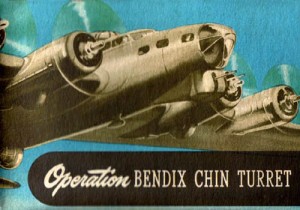
Bendix manual on the Operation and Maintenance of the Bendix Chin Turret for the B-17 Flying Fortress:
GENERAL SPECIFICATIONS
Armament Two Caliber .50 M-2 machine guns. Ammunition Capacity 450 rounds per gun.
Speed of Turret Slow speed (tracking) ¼° per second to 12° per second. High speed (slewing, with high speed button depressed) ¼° per second to 33° per second.
Weights Turret Complete (no guns or ammunition) 438 lbs. Ammunition 33 lbs. per 100 rounds. Guns 65 lbs. each.
Gear Drive Speed Reducer ratio 25-1. Azimuth gear ratio 50-1. Elevation gear ratio 42-1. Azimuth gear train reduction 1250-1. Elevation gear train reduction 1050-1.
Electrical Requirements 24 Volt D.C. Peak starting current motor amplidynes 1280 amps. Maximum current draw running full load 92 amps. Maximum current draw running no load 40 amps.

GENERAL DESCRIPTION
BENDIX CHIN TURRET
The Bendix Chin Turret Model “D” is an electrically driven power turret, mounting two caliber, .50 M-2 Machine Guns, equipped with recoil absorbing mechanism, firing solenoids, and manual gun chargers.
The turret is designed to be mounted in the Bombardier’s Compartment and to be operated by the Bombardier to protect the forward approaches to the ship. The guns rotate 172° in azimuth (86° to the left and to the right of forward) and swing from 26° above horizontal to 46° below horizontal. Switch limits are adjustable. The turret is mounted at floor level in the Bombardier’s Compartment. The guns extend below the fuselage at the nose of the ship. The lower assembly, with the exception of the gun barrels which protrude through covered slots, is enclosed in an aluminum, movable housing to minimize wind resistance. Plexiglass windshields seal the space at the floor of the ship around the turret.

Continue reading Bendix Chin Turret |
By Lone_Sentry_Admin, on December 29th, 2010%
An intelligence report on the Japanese Nakajima Ki-44 Shōki fighter (Allied codename “Tojo”) from “Eastern Air Command Weekly Intelligence Summary”, No. 31, March 30, 1945 published by Headquarters Eastern Air Command, Southeast Asia:
A crashed TOJO, examined by an ATAIU party at Meiktila airstrip, although it had been stripped of all the internal equipment and was badly damaged, revealed several facts of importance to TAI. The airframe and engine (Type 2—1450 HP Nakajima) were badly, damaged but showed no change from present information with the exception of one recognition feature. This was that the wing’s trailing edge was reported as having two straight tapers (one from root to end of flaps, and the second from this point to outboard end of aileron) instead of the gentle curve previously shown in silhouettes. The photograph above shows this.

The most interesting find was the two 40 mm cannon, one fitted in each wing. A brief report on these was given in a previous EAC WIS Summary, No. 30, 23 Mar 45, but photographs herewith, give a better idea of the mounting particulars. It is now believed that either 40 mm cannon or a 12.7 mm MG can be fitted in the wings of these TOJOs, but it is thought that the later models will all be fitted with 12.7 mm MGs, only.

Two pieces of armor were placed vertically, one behind the other, in the headpiece behind the pilot and one curved piece arranged to protect his shoulders was fitted around the curve of the fuselage. No back armor was found but mounting brackets for this were on the seat supports.
Photos by ATAIU.
By Lone_Sentry_Admin, on December 26th, 2010%
PBS’ American Experience presents The Bombing of Germany, an excellent documentary on the American and British bombing of Germany in WWII with extensive color footage and veteran interviews.
The documentary is also available on Hulu.
By Lone_Sentry_Admin, on December 24th, 2010%
Recognition features for the German Me 262 and Me 163 aircraft from “Antiaircraft Artillery Notes,” HQ ETO, No. 8, December 1944:
SUBJECT: Aircraft Recognition — Me 262 and Me 163 SOURCE: AA Section, Headquarters, Twelfth Army Group
Of the jet-propelled planes now being operated by the German Air Force, two types are appearing over the Army Group area in increasing frequency — the Me 262 and Me 163, both fighters. Provisional drawings and descriptions of both those types appeared in Twelfth Army Group AAA Notes Nos. 2 & 3. German documents captured recently by Ninth US Army included silhouettes of the Me 262 and Me 163 prepared September 1944 by the High Command of the Luftwaffe; these are reproduced in Appendix I and II of this issue. It should be noted that dimensions differ very little from those given in previous publication, but certain recognition features are considerably different.
 Me-262
Continue reading Me 262 and Me 163 Aircraft Recognition
By Lone_Sentry_Admin, on December 22nd, 2010%
WWII B-24 Liberator nose art from 864th, 865th, and 866th Bombardment Squadrons of the 494th Bombardment Group and 392nd Bombardment Squadron of the 30th Bombardment Group. Source: U.S. Air Force photographs.
 B-24 "Lady Leone" of the 864th Bombardment Squadron, 494th Bombardment Group. (U.S. Air Force Photo)
Continue reading B-24 Nose Art
|
|
Recent Comments