
During the Battle of the Bulge, the Germans disguised several Panther tanks as U.S. M10 tank destroyers (“Ersatz M10″). Part of the Operation Greif created and commanded by Otto Skorzeny, Panzer Brigade 150 deployed these Panther Ausf. G tanks which had been extensively modified and painted to resemble U.S. M10 tank destroyers.
The history of the bazooka from U.S. Rocket Ordnance: Development and Use in World War II, U.S. Joint Board on Scientific Information Policy, 1946.
Bazooka Versus Tank
Among the now-it-can-be-told weapons of the American rocket family, is the super-bazooka, bigger and better version of the foot-soldier’s famed tank-buster.
By their surrender, the Germans and Japs missed feeling the impact of a rocket which travels at almost twice the speed and carries double the explosive payload of the standard bazooka projectile; which has an effective range of as much as 700 yards, instead of the 200 to 300 yards of the regular bazooka; and which can function safely through a considerably wider temperature range, thus affording greatly increased protection against the dangers of motor explosion and blast. Though the super-bazooka retains the 2.36-inch diameter of the original bazooka, and is fired from the same launcher, it is propelled by a larger motor, and its heavier explosive charge can penetrate thicker armor plate.
Another development of the original bazooka-still secret at the war’s end-is a super-powered rocket of 3.5 inches in diameter with greatly increased power to penetrate armor plate and reinforced concrete.
The super-bazooka was the joint product of Section H, which produced the design for the motor, and Division 8 of NDRC, which developed the far more powerful head. The 3.5-inch rocket was designed by the Army Ordnance Department.
Bazooka Development
To arm United States infantry to fight tanks on more nearly equal terms, the Army Ordnance Department, in early 1941, had under development a rifle grenade, carrying a “shaped charge” of high explosive. A cone-shaped cup hollowed in the front face of the explosive filling focussed the blast energy into a narrow beam of great penetrating power.
These rifle grenades had too much recoil for field use as a shoulder weapon. Recoilless rocket propulsion was suggested, tried, and adopted. Colonel Skinner, then an Ordnance Department major, and Lt. (now Major) E. G. Uhl, with Section H at Indian Head, undertook the development of a suitable rocket motor.
Following unsuccessful attempts to launch these rocket grenades from attachments to the service rifle, it was concluded that a separate launcher would be required.
To protect the gunner from the rocket blast, the launching tube had to be longer than the maximum burning distance of the rocket motor. To be portable and easily aimed from the shoulder, the launcher, and hence the burning distance, had to be short. By the use of a charge of several thin-web tubular grains of solvent extruded powder in a motor about an inch in diameter, the burning distance was made short enough for a 54-inch launcher, soon dubbed “the bazooka.”
“Lessons Learned” by U.S. Eighth Air Force fighters against German flak taken from Light, Intense, and Accurate: U.S. Eighth A.F. Strategic Fighters Versus German Flak in the ETO, Headquarters, 65th Fighter Wing, August 1945. The booklet was the work of Lt. Col. San Souci and Capt. William D. Thurston, assisted by Lt. Col. R. F. Kennedy, Wing A-2.
CHAPTER XI: LESSONS LEARNED
In fighting back at light flak, Enemy No. 1 of our fighters in the Eighth Air Force, we all learned a great deal. Operating as we did in East Anglia in England, a tight little area crowded to capacity with strategic air units, we were ideally situated to analyze, discuss and record what we learned over a considerable period of time. Our military communications net was perhaps the finest that ever existed in any combat zone, and the exchange of information among units left little to be desired.
Some of the lessons that grew out of this particular situation are worth setting down in a list, followed in Chapter XII by recommendations based on our experience:
1. Specialization in Fighters is a Myth. Anyone using fighters in a strategic air force might just as well make up his mind in the beginning that before it’s over his pilots will come up against every type of defense the enemy has. It was an error in the early days in the ETO to assume that high-level escort fighters would not be bothered by light flak. Ultimately we had to prepare to meet it, and we should have started sooner than we did.
2. Photo Interpretation is Reliable in Locating Flak. Our own experience as we went along, and investigations on the ground in Germany after the war, both proved that the flak defenses pin-pointed by photo reconnaissance were over 90% correct.
3. Reconnaissance Must be Continuous. It is obvious that frequent photos of every area reached by the strategic air force are absolutely essential in order to keep abreast of the fluid flak situation.
Front and rear views of the M55 quad .50 cal. mount and trailer from ORD 7SNL G-220: Organizational Spare Parts and Equipment for Mount, Trailer, Multiple Cal. .50 Machine Gun, M55, Ordnance Supply Catalog, Headquarters, Army Service Forces, June 1945.
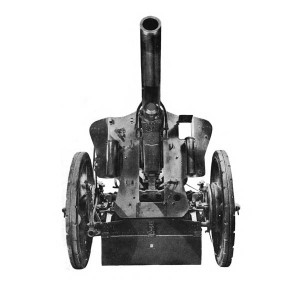
Three views of the German 105-mm howitzer (10.5 cm leFH 18, leichte FeldHaubitze) from the U.S. War Department technical manual TM E9-325A: German 105-mm Howitzer Materiel, June 1944.
German 105-mm Howitzer and Carriage, Firing Position
Instruction for demolition of the 155-mm gun M2 from the WWII U.S. War Department Technical Manual TM 9-350: 155-mm Gun M2; Carriage M1 and M1A1, Gun Mount M13; Heavy Carriage Limber M2 and M5; and Firing Platform M1, May 1945.
DEMOLITION TO PREVENT ENEMY USE
34. GENERAL.
a. The destruction of the materiel, subject to capture or abandonment in the combat zone, will be undertaken by the using arm only on authority delegated by the division or higher commander as a command function when such action is deemed necessary as a final resort to keep the materiel from reaching enemy hands.
b. Adequate destruction of artillery materiel means damaging it in such a way that the enemy cannot restore it to usable condition in the combat zone either by repair or by cannibalization. Adequate destruction requires that:
(1) Enough parts essential to the operation of the materiel must be damaged.
(2) Parts must be damaged beyond repair in the combat zone.
(3) The same parts must be destroyed on all materiel, so that the enemy cannot make up one operating unit by assembling parts from several partly destroyed units.
c. The tube and breech are the most vital parts of any piece of artillery. These are the first things to damage. After the tube and breech in importance come the recoil mechanism, sighting and fire control equipment, carriage, tires, gun book, and firing tables.
35. METHODS.
a. General.
(1) The destruction procedures outlined are arranged in order of effectiveness. Destruction should be accomplished by method No. 1, if possible. If method No. 1 cannot be used, destruction should be accomplished by one of the other methods outlined, in the priority shown.
(2) Whichever method is used, the sequence outlined must be followed. Uniformity of destruction will then be obtained, whether or not the method is carried to completion.
(3) Certain of the methods outlined require special tools and materials, such as nitrostarch and incendiary grenades, which may not be items of issue normally. The issue of such special tools and material, the vehicles for which issued, and the conditions under which destruction will be effected are command decisions in each case, according to the tactical situation.
(4) SIGHTS. Detach all optical sights. If evacuation is possible, carry the sights; if evacuation is not possible, thoroughly smash the sights.
b. Method No. 1 — destruction of tube, breech, and recoil mechanism.
(1) Open drain plug on recoil mechanism, allowing recoil fluid to drain. It is not necessary to wait for the recoil fluid to drain completely before firing the cannon in step (4), below.
(2) Place an armed (safety pin removed) antitank grenade M9A1, HE, or armed (safety pin removed) antitank rocket M6 in the tube with the nose end toward the rear. The grenade or rocket must be centered in the tube, using a wooden adapter. An alternate for the wooden adapter is the use of waste.
(3) Insert an unfuzed HE complete round or HE shell with propelling charge into the cannon and close the breech. Base-detonating HE shell cannot be used in this method.
(4) Fire the cannon, using a lanyard at least 100 feet long. The person firing should be under cover to the rear of the piece and approximately 20 degrees off the line of fire. Elapsed time: Approximately 2 to 3 minutes.
(5) The danger zone is approximately 500 yards.
c. Method No. 2.
(1) Insert TNT blocks in the bore, near the muzzle and in the chamber of the cannon. Close the breechblock as far as possible without damaging the safety fuse. Plug the muzzle tightly with earth to a distance of approximately 3 calibers from muzzle. Detonate the TNT charges simultaneously. Thirty to fifty half-pound blocks will be needed for effective demolition. If it is not possible to plug the bore, a larger number of TNT blocks will be needed for effective demolition.
(2) Ram an HE shell (without base fuze) into the forcing cone and place TNT blocks behind it, as specified above. Close the breechblock and detonate the TNT charge. A sufficient length of safety fuse should be used to permit personnel to reach safety zone or cover. The fuse may be routed through the primer hole in the spindle.
(3) Attention is invited to the fact that, for the larger calibers, the number of blocks to be used is an estimate not proved by tests.
d. Method No. 3.
(1) Place unfuzed incendiary grenades M14, on their sides, one on top of another, in the chamber. Close the breech. Equip another incendiary grenade with a 15-second safety fuse, ignite, and toss it in the muzzle. Quickly elevate the cannon to its maximum elevation. Elapsed time: 3 to 5 minutes. Six to eight grenades per cannon are required.
(2) The metal from the grenades will fuse with the interior of the breechblock, making it impossible to open the breech.
e. Method No. 4.
(1) Fire adjacent guns at each other at point-blank range, using HE or AP shells. Two or more direct hits from a weapon of the same caliber, on a vital spot such as the breech mechanism, recoil mechanism, or tube should adequately destroy the artillery piece. Fire from cover. Danger space is from 200 to 250 yards.
(2) Destroy the last gun and carriage by the best means available.
(3) Danger from cannibalization is inherent in this method.
f. Ammunition. Instructions for demolition of ammunition are contained in TM 9-1901.
“The Flying Bomb” from C.I.C. (Combat Information Center), U.S. Office of the Chief of Naval Operations, August 1944.
the flying bomb
The pilotless airborne bomb which was first used by the Germans on June 13, has been officially designated as the “Flying Bomb”. (Newspapers have referred to it also as “Doodle Bug” and as “Buzz Bomb”.)
This weapon, known to the Germans as V-1, appears to be one answer to Allied air supremacy in the Channel area. While the inaccuracy of the missiles as used to date is such as to make it impossible to assign specific military targets as objectives, approximately 35 percent of the bombs have landed in the London area causing considerable damage to non-military installations.
The bomb, as may be seen from the illustration, is of relatively simple construction and apparently designed for mass production.
From an examination of fragments and parts of unexploded bombs recovered in England, it has been possible to determine the method of operation. The bomb is originally launched from an inclined ramp on the mainland, by means not yet determined, at an initial speed of approximately 270 miles per hour and continues under the drive of the jet propulsion motor which operates as a result of the increased pressure developed on the forward side of the air intake grill by the high speed of the missile.
A clockwork mechanism which precesses the gyro normally under control of the magnetic compass allows the bomb to be put into a turn within three minutes after launching. The maximum duration of the turn is one minute and corresponds to about 40° in azimuth. After being put on course by this method, the missile flies in a straight line under control of the magnetic compass which precesses a gyro controlling a servo motor actuated by air pressure from two high pressure air bottles located in the fuselage. The gyro is further precessed by a barometric capsule which can be preset for any desired altitude up to 10,000 feet. A small two-bladed propeller, 10 centimeters long, mounted on a shaft geared to a veeder counter, registering to 9999, constitutes an air log. By pre-setting the counter, which is turned backwards during flight, the electrical fuse can be armed, the radio transmitter turned off, and the detonators in the tail assembly exploded. The radio transmitter, which appears in approximately one out of every twenty missiles, is provided in order that shore D/F stations may obtain fixes on the bomb for the purpose of correcting errors in flight. A prisoner of war has reported that the fix must be obtained and telephoned to the control central within ten seconds in order to insure sufficient accuracy. The detonators in the tail assembly operate at a pre-determined time prior to the end of the flight, shutting off the fuel supply and causing the elevators to operate and put the plane in a dive. At the same time, two small spoilers of different sizes are projected from the surfaces of the elevators presumably causing the plane to spin in.
Some instances have been reported in which the plane glided in to the target after the motor had stopped instead of diving. Later reports have indicated that some of the bombs circle before going into a dive. The exact reason for this is not known. but it is assumed that it is for the purpose of obtaining a fix as a check on the accuracy of the flight.
Countermeasures to date have consisted of:
a. Bombing launching sites.
b. Destruction of missiles by fighter planes.
c. Destruction of missiles by antiaircraft fire.
d. Use of barrage balloons.
On one instance a fighter pilot who had run out of ammunition succeeded in crashing a bomb by tipping it over with his wing tips.
A summary of the results of the flying bomb attacks on England (as excerpted from Prime Minister Churchill’s address of July 6th) appears in “German Flying Bombs” in the July 12, 1944 issue of The O.N.I. Weekly.
Side and rear views of the M51 quad .50 cal. mount and trailer from ORD 7 SNL G-217: Organizational Spare Parts and Equipment for Carriage, Multiple Cal. .50 Machine Gun, M51, Ordnance Supply Catalog, Headquarters, Army Service Forces, October 1944. The M51 was composed of the M17 trailer and the M45 multiple .50 cal. mount.
Recent Comments