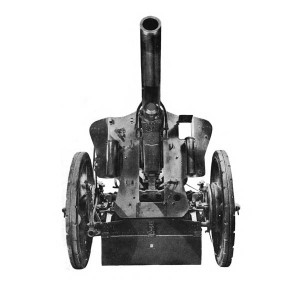

WWII 105mm Howitzer M2A1 from AFV Club

Further artwork and details have been released by AFV Club on their upcoming 1/35th scale release of the U.S. WWII 105mm Howitzer M2A1 & Carriage (Kit No. AF 35160).

U.S. M2A1 105-mm Howitzer World War II
 

German Air Tactics Against Ground Targets

Statistical analysis of Luftwaffe air attacks on ground targets in the Third U.S. Army from Antiaircraft Artillery: A Brief History of Operations in Europe, 1 August 1944 to 8 May, 1945, Third United States Army.

German Air Tactics Against Ground Targets in the Third U.S. Army Area

1. Prior to the allied landings of the continent, 6 June 1944, a great deal already was known of the tactics of the German Air Force in attacking ground targets. Attacks of appreciable size had occurred in Italy and Sicily and along the North African coast, and some time had been devoted to their study. Targets of opportunity in forward areas received 63% of attacks, highways and bridges received but 4% of attention, and ports and harbors, airfields and ammunition dumps received 33%, 55% of attacks were by dive-bombing, 20% level-bombing, 10% strafing, 12% unknown, and 3% reconnaissance flights. Bombers made much use of cloud cover and the blinding effect of the bright sun in making their approaches to the target areas. In brief, strong, close-in defenses of all vital objectives seemed dictated by past Luftwaffe performances, with forward zones of divisions, and roads and bridges being of prime importance. An adequate alert status and an efficient warning system were necessary to guard against surprise.

2. Experiences in Italy were, to a certain extent, repeated during the course of Third U.S. Army’s operations on the continent from 1 August 1944 to 8 May 1945. Thus, during periods of rapid and threatening advance, armored spearheads were continually attacked by large numbers of low-flying aircraft which attempted to blunt their thrusts. As rivers were reached, emphasis turned to attacks upon the bridges and crowded bridge areas. It the air effort was particularly large, much of it spilled over into troop and artillery areas of infantry divisions following the armor. Little if any air activity was encountered behind corps rear boundaries during such times. Sole large-scale exception to this was during the initial break-through drive of Third U.S. Army’s VIII Corps down the Cotentin Peninsula. During that period, from 1 August to 12 August 1944, the GAF made a frenzied effort that struck night and day not only at the spearheading armor and motorized infantry, but at bridges, road defiles, dams and antiaircraft behind them up and down the historic Avranches supply route Thus, targets were chosen because of their vital importance, and merely vulnerable targets, such as supply dumps, airfields, and the like were left almost untouched.

3. During periods of comparatively little forward movement, such as occurred along the Moselle River in France, there were few attacks made but, weather permitting, reconnaissance was flown almost daily over division and corps zones while some nuisance strafing and bombing of artillery positions occurred.

Continue reading German Air Tactics Against Ground Targets

143rd AAA Gun Battalion

143rd AAA Gun Battalion in WW2The website Army Book of Memories tells the story of the 143rd AAA Gun Battalion during WWII from training through the fighting in the Ardennes Offensive and on to V-E Day. The website also includes photographs and a copy of the rare 143rd AAA’s unit history booklet which was published in 1945 after the end of the war.


Employment of AAA in Anti-tank Role

A report on the activities of antiaircraft gun battalions in the antitank role during the Battle of the Bulge reproduced from “Antiaircraft Artillery Notes,” HQ ETO, No. 15, January 1945:

Subject: Employment of AAA in Anti-tank Role
Source: AA Section, Headquarters Twelfth Army Group

During the recent German Ardennes offensive the 110th and 143rd AAA Gun Battalions, and Battery D, 639th AAA AW Battalion, were placed in anti-tank support of the 30th Infantry Division, in the Malmedy-Stavelot-Stoumont sector. The Division has submitted a report of the activities of these units, and made recommendations for future employment of AAA in an anti-tank role, (See ETOUSA AAA Notes No. 14 for a detailed account of the activities of the 143rd AAA Gun Bn during this action.)

Report of 30th Infantry Division

a. The above listed units were attached to the Division at 210030A December 1944. Prior to daylight of the 21st, liaison was established with the Division by the 11th AAA Group, and by each of the attached units. Upon the arrival of these representatives they were given maps of the area and were fully informed of the tactical situation. A map reconnaissance was made, and officers from the supporting tank destroyer battalion accompanied the antiaircraft officers on their ground reconnaissance, and assisted in the actual placing of their guns in firing positions.

Continue reading Employment of AAA in Anti-tank Role

OP and CP Security

Observation post and command post security from Combat Lessons, No. 7:

U.S. Army WW2 Observation Post

OP and CP Security

Even at this late date, needless casualties, delays, and expenditures of effort are being caused by breaches of OP and CP security rules. The inevitable results of security carelessness are pointedly illustrated by the three following incidents.

Carelessness Costs Lives

Reported by Technician Fifth Grade Ernest J. Langle, 135th infantry: “We stayed in one CP for 2 weeks without drawing a shell and felt quite secure, for we had been told that the enemy hadn’t been shelling in that particular vicinity for the past 30 days. Eventually, however, a few of the men either forgot or disregarded their instructions. They washed some white towels and shirts and hung them out to dry—an effective signal for enemy artillery fire upon our CP. Three of our men were killed in the shelling that followed this breach of security.”

Learning Security the Hard Way

Reported by an Infantry Battalion Commander, ETO: “After being shelled out of two CP locations (the first time with severe casualties) we reorganized a sadly depleted CP group and opened for business in another building. A third-story battalion OP in the same building could be reached only by passing a large open window on a stair landing. Since the entire village was under enemy observation and direct fire, it was necessary to crawl past this open window. To insure that this would be done, a sentry was stationed in the stairway. All went well until it was discovered that the Sergeant Major had just covered the opening with a huge sheet of tin ‘so that the sentry could be released for work with the wire team.’ We abandoned the CP in haste and moved to an already established alternate CP (the only remaining location in the town). The last men had hardly left the building before it was taken under direct artillery fire and rapidly disintegrated.

“This incident thoroughly impressed our personnel with the folly of signalling OP and CP locations to the enemy by altering the outward appearance of a building after occupancy. That particular error was not repeated.”

One Mistake Is Too Many

Reported by the Commanding General, 1st Infantry Division: “Officers visiting front-line units should be warned against actions that might reveal to the enemy the locations of our installations.

“In one case, an observation post was located in a wrecked building. Inside walls of the rooms had been camouflaged to give a dark background, instruments had been set well back in the rooms, the observers were careful to move about only in the shadows. All went well until the day when some visiting officers stopped by. They moved about freely, even leaning out of the windows with their field glasses. Within half an hour, the building was completely destroyed by enemy fire. One of our observers was killed.”

Officer Observation Post

You sure have a fine view from this OP, Sergeant.


Triple 20mm “Drilling” Flak on Railcar

Drilling Triple 20mm Train Railcar M.G. 151 20-mm Flak

German Light Flak Car Carrying Two Triple-20-mm Gun Mounts, Each Sheltered Behind Concrete Walls 3 Feet Thick.

Source: Light, Intense and Accurate: U.S. Eighth A.F. Strategic Fighters Versus German Flak in the ETO, 1943-1945
 

120mm Granatwerfer 42 Mortar

U.S. troops demonstrate a captured Granatwerfer 42 (12cm GrW 42) German heavy mortar on the First Army Front in Echtz, near Duren, Germany.


Artillery Against Siegfried Line Pillboxes

The following combat report by the 258th Field Artillery Battalion described the effect of short-range 155-mm artillery fire against the pillboxes of the Siegfried Line.

HEADQUARTERS, 258TH FIELD ARTILLERY BATTALION

APO 230, U.S. Army
5 October 1944

SUBJECT: Destruction of concrete pillboxes by short range fire from M12, 155mm Gun, SP.
TO: Commanding General, XIX Corps, APO 270, U.S. Army

1. Between 26 September 1944 and 2 October 1944 this battalion was assigned to the mission of methodical destruction of all pillboxes which could be located on the front or immediate flanks of the impending attack on the Siegfried Line by the 30th Division.

2. During this period intensive aerial and ground reconnaissance, in conjunction with aerial photo study, revealed 49 pillboxes as potential observable targets.

3. Of this number 43 were attacked by short range M12 fire, 1 by direct fire and 2 by 3″ guns of Co A, 823d TD Bn. M12 adjusted using fuze delay, switching to T105 fuze on obtaining the first target shot. The TD company commander fired using one gun, direct laying, firing both HE with fuze CB, and armor piercing shot. Evidence of penetration was obtained on all 46 targets above. For details of each mission, see accompanying annex.

4. Firing was terminated only on evidence that a penetration has been obtained. It has not yet been possible to verify by close-up examination of the targets whether penetration was accomplished in every instance.

Continue reading Artillery Against Siegfried Line Pillboxes

Economical Shooting

Report on a single lucky 40mm shot from “Antiaircraft Artillery Notes,” HQ ETO, No. 15, January 1945:

Subject: More Economical Shooting
Source: AA Section, Headquarters Twelfth Army Group

The 445th AAA AW Bn (M) claims to have at least tied the world’s record for low ammunition expenditure when one of its gun crews shot down an FW 190 on 1 January with one round of 40mm. The plane came over a heavily wooded area at high speed. Because of the limited field of fire, the gun section was able to fire only one round of 40mm ammunition. The shell hit the fuselage behind the cockpit. Fire broke out immediately, and the plane turned off course, out of control. Front line observers saw the plane crash a few seconds later.


Japanese Rockets and Launchers

The following U.S. intelligence report on Japanese spin-stabilized rockets and launchers was published in Enemy on Luzon: An Intelligence Summary:

ARMY 20-CM SPIN STABILIZED ROCKET AND TYPE 4 LAUNCHER:

Several of these projectiles, the first Army rockets recovered, and the Type 4 launcher, were used against our troops in the Manila area and east of Manila. The date of manufacture, late 1944, emphasized the trend toward increased use of rockets by the enemy.

In general appearance the launcher was similar to a large trench mortar. It incorporated traversing mechanism in the bipod and employed standard mortar fire-control devices. The tube, 20.3-cm inside diameter and 75 and 5/8 inches long, was open at both ends and contained a hinged opening for insertion of the rocket. It was fired with a 25-foot lanyard attached to a pull igniter.

Japanese WWII Army 20-cm SS Rocket and Type 4 Launcher

Army 20-cm SS Rocket and Type 4 Launcher

The explosive head was a thin-walled tube containing nose fuze, booster and filling of cast TNT. The motor threaded onto the explosive head and was equipped with six nozzles canted 25 degrees. The propellant was ballistite ignited by a black powder charge located just forward of the igniter, which screwed into the motor base plate. Projectile and motor had a combined weight of approximately 185 pounds.

Japanese WW2 Army 20-cm SS Rocket and Type 4 Launcher (Firing)

Army 20-cm SS Rocket and Type 4 Launcher (Firing)

The rocket was stable in flight, exploded high order, and had an approximate range of 3,200 yards at 800 mils.

Continue reading Japanese Rockets and Launchers