Published on
January 10, 2010 in
German.
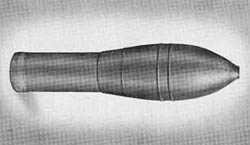
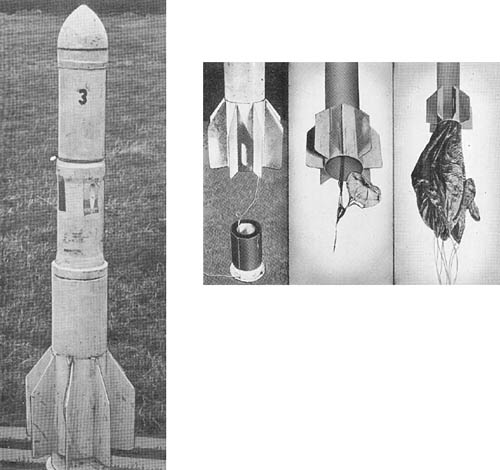
This is an antiaircraft rocket projectile containing a parachute to which is attached a length of cable, designed for use in large numbers to form a barrage against low flying aircraft. The projectile consists of four parts: nose piece, propellant chamber, parachute housing, and cable housing and tail unit.
The nose piece is ogival in shape and screws onto the forward end of the propellant chamber. It contains a TNT destructive charge, weighing approximately 2.3 pounds, and initiated by means of a delay fuze connected to the propellant chamber.
This is a steel cylinder closed at the forward end and threaded externally at the rear end to fit into the parachute housing. Four drillings in the forward end of the parachute housing form the venturi through which the propelling gases escape.
At the forward end of the parachute housing is a TNT charge, weighing approximately 2 pounds. Below this charge are located the main and pilot parachutes which are attached to the forward end of the cable. The cable housing is constructed in two parts, the lower of which remains on the ground when the rocket is launched. The upper portion has a finned tail unit which fits over the lower portion of the cable housing. The 1/8-inch cable, attached at its forward end to the parachute, is coiled the length of the cable housing and passes through a hole in the lower portion to a ground anchor.
After launching, the projectile continues upwards until the whole of the cable has been uncoiled; the parachute is then pulled out of the parachute housing and remains suspended in the air until dragged to earth by the weight of the cable. The rocket casing continues in flight until a delay igniter initiates the destructive charge in the nose of the projectile.
SPECIFICATIONS
| Total weight (approx.) |
|
150 lbs. |
| Weight of parachute housing (containing parachutes and H.E. charge) |
|
28 lbs., 1 oz. |
| Weight of fins and cable housing |
|
90 lbs, 4 ozs. |
| Weight of nose (containing H.E. charge) |
|
4 lbs., 12 ozs. |
| Weight of rocket motor unit |
|
27 lbs., 11 ozs. |
| Weight of propellant charge |
|
11 lbs., 10 ozs. |
| Length of projectile (overall) |
|
58.2 ins. |
| External diameter (maximum) |
|
7.09 ins. |
| External diameter of motor tube |
|
5.51 ins. |
| Internal diameter of motor tube |
|
5.2 ins. |
| Length of propellant charge |
|
11.7 ins. |
| Length of cable (approx.) |
|
950 yds. |
| Diameter of main parachute |
|
11 ft. |
| Diameter of pilot parachute |
|
6 ins. |
German: p. 356.1 (May 1, 1945)
Published on
January 10, 2010 in
German.
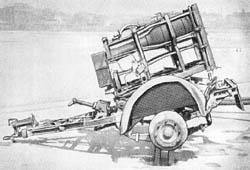
This rocket is packed in a wooden crate from which it may be fired in the same manner as the 28 cm rocket described on page 354. It is also fired from a rocket projector consisting of six welded metal frames mounted on a two-wheeled, split trailed carriage described on page 350.
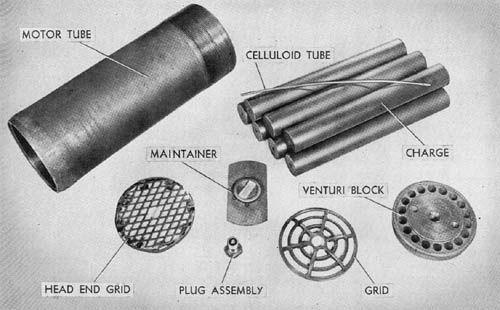
This model has been selected to illustrate the construction of the motor assembly of a typical rotating rocket. The motor tube is 0.43 inch thick, closed at one end, and threaded inside to take the venturi block. Eighteen venturis are drilled in this solid block. The throat diameter of each venturi is 0.365 inch with an exit section of approximately 0.82 inch in diameter. The axes of the venturis are inclined at an angle of 12° 42′ so that the effluent gases cause the round to rotate. A threaded hole in the center takes the primer unit.
Seven tubular sticks make up the propellant charge composed of nitrocellulose and diglycol dinitrate.

The sticks are supported at the venturi end on a grid. The center stick contains a length of quickmatch in a celluloid tube, and ending in a primed maintainer pellet. A small primer unit screwed into the steel venturi plug flashes directly on to the gun powder pellet at the end of the celluloid tube.
This motor unit is similar to that of the 15 cm Wurfgranate. However, because of the heavier charge in the 30 cm ammunition, the metal mesh has been introduced to prevent the maintainer pellet from being crushed by the central stick of the propellant charge if the rocket is dropped.
SPECIFICATIONS
| Weight of filled motor unit |
|
129 lbs., 10 ozs. |
| Weight of filled bomb |
|
146 lbs., 4 ozs. |
| Weight of propellant charge |
|
33 lbs., 3 3/4 ozs. |
| Length (overall) |
|
47 ins. |
| Length of bomb |
|
28.5 ins. |
| Length of motor tube |
|
22.5 ins. |
| Diameter of bomb |
|
11.8 ins. |
| External diameter of motor tube |
|
8.56 ins. |
| Length of propellant charge |
|
18.4 ins. |
| Burnt velocity |
|
754 f/s |
| Range, maximum |
|
4,976 yds. |
German: p. 354.1 (June 1, 1945)
Published on
January 10, 2010 in
German.
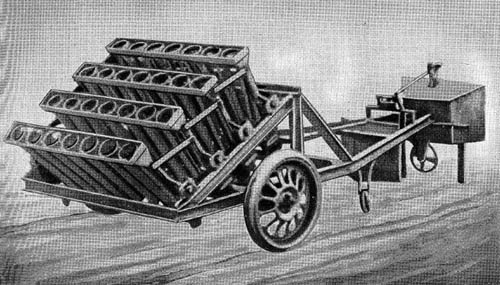
This projector consists of 28 projector rails mounted in four rows of seven each, at the forward end of a long, low carriage. The projectors are constructed of welded T-section steel bar. Each row is a separate assembly, and is bolted to an inclined welded steel superstructure built above the carriage. The projectors are displaced from the center both for line and elevation to give dispersement of fire. Each row is fired as a unit by means of a bar provided with a firing hammer and striker for each projector. Each of the four bars may be separately cocked, and all may be fired by one pull of the firing cable from the central point.
The carriage consists of a framework of U-section steel extended well to the rear, where it terminates in a protected control point containing the elevating handwheel, the firing cable, and two handgrips for traverse. A 1 cm thick (0.39 inches) protection shield is provided. There are two metal-rimmed, rubber sprung detachable wheels 27 inches in diameter. The equipment can be traversed about a fixed center pivot or about its wheels. The center pivot is locked into a bracket welded to the center of the axle-tree and rear support is provided by two steel rollers welded on the under side of the carriage.
Each row of projectors is independently trunnioned and all four are elevated together by means of a linkage through a chain drive from the handwheel.
SPECIFICATIONS
| Overall length (approx.) |
|
14 ft. |
| Overall width |
|
5 ft., 11 ins. |
| Track (wheel center to center) |
|
5 ft., 7 7/8 ins. |
| Width of each projector frame |
|
49 ins. |
| Depth of each projector frame |
|
5 3/4 ins. |
| Maximum height (above center pivot platform) |
|
3 ft., 4 ins. |
| Maximum height (on road wheels) |
|
4 ft., 5 ins. |
| Elevation (approx.) |
|
55° |
| Depression (approx.) |
|
4° |
German: p. 352.3 (August 1, 1945)
Published on
January 10, 2010 in
German.
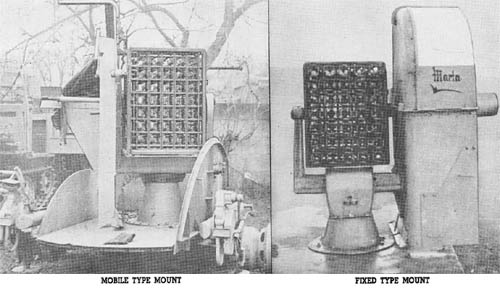
This multiple rocket launcher, used for antiaircraft barrage purposes and known as the “Föhn” is of different design from any other weapon of its type used by the Germans. Launching sites were located along river fronts, indicating the use of this weapon against river crossings. There are 35 individual launchers, each 31 inches long and approximately 7.3 cm square, assembled in 5 horizontal and 7 vertical rows. The rockets are fired by hammer type firing pins mounted on horizontal shafts. All 35 of the pins are actuated by a single trigger. The whole assembly measures 32 inches from top to bottom, and 23 inches from side to side. A simple clamp at the rear of the racks holds the rockets in position until firing takes place. The frame of the assembly is made of 3/16-inch metal.
A trunnion, set in each side of this framework, rests upon arms extending up from the pedestal base. The weapon, with its pedestal base, is used with either a mobile or fixed mount. When used as a mobile mount, the launcher is fitted with a circular metal folding platform mounted on a 2-wheeled trailer. The fixed launchers are not provided with the folding platform, and it is believed that they are normally set up more or less permanently on sheet iron platforms.
The sight, trigger mechanism, and elevating and traversing mechanisms are mounted on the inside of a metal protective shield located on the left side of the launcher. Elevation is from -10° to 90°. The upper part of the front wall of the shield is made of transparent plastic for sighting purposes.
The 7.3 cm Raketen Sprenggranate, used with the launcher, is a spin stabilized rocket fitted with a nose percussion fuze and a self-destroying delay element ignited by the burning propellant.
SPECIFICATIONS
| Traverse | |
360° |
| Elevation | |
90° |
| Depression | |
-10° |
| Ammunition | |
|
| 7.3 cm R. Sprgr. (H.E.) | |
|
| Weight of complete round | |
6 lbs. |
| Weight of propellant | |
1.19 lb. |
| Weight of explosive charge | |
0.62 lb. |
| Type of explosive | |
“95″ |
| (RDX/TNT/WAX = 55/40/5) |
German: p. 352.2 (August 1, 1945)
Published on
January 10, 2010 in
German.
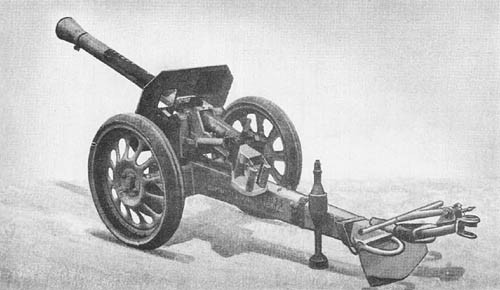
The piece is aimed by grasping two handles fitted to the left rear of the cradle and aligning the open sights on the target. The rear sight is adjustable from 180 to 700 meters.
The launcher fires from a closed breech which is operated by a handle on top of the breech ring. Opening of the breech cocks the hammer which is held in firing position by a sear. When the projectile has been inserted and the breech closed, a squeeze of the right handle depresses the sear, releasing the hammer. A safety device fitted to the left of the firing pin in the center of the breechblock must be turned to “F” position before the launcher can be fired. An additional safety feature prevents the hammer from striking the firing pin unless the breech is fully closed. The small shock of recoil developed by the rocket gases against the closed breech is transmitted directly to the spade.
Ammunition used with the rocket launcher is a modified version of the 8.8 cm rocket projectile, having a percussion primer instead of the electric type. The rocket is fitted with a base plate with a protruding rim to seat the round in the tube. The base plate and primer are the only parts of the round which are extracted after firing.
SPECIFICATIONS
| Caliber | |
88 mm (3.46 ins.) |
| Weight (firing position) | |
315 lbs. |
| Length of weapon (overall) | |
9 ft., 9 ins. |
| Length of barrel | |
63 ins. |
| Height (traveling position) | |
2 ft., 11 ins. |
| Height (on segments) | |
1 ft., 7 1/8 ins. |
| Width (overall) | |
3 ft., 4 ins. |
| Length of bore | |
| |
| No. of grooves | |
| |
| Width of grooves | |
| Smooth bore |
| Depth of grooves | |
| |
| Width of lands | |
| |
| Muzzle velocity | |
460 f/s* |
| Max. range (horizontal) (limited by sight) | |
765 yds. |
| Rate of fire |
| Traverse on wheels: Right (max.) | |
28° |
| Left (max.) | |
28° |
| Traverse on firing segments | |
360° |
| Elevation | |
23° |
| Depression | |
14° |
| Length of recoil | |
none |
| Ammunition | |
8.8 cm R. Pz. B. Gr. 4312 |
| Wt. of projectile | |
5 lbs., 13 ozs. |
*Not verified.
German: p. 352.1 (August 1, 1945)
Published on
January 3, 2010 in
German.
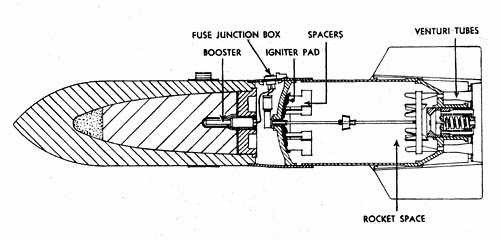
The German 1,000 kg. (actual wt. 2,176 lb.) armor-piercing bomb (PC 1000 Rs) is a rocket-propelled type designed primarily for use against ships or similar targets The rocket, which is used to increase terminal velocity and armor penetration qualities of the bomb, consist of 19 sticks of propellant contained in a separate compartment at the base of the bomb. Gases generated by the propellant escape from the rocket container through six propulsion venturi tubes which are sealed with pitch until combustion is effected. The compartment is provided with a spring-loaded pressure release valve at the base. It is reported that the minimum height for release is 4,000 ft., and that the rocket burns for approximately three seconds after ignition, leaving a trail of flame 150 ft. long.
The bomb which is filled with alternate layers of good and poor quality TNT, and a very pure cast TNT in an aluminum container in the nose, is fuzed through the baseplate. A charging head, located in a distance piece between the bomb and the rocket container, has a junction box with connections leading to a pyrotechnic and an impact fuze through two pin plugs. These plugs are colored black and red respectively. The pyrotechnic fuze has a 2 1/2-second delay, and consists of an igniter bridge (which functions when an electrical impulse from the charging plate is received at the time of the bomb’s release), and a pyrotechnic train calculated to give a safe interval between the time of release and ignition of the rocket element.
The bomb fuze, of the electrical impact type, is also armed by the electrical impulse from the charging head.
There are three other bombs of the same general type: PC 500 Rs; a lighter version of the PC 1000 Rs; PC 1000 Rs Ex, for practice or experimental use (it has no main filling, no baseplate or bomb fuze and the weight is made up by the extra thickness of the bomb casing); and the PC 1800 Rs.
SPECIFICATIONS
| Total weight | | 2,176 lbs. |
| Weight of case | | 1,470 lbs. |
| Weight of explosive | | 119 lbs. |
| Overall length | | 7 ft., 2 3/4 ins. |
| Length of bomb | | 3 ft., 9 ins. |
| Diameter of bomb | | 1 ft., 3 1/2 ins. |
| Diameter of tail fins |
| Large | | 2 ft. 4 ins. |
| Small | | 1 ft., 10 ins. |
| Dimensions of Propellant |
| 6 22 1/2 ins. long x 2 15/16 ins. diameter |
| 12 20 7/8 ins. long x 2 15/16 ins. diameter |
| 1 11 1/4 ins. long x 2 15/16 ins. diameter |
| Filling | | T.N.T. |
| Color | | Sky-blue |
German: p. 316
Published on
January 3, 2010 in
German.
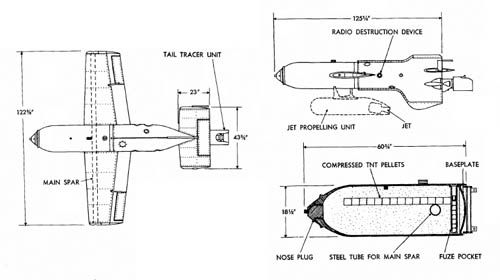
The German high explosive bomb, H. s. 293, is a radio-controlled, jet-propelled glider, designed primarily for use against merchant ships and naval craft. It is usually released when the plane is in level flight at an altitude of from 3,000 to 5,000 feet, and at a distance of from 3 to 5 miles from the target. However, the bomb is not launched directly at the target, but is released during flight on a course parallel to that of the target. Upon release, the jet propulsion automatically goes into action, and thereafter the flight of the bomb is controlled from the airplane by radio. It is apparently aimed by eye alone and, as an aid to visibility, the tail is provided with flares and an electric lamp for night use.
H. s. 293 is made up of six main parts: the bomb which forms the forward part of the fuselage; the rear portion of the fuselage containing the radio control unit, a gyro, and a destructor; the jet propulsion unit (slung from the base of the bomb); the wings, or planes; the tail plane; and the tail tracer unit. The bomb case is of forged steel and is filled with approximately 600 pounds of 60/40 poured Amatol. A cylinder of compressed T.N.T. pellets lies in this filling, running forward from the fuze pocket. The control unit consists of a radio receiver, a motor generator, and a relay unit. A radio destruction device is located directly under the radio receiver and consists of a small charge with a clockwork fuze.
Propulsion is accomplished by means of a bi-liquid rocket unit. Wings and tail planes are of aerofoil section and the skin is of thin sheet alloy. Ailerons are provided for lateral control, and an elevator is concealed in the tail plane. Five flare candles burning consecutively make up the tail tracer unit.
SPECIFICATIONS
| Overall length | |
148 ins. |
| Length of bomb | |
60 3/4 ins. |
| Diameter of bombV18 1/2 ins. |
| Total weight (approx.) | |
1,980 lbs. |
| Span of mainplanes | |
122 5/8 ins. |
| Span of tailplanes | |
43 3/4 ins. |
| Diameter of jet-propulsion unit (approx.) | |
12 ins. |
| Weight of bomb (approx.) | |
1,320 lbs. |
| Color | |
Sky-blue |
German: p. 315
Published on
January 3, 2010 in
German.
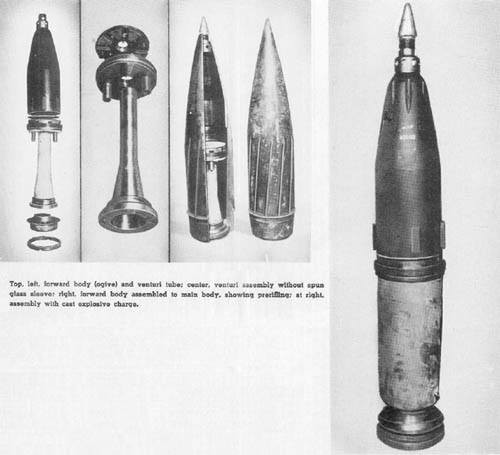
This high explosive projectile is fired from the 28 cm K. 5 (E) railway gun, and is prerifled in the same manner as the 28 cm Gr. 35 described on page 312. The outstanding feature of this new projectile is an increase in range from 67,800 yards to 93,100 yards—nearly 53 miles. This increase of 37% over the maximum range for the standard high explosive round is the result of energy supplied to the projectile by the addition of rocket propellant powder which is ignited 19 seconds after leaving the gun. After building up sufficient pressure to shear the lip on the base plug, the rocket propellant located in the ogive of the projectile discharges through a central venturi tube.
On the main body there are 12 steel splines set at the angle of rifling. The forward body (ogive) is threaded externally to screw into the main body and internally at its nose to receive the fuze and a rocket propellant ignition system. The venturi tube which extends from the base of the projectile to its middle section is secured by being screwed into the fuze and venturi adapter. A spun glass sleeve insulates the venturi tube from the explosive charge which is cast on the resulting assembly. A Zt. Z. S/30 time fuze set to operate 19 seconds after the projectile is fired is screwed into the nose of the projectile. Two percussion fuzes, AZ 4331, are located in the venturi adapter. These are armed by the burning of the rocket propelling charge through a powder pellet incorporated in the fuze. The rocket propellant is moulded as one piece, and extending through it are eight longitudinal holes 3/4-inch in diameter, located around a circular hole 1 5/8-inch in diameter.
SPECIFICATIONS
| Length of projectile (less fuze) |
| 48.79 ins. |
| Diameter of ribs |
| 11.70 ins. |
| Diameter of rotating band |
| 11.85 ins. |
| Diameter of body |
| 11.10 ins. |
| Total weight |
| 545 3/4 lbs. |
| Rocket propellant weight |
| 43 lbs. |
| Explosive weight |
| 30 3/4 lbs. |
| Maximum range |
| 93,100 yds. |
German: p. 312.1 (June 1, 1945)
Published on
December 28, 2009 in
German.
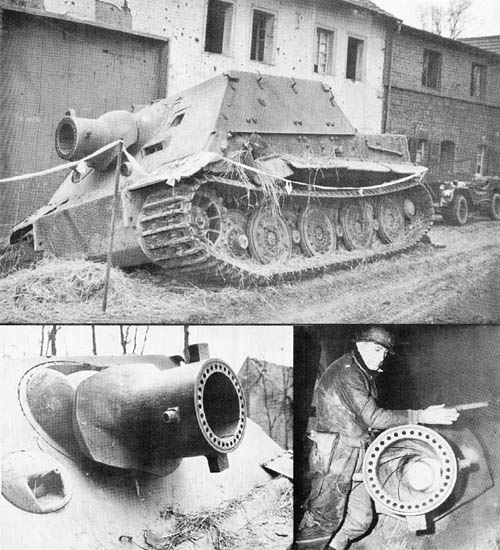
This equipment consists of a 38 cm rocket projector (Raketen Werfer 61) mounted on a modified Model E Tiger I chassis (see p. 38). A heavy rectangular superstructure of the type used on the German self-propelled guns replaces the normal superstructure and turret of the Model E. The rocket projector is mounted in the front plate of the superstructure, offset to the right of center. The superstructure is made of rolled armor plates and is of welded construction with the side plates interlocked with the front and rear plates. A heavy strip of armor is used to reinforce the joint between the front plate and glacis plate on the outside. Armor thickness varies from 40 mm to 150 mm.
The main armament, which fires a splined projectile 58.6 inches long (see page 354.2), differs radically in design and construction from any weapon previously examined. The barrel consists of a cast outer jacket, and a spaced liner of 1/2-inch steel. The latter, which is 74 1/4 inches long, is rifled, having nine grooves with right hand twist, one turn in 17.6 calibers. At the extreme rear, the grooves widen to aid in positioning splines near the base of the projectile. The liner is held in place by four steel blocks at the rear, and a perforated ring at the muzzle end. This ring has 31 equally spaced holes around its face. The breech mechanism is a horizontal sliding plate 2-5/16 inches thick opening from left to right.
The propellant gases are deflected between the tube and liner by an unusual obturator, and escape through a perforated ring at the muzzle. The metal obturator comprising a thin “L” shaped outer ring, a heavier “L” shaped perforated inner ring, and a spacer ring, fits into a circular recess in the front face of the breech plate. When the projectile is fired, the propellant gases pass through the ports to the chamber between the inner and outer rings. The face of the outer ring is forced against the rear face of the tube, and the sides against the recess in the breech plate, thereby obtaining the gas seal.
SPECIFICATIONS
| (VEHICLE) |
| Weight (in action) (estimated) |
|
68 tons |
| Length (overall) |
|
20 ft., 8 1/2 ins. |
| Width (overall) |
|
12 ft., 3 ins. |
| Height (overall including stowage crane) |
|
11 ft., 4 ins. |
| Height (overall less stowage crane) |
|
9 ft., 3 ins. |
| Ground clearance |
|
17 ins. |
| Tread centers |
|
9 ft., 3 1/2 ins. |
| Ground contact |
|
12 ft., 6 ins. |
| Width of track |
|
28 1/2 ins.—20 1/2 ins. |
| Pitch of track |
|
5 1/8 ins. |
| Track links |
|
96 |
| Fording depth |
|
70 ins. |
| Theoretical radius of action |
| Roads |
|
87 miles |
| Cross-country |
|
53 miles |
| Speed |
| Roads |
|
25 miles |
| Cross-country |
|
15 miles |
| Superstructure Armor |
| Front plate |
|
150 mm at 45° to vertical |
| Projector mantlet (average) |
|
69 mm rounded |
| Projector shield (average) |
|
150 mm rounded |
| Side plates |
|
84 mm at 20° to vertical |
| Rear plate |
|
84 mm at 10° to vertical |
| Top plate |
|
40 mm |
| Spherical cradle |
|
100 mm rounded |
| Ammunition (Rds.) |
|
12 |
| Engine |
|
Maybach HL 210, V-12, 630 hp. |
| Transmission |
|
Preselector, hydraulic—8 speeds forward, 4 reverse |
| Steering |
|
Controlled differential, hydraulic |
| Crew (unconfirmed) |
|
7 |
| |
| (PROJECTOR) |
| Caliber |
|
380 mm (14.96 ins.) |
| Length of tube |
|
81 1/8 ins. |
| Length of liner |
|
74 1/4 ins. |
| Thickness of liner |
|
1/2″ |
| No. of grooves |
|
9 |
| Width of grooves |
|
0.4 in. |
| Width of grooves at rear |
|
1.06 in. |
| Depth of grooves |
|
0.2 in. |
| Twist of grooves |
|
Right hand, one turn in 17.6 caliber |
| Max. range (horizontal) |
|
6,179 yds. |
| Firing mechanism |
|
Continuous-pull |
| Traverse |
|
20° |
| Elevation (approx.) |
|
85° |
| Depression (approx.) |
|
0° |
| Ammunition |
|
H.E. (R. Sprenggranate 4581) |
| |
|
HEAT (R. Hollandungsgranat 4592) |
| Wt. of projectile* |
|
761 lbs. |
| *Weight zones are marked to the nearest 5 kg. (12 lbs.)
German: p. 38.3-38.4 (June 1, 1945)
Published on October 27, 2009 in German.
This rocket projector very closely resembles the 28/32 cm Nebelwerfer 41. The individual projectors are of similar construction, each one being shaped to the contours of the standard 30 cm rocket ammunition. The rear portion, however, is considerably larger than that of the 28/32 cm projector to accommodate the larger propelling chamber of the 30 cm rocket. As a result of the heavier charge, this rocket achieves a range of 4,976 yards.
Both traversing and elevating mechanisms are identical with those of the 28/32 cm piece. Total traverse is 30 degrees, and elevation is 45 degrees. The firing mechanism is electric with a contact box located at the right side of the piece.
A sight bracket is located at the rear of the framework.
There is a small spade under the frame in the rear, but no other evidence of supports.
The ammunition for this projector is described on page 354.1.
German: p. 350 (May 1, 1945)
|