Published on
July 23, 2010 in
German.
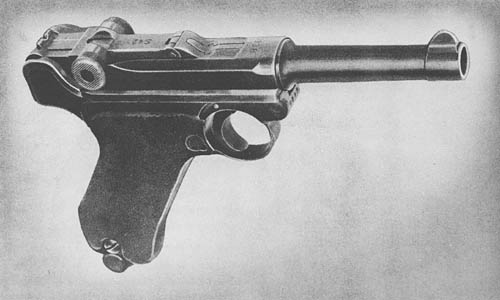
The German 9 mm Luger ’08 or Parabellum pistol, one of the official sidearms of the German army, is a semi-automatic weapon of unquestionable power and accuracy. Extensive tests have proved that the American .45 Colt automatic is superior because of greater shock effect.
Action of the Luger is based on the design of an American, Borchardt. The original Borchardt pistol utilized a recoil-operated mechanism with the breechblock locked to the barrel at the moment of discharge. The breechblock was unlocked by a toggle-joint action which was free to move after the breechblock and barrel had recoiled together for a short distance.
The pistol, which was heavy, clumsy, and badly balanced, was redesigned in 1900 and designated the Luger. The toggle-breech mechanism and retractor-spring housing of the Luger were much more compact than those of the Borchardt. The simpler 1908 model of the gun uses the German 9 mm Parabellum ball ammunition fed by an 8-round magazine fitted into the butt or grip. The bolt group indicates after firing whether a new cartridge has been inserted, in which case the extractor projects above the chamber showing the inscription “Geladen” (loaded) on the left side. There are two versions of the Luger, one with a short barrel, and the other with a long barrel and shoulder stock attachment. A 32-round drum magazine which enables a higher fire capacity may be used with either type, but the long barrel type with the shoulder stock and drum magazine has been replaced by the submachine gun in the current war.
SPECIFICATIONS
| Caliber |
|
9 mm (actually .347 in.) |
| Weight |
|
30 oz. (1 lb., 14 oz. with empty magazine) |
| Length |
|
8 3/4 ins. |
| Length of barrel |
|
4 ins. |
| Capacity |
|
8 rounds |
| Action |
|
Recoil—semi-automatic |
| Range |
|
50 ft.—effective |
| |
|
150 yds.—maximum |
| Muzzle velocity |
|
1,075 f/s-1,250 f/s |
German: p. 202
Published on
April 7, 2010 in
German.
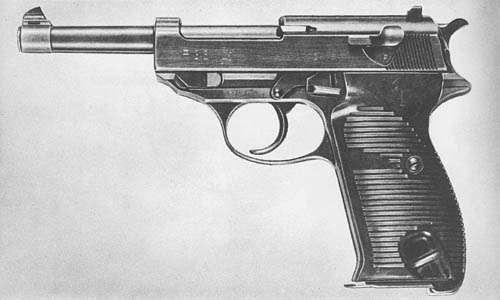
This weapon is steadily taking its place as the standard issue for the German Army. It is even believed to be gradually replacing the Luger (Pistole ’08) as the official German military sidearm.
Although the Walther lacks the stopping power of the U.S. Colt .45, it is, nevertheless, a handy weapon because of its good balance and its double action. This latter feature enables the weapon to be fired simply by squeezing the trigger without cocking the hammer. It is one of the few military automatic pistols with the double action feature.
The Walther is a recoil-operated pistol with a slide that moves directly to the rear, resembling in this respect the Colt rather than the Luger. It is fed by an eight-round magazine that fits into the pistol butt. The safety catch is located at the left rear of the slide. There is also a device which enables a quick check in order to determine whether or not there is a cartridge in the chamber. This is in the form of a small pin which protrudes from the back of the slide when a cartridge is in the chamber.
German standard 9 mm Parabellum ammunition is regular issue, but the pistol will accommodate British and United States manufactured 9 mm Parabellum ammunition for the Sten and Lanchester submachine guns. It will also use Italian Mod. 38 9 mm ammunition designed for the Beretta submachine gun.
A leather holster, spare magazines, and a magazine holder are issued with this weapon.
SPECIFICATIONS
| Caliber |
|
9 mm (actually .347 in.) |
| Weight with empty magazine |
|
2 lb., 1 3/4 oz. |
| Weight with full magazine |
|
2 lb., 5 1/4 oz. |
| Length |
|
8 1/2 ins. |
| Length of barrel |
|
4.75 ins. |
| Principle of operation |
|
Short recoil, double action |
| Feeding device |
|
Removable magazine in butt |
| Capacity |
|
8 rounds |
| Sights |
| Front |
|
Inverted V blade |
| Rear |
|
Open V notch |
| Muzzle velocity |
|
1,040 f/s-1,250 f/s |
| Range |
| Effective |
|
50 ft. |
| Maximum |
|
1,150 yds. |
German: p. 203