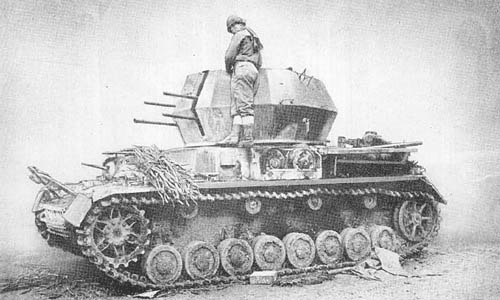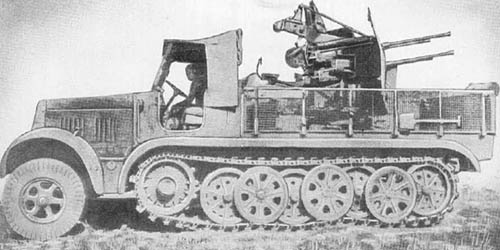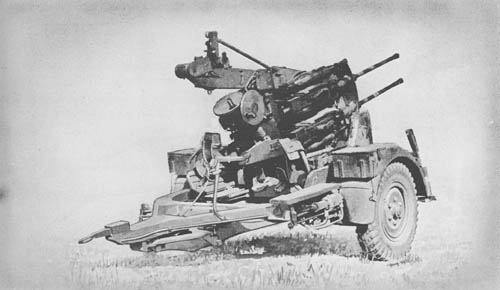
The 2 cm Flakvierling 38, consisting of four 2 cm Flak 38’s on a quadruple mounting, may be employed against both ground and aerial targets. It is normally transported on a trailer (Sd. Ah. 52) but may be mounted on railed or semi-tracked vehicles. The Trailer 52 consists of a wishbone-shaped, welded 1/4 inch steel plate frame supported on pneumatic tires. Because of its collapsing seats, folding handles, and handy ammunition racks, the Flakvierling 38 is a trim, compact, and conveniently operated weapon. The monobloc barrels may be quickly and easily changed, and the piece rapidly emplaced for fire.
The method of operation is basically that of the Solothurn. Both barrel and bolt recoil a short distance together; the barrel stops, and the bolt continues on to the rear. The guns fire from an open bolt position and may be operated either automatically or semi-automatically. Each one is equipped with a spring type equilibrator that is attached to the mount.
The mount consists of a triangular base which has a jack at each apex for leveling the gun when it is in firing position; a traversing ring which is fixed to the base and upon which the carriage body sits; and the carriage body, which in turn supports the four barrels and accessories. A compensator bolted to the carriage body counteracts muzzle preponderance.
The guns are fired by a set of foot pedals; each of two pedals fires two diametrically opposite guns. The mount is traversed and elevated manually by the tracker who has the two handwheels within easy reach. Empty cartridge cases are ejected toward the center of the gun mount into chutes leading to a deflector box which holds about 500 cases.
Sighting equipment for the Flakvierling 38 consists of the tachymetric sight, Flakvisier 40, or for ground targets, the Linealvisier 21.
SPECIFICATIONS
| Caliber | 2 cm (.79 in.) | |
| Length of tube | 45.82 ins. plus flash hider of 5.75 ins. | |
| Weight (travelling position) | 4,890 lb. | |
| Weight (firing position) | 3,200 lb. | |
| Length (overall) | 169 ins. | |
| Length (firing position) | ||
| Height (travelling position) | 84 ins. | |
| Height (firing position) guns elevated | 10 ft., 1 in. | |
| Width (overall), (travelling position) | 95 ins. | |
| Width of trail spread | ||
| Length of bore | ||
| No. of grooves | 8 lands and grooves | |
| Width of grooves | ||
| Depth of grooves | ||
| Width of lands | ||
| Muzzle velocity | (H.E. shell) 2,950 f.s. (A.P. shell) 2,624 f.s. |
|
| Max. range (horizontal) | 5,246 yds. | |
| Max. range (vertical) | 4,012 yds. | |
| Rate of fire | 800 practical; 1,400 cyclic rds. per min. | |
| Traverse | 360° | |
| Elevation | 100° | |
| Depression | -10° | |
| Length of recoil | ||
| Ammunition | H.E. four types; A.P. two types | |
| Wt. of 1 magazine of 20 rds | 21 lb. | |
| Ammunition stowage | 320 rds. |
German: p. 133