Published on
September 12, 2010 in
German.

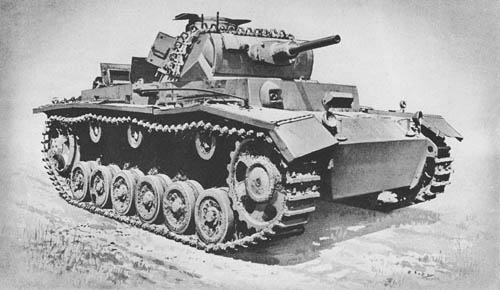
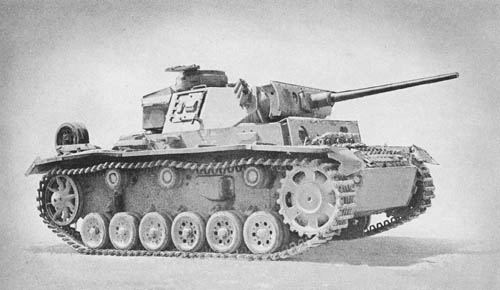
Model J—The principal differences between Model J and earlier models are:
1. Increased thickness of basic armor plate on certain front and rear plates from 30 mm to 50 mm and the addition of spaced armor on the front of the gun mantlet and the front plate of the superstructure.
2. Hydraulically operated steering in the earlier models has been replaced by mechanical steering. As previously reported, the complicated Maybach Variorex ten-speed gear was abandoned in Model H in favor of a manual six-speed and reverse gear box.
3. Wider tracks—15 inches instead of 14 1/8 inches. The heavier track necessitated a change in the spacing of the return rollers. Front and rear rollers are now mounted directly over the Luvax shock absorbers and prevent the track fouling the latter.
4. The tail plate has been modified to give better protection to the rear air outlet; it also allows the smoke device to be mounted inside the plate.
5. One or two mild steel bars, welded at each end, are fixed across the middle of the nose plate. The track shoes are placed behind the bars and are held in position by the bridge of the shoe.
6. The mounting of the 5.0 cm Kw. K. 39 (long gun) was incorporated in the latest of the Model J tanks.
The most prominent recognition points of this model are: the mounting of the hull machine gun is of prominent ball type; the driver’s visor consists of a single hinged piece of armor instead of two separate plates; the front sprocket and rear idler are similar to those in Model H; particularly squat turret, pear-shaped with circular cupola well set to the rear.
Model K—Same as Model J. This model mounted the 5.0 cm long gun (Kw. K. 39).
SPECIFICATIONS
| Weight |
|
22 tons |
| Length |
|
17 ft., 9 ins. |
| Width |
|
9 ft., 8 ins. |
| Height |
|
8 ft., 3 ins. |
| Ground clearance |
|
15 ins. |
| Tread centers |
|
8 ft., 2 1/2 ins. |
| Ground contact |
|
9 ft., 4 1/2 ins. |
| Width of track |
|
15 ins. |
| Pitch of track |
|
4 3/4 ins. |
| Track links |
|
90 |
| Fording depth |
|
3 ft. |
| Theoretical radius of action: |
| Roads |
|
100 miles |
| Cross-country |
|
60 miles |
| Speed: |
| Road |
|
28 m.p.h. |
| Cross-country |
|
15 m.p.h. |
| Armor: |
| Front plate |
|
50 mm |
| Sides |
|
30 mm |
| Armament |
|
5.0 cm Kw. K. 39 2 MG’s |
| Ammunition |
|
5.0 cm gun—75 rds. |
| Engine |
|
Maybach HL 120 TRM, V-12, 320 hp. |
| Transmission |
|
Manual, 6 speeds forward, 1 reverse |
| Steering |
|
Epicyclic, clutch brake |
| Crew |
|
5 |
German: p. 24
Published on
September 12, 2010 in
German.

Model F—This is the first tank of the series to mount a 5.0 cm Kw. K. electrically fired tank gun in place of the 3.7 cm Kw. K. and also the first to have a new type mantlet. This mantlet has a thick shield on the front which moves with the gun. A single machine gun is mounted coaxially on the right of the 5.0 cm gun and the hull machine gun is retained.
The hull consists of three separate subassemblies: (1) lower hull, (2) front superstructure carrying turret, and (3) rear superstructure covering the engine compartment. All units are of single skin welded construction.
The turret forms the roof of a spacious fighting compartment, being mounted over the middle part of the hull. It has no rotating platform, the commander and the gunner having seats suspended from and rotating with the turret. The loader apparently stands on the floor of the fighting compartment. The commander’s cupola is bolted to the roof of the turret on the center-line to the rear.
The suspension is the same as that used in Model E.
The engine is the Maybach V-12, gasoline, rated 320 hp. Its transmission is the synchromesh type with 10 speeds forward and 4 reverse. Its steering is of the epicyclic, clutch brake type with hydraulic control.
Model G—Identical in armament, mantlet, and mechanical components to Model F, the only difference being in the cupola, which is more squat and has all-around vision.
Model H—This model has additional 32 mm plates bolted on the front of the superstructure, on the upper and lower nose plates and on the tail plate. The outstanding recognition features of this model are its front sprocket which has six spokes, and its rear idler which is more open than the earlier type, though it has eight spokes. Wider tracks and narrower bogie wheels are also used.
SPECIFICATIONS
| Weight |
|
22 tons |
| Length |
|
17 ft., 9 ins. |
| Width |
|
9 ft., 7 ins. |
| Height |
|
8 ft., 3 ins. |
| Ground clearance |
|
15 ins. |
| Tread centers |
|
8 ft., 1 7/8 ins. |
| Ground contact |
|
(approx.) 10 ft., 6 ins. |
| Width of track |
|
14 1/8 ins. |
| Pitch of track |
|
4 3/4 ins. |
| Track links |
|
90 |
| Fording depth |
|
3 ft. |
| Theoretical radius of action: |
| Roads |
|
100 miles |
| Cross-country |
|
60 miles |
| Speed: |
| Road |
|
28 m.p.h. |
| Cross-country |
|
15 m.p.h. |
| Armor: |
| Front plate |
|
30 + 32 mm |
| Sides |
|
30 mm |
| Armament |
|
5.0 cm Kw. K. 2 MG’s |
| Ammunition |
| Engine |
|
Maybach, HL 120, V-12, 320 hp. |
| Transmission |
|
Synchromesh, 10 forward, 4 reverse, and 6 forward, 1 reverse. |
| Steering |
|
Epicyclic, clutch brake |
| Crew |
|
5 |
German: p. 23
Published on
September 11, 2010 in
German.

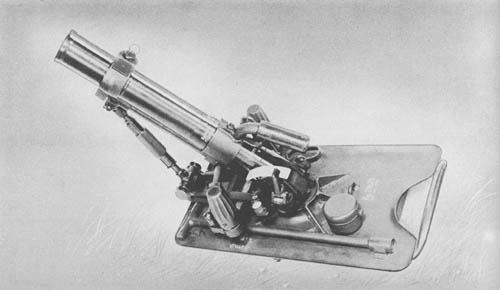
The German 5 cm light mortar, developed in 1936, is a compact piece which can be easily broken down into two loads for transport. It differs radically from the conventional mortar design in that it is trigger-fired.
A short, seamless tube is threaded at its base to the breech ring containing the firing mechanism. The firing-pin assembly is actuated by a manually operated trigger, fixed to the rear half of the breech ring. Two large holes in the rear of the ring serve as trunnions by which the mortar is fastened to the cradle, and about which the mortar is elevated.
The forward end of the mortar tube is connected to the base plate by means of two brackets and the elevating mechanism. The front bracket is tightened around the tube by a bolt; the rear one fits around the breech ring and is locked by a set screw.
Two elevating mechanisms, one coarse and one fine, permit a total range of elevation from 43.5° to 90°. A range scale, calibrated in meters from 0 to 525 is screwed to the left side of the breech ring. A hook-shaped lever, pinned to the rear left side of the cradle, rides along the range scale as the elevation of the mortar is changed and serves as an indicator. The combination leveling and traversing mechanism allows a total traverse of 30°, 15 to the right and left, respectively. Center traverse is indicated by an arrow, pointing to an “0″ engraved on the rear top of a ball joint about which the cradle traverses.
The base plate, constructed of sheet metal, is reinforced by ribs welded to the bottom side. Two ribs, serving as the main spades, are set at an angle of 23° from the vertical at front and rear of the plate. Reinforcing ribs, welded perpendicularly to the base plate and running lengthwise as well as crosswise, also act as spades.
SPECIFICATIONS
| Caliber |
|
50 mm (1.969 ins.) |
| Weight (complete) |
|
31 lb. |
| Length of tube |
|
13.75 ins. |
| Mount |
|
Cradle and base plate, no bipod |
| Firing mechanism |
|
Trigger-operated |
| Method of loading |
|
Muzzle |
| Muzzle velocity |
|
230 f/s |
| Range (maximum at 45° elevation) |
|
550 yds. |
| (minimum at 85° elevation) |
|
50 yds. |
| Elevation (maximum) |
|
90° |
| (minimum) |
|
43.5° |
| Traverse |
|
30° (15° right; 15° left) |
| Elevating and traversing mechanisms |
|
Enclosed, well-sealed |
| Direct-sighting equipment |
|
None |
| Cross leveling system, |
|
Operated by leveling knobs and bubble |
| Ammunition |
|
H.E. (equipped with fin assembly, point-detonating fuze, & booster). Wt. 2.00 lb. |
German: p. 124
Published on
January 19, 2010 in
German.
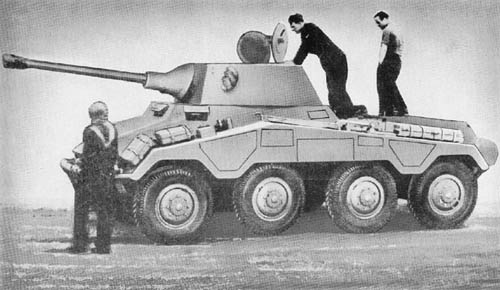
This armored car is basically the 8-wheeled Model Sd. Kfz. 234 equipped with a 12-cylinder, 75°, air-cooled diesel engine. The armor plate on the front of the turret, superstructure, and hull is heavier than that of earlier models. The vehicle, itself, is also about three tons heavier.
The main armament consists of the 5 cm tank gun, Kw. K. 39/1, fitted with a muzzle brake. This gun has a muzzle velocity of 2,700 f/s, with A.P. ammunition. Its penetration performance with A.P.C. ammunition is estimated at 2.2 inches at 30° from 1,000 yards.
The mantlet is cast in one piece somewhat similar in appearance to that on the latest assault guns, but the casting also includes the coaxial machine gun. This design gives greater protection than the older types. The gun has a vertical sliding block and is of the semi-automatic type. A spring type equilibrator is mounted on the right hand side between the cradle and the turret top plate. The hydropneumatic recoil mechanism is mounted in the mantlet on top of the piece. Elevation is from -7° to +25°. Six smoke projectors are mounted, three on each side of the turret.
The front of the turret is protected by 30 mm armor set at an angle of 20° from the vertical. The sides and rear have 10 mm armor set at 25°, and the top plate is of the same thickness. The gun mantlet is rounded, and is 40 to 100 mm thick. The front of the superstructure has 30 mm armor set at a 35° angle, and the sides 10 mm at 30°. The nose plates of the hull are 30 mm thick, the upper plate being set at a 55° angle and the lower at 30°. The glacis plate is 17 mm at 70° and the sides of the hull 9 mm at 30°.
SPECIFICATIONS
| Weight |
|
11.5 tons |
| Length (overall with gun at 12 o’c.) |
|
22 ft., 4 ins. |
| Length (overall with gun at 6 o’c.) |
|
19 ft., 8 ins. |
| Width |
|
7 ft., 10 ins. |
| Height |
|
7 ft., 6 ins. |
| Ground clearance |
|
1 ft., 2 ins. |
| Tread centers |
|
6 ft., 4 3/4 ins. |
| Wheelbase |
|
13 ft., 5 1/2 ins. |
| Tire size |
|
8.27 x 16 |
| Fuel tank |
|
89 gal. capacity |
| Fording depth |
|
4 ft., 7 ins. |
| Speed (maximum) |
|
50 m.p.h. |
| Engine |
|
12-cylinder, 75°, air-cooled diesel. |
| |
|
217 BHP at 2250 engine r.p.m. |
| Bore and stroke |
|
110 mm/130 mm |
| Ignition |
|
Diesel |
| Battery |
| Transmission |
|
6 speeds forward: 6 reverse |
| Steering |
|
(Dual control) worm and nut |
| Crew |
|
4 |
German: p. 42.1 (April 1, 1945)
Published on
December 31, 2009 in
German.
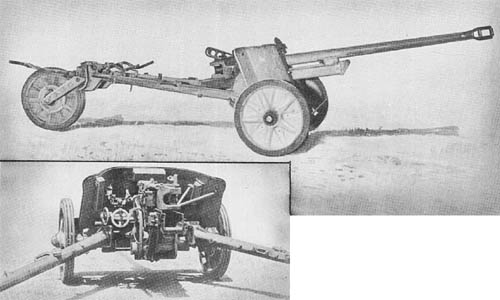
The 5 cm Pak 38, introduced during the 1941 campaigns in Greece and Egypt, was developed to combat the more heavily armored vehicles of the Allies.
The gun has a barrel of monobloc construction, threaded at the muzzle for attaching a two-baffled muzzle brake. Because of the position of the breech-operating cam, a minimum length of recoil of approximately 18 1/2 inches is needed to operate the semi-automatic breech mechanism which is of the sliding horizontal block type. The recoil recuperator system is hydropneumatic.
The carriage, constructed of welded steel, is mounted on metal disk wheels with solid rubber tires. Torsion bar suspension is automatically locked when the tubular trails are spread. A 5 mm spaced armor shield and single apron protect the gun crew. The left side of the shield has a sighting port.
There are five types of ammunition fired from the Pak 38: an armor-piercing capped, high-explosive projectile; a high-explosive shell; an A.P.-H.E. (uncapped) shell; a tungsten carbide core arrowhead type projectile (A.P. 40), and a stick grenade similar to the 3.7 cm grenade described on page 306.
SPECIFICATIONS
| Caliber | | 50 mm (1.97 ins.) |
| Weight (complete) | | 2,015 lbs. (approx.) |
| Length of gun (overall) | | 15 ft., 3 ins. |
| Length of barrel (overall) | | 9 ft., 3 ins. |
| Width C-C | | 5 ft., 1 in. |
| Carriage | | Welded steel w/solid rubber tires and tubular trails |
| Breech mechanism | | Horizontal sliding block |
| Recoil mechanism | | Hydropneumatic |
| Rifling | | 20 lands & grooves; right-hand twist |
| Muzzle velocity |
| A.P.C.-H.E. | | 4.5 lb.—2600 f/s |
| H.E. | | 4.0 lb.-1800 f/s |
| Elevation | | 22° |
| Depression | | -4° |
| Traverse | | 80° |
| Sights | | Straight tube telescope |
| Ammunition | | A.P.; A.P.C.; H.E.; A.P. 40 |
| Penetration |
| |
Range | | Thickness of armor in mm |
|
Yards | | 30° | | Normal |
|
500 | | 2.6 | | 3.1 |
|
700 | | 2.4 | | 2.9 |
|
1000 | | 2.2 | | 2.6 |
|
1200 | | 2.0 | | 2.5 |
German: p. 126 (June 1, 1945)
Published on
December 31, 2009 in
German.
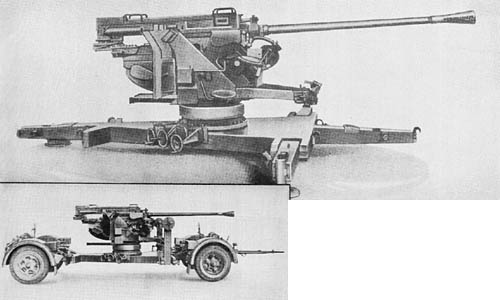
This gas-operated, automatic, antiaircraft gun is transported on two-wheeled transporters. To put the gun into action, the platform is lowered from the transporters by means of winding gear. The two transverse legs are lowered and the platform is roughly leveled with jacks. The final leveling is done with leveling screws in the base ring of the mounting. The barrel is removable for easy replacement in the field. The right hand twist of the rifling increases from one in 36 1/2 to one in 30 calibers.
The breech mechanism is similar to that of the 3.7 cm Flak 43. It differs in that the breech block drops into the closed position from the open position. The dropping of the block allows buttress guides on the block to engage with similar guides on the jacket. This locks the block in the firing position and prevents any rearward movement. The feed mechanism is operated by the recoil of the breech casing. The recuperator consists of two spiral springs which are mounted side by side in the cradle. The buffer is mounted centrally in the cradle.
The traversing gear and the sight are on the right hand side of the mounting. The sight bracket is connected by means of a parallel motion link to a cross shaft. Here it is keyed to a pointer on the elevation scale. The gun elevating gear is on the left side of the mounting. This is also connected to a pointer on the elevation scale. The layer keeps the two pointers in line and the gun is laid at the same angle of elevation as the sight.
SPECIFICATIONS
| Caliber |
|
5 cm (1.97 ins.) |
| Weight (traveling position) |
|
7.18 tons |
| Weight (firing position) |
|
4.30 tons |
| Length (traveling position) |
|
27 ft., 5.5 ins. |
| Length (firing position) |
|
19 ft., 10 ins. |
| Height (traveling position) |
|
7 ft., 1 in. |
| Height (firing position) |
|
7 ft., 4 ins. |
| Width (overall-traveling) |
|
7 ft., 10 ins. |
| Width of trail spread |
|
|
| Length of gun (incl. muzzle brake) |
|
184.5 ins. |
| Length of gun (excl. muzzle brake) |
|
170.8 ins. |
| Length of rifling |
|
117.28 ins. |
| No. of grooves |
|
20 |
| Width of grooves |
|
0.160 in. |
| Depth of grooves |
|
0.020 in. |
| Width of lands |
|
|
| Muzzle velocity (H.E. shell) |
|
2,756 f/s |
| Firing mechanism protrusion |
|
0.1 in. |
| Max. range (horizontal), APCBC |
|
11,300 yds. |
| Max. range (vertical), APCBC |
|
8,600 yds. |
| Effective ceiling |
|
10,000 ft. |
| Rate of fire |
|
130 r.p.m. |
| Traverse |
|
360° |
| Elevation |
|
90° |
| Depression |
|
-10° |
| Length of recoil |
|
7 ins. (approx.) |
| Ammunition |
|
H.E. 41/tracer; Incendiary/H.E. 41/tracer; A.P.C.B.C. 42 |
| Wt. of projectile |
|
H.E.—4.8 lbs. |
| |
|
A.P.—4.87 lbs. |
| Tracer burn out point |
|
Short (8 sec.) 2,740-3,750 yds. |
| |
|
Long (18 sec.) 5,400-6,120 yds. |
German: p. 125 (June 1, 1945)