Published on
August 29, 2010 in
German.

This rocket is very streamlined and in outward appearance resembles an artillery projectile. All metal components of the body are machined inside and out and appear to be of mild steel.
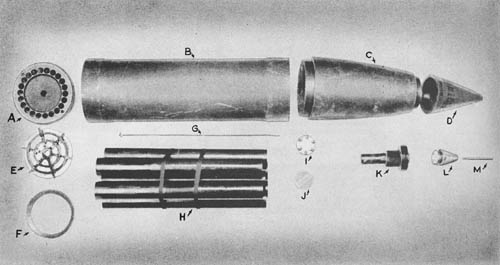
A complete round of this ammunition is made up of the following components (see photograph above):
(a) Nozzle assembly containing 22 orifices evenly spaced around the rim of the nozzle. These orifices are set an an angle of 16° from the axis of the rocket. This angle gives the rocket clockwise rotation in flight besides providing forward thrust. In the center of the nozzle there is an ignition hole which receives the electric squib.
(b) Motor body having two bourrelet surfaces.
(c) High-explosive body containing 22.4 pounds of TNT. It is made of mild steel with fairly thick walls and is threaded on its base and screwed into the motor body.
(d) False ogive, which completes the streamlined contour of the rocket.
(e) Trap, a casting painted rust red. Between the trap and the nozzle there is a tinfoil disk which is used as a moisture and dirt seal.
(f) Black powder base igniter.
(g) Igniter wick, a celluloid tube containing a charge of quickmatch.
(h) Propellant charge consisting of seven sticks 21.67 inches long and 2.46 inches in external diameter.
(i) Spacer to hold the head igniter in place and allow for the proper ignition of the entire propellant.
(j) Igniter.
(k) Booster cup.
(l) Point-detonating fuze.
(m) Wooden actuating rod.
SPECIFICATIONS
| Weight of projectile as fired |
|
241.30 lb. |
| Weight of TNT bursting charge |
|
22.40 lb. |
| Weight of propellant powder |
|
39.50 lb. |
| Weight of high-explosive body |
|
65.25 lb. |
| Weight of propellant body |
|
87.75 lb. |
| Weight of nozzle assembly |
|
5.12 lb. |
| Length |
|
49.21 ins. |
| Diameter |
|
8.27 ins. |
German: p. 355
Published on
August 29, 2010 in
German.

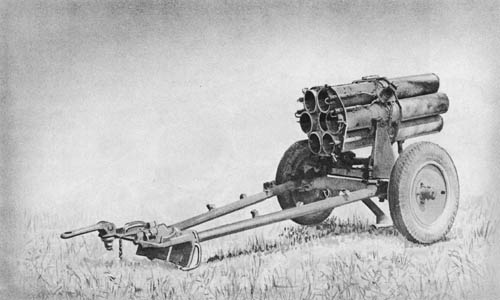
This 15 cm Nebelwerfer, formerly known as the Nebelwerfer d, is a six-barreled, breech-loading weapon firing gas, smoke and high-explosive projectiles. The four-foot barrels are not rifled, but have within them three straight guide rails about 1/3 inch deep. The projectile rotates in flight, however, due to the set of the gas jets. There is no breech mechanism, but each barrel has a kind of spring-operated latch to retain the ammunition in position after loading.
The rocket type projectiles are fired electrically by remote control at the rate of one ripple of six rounds in 90 seconds. They are always discharged from the projector in the following barrel order: 1, 4, 6, 2, 3, 5. This is a fixed firing order calculated to prevent the projector from being overturned by blast.
Due to extremely great dispersion, targets of limited area are not engaged.
The carriage is two-wheeled and has a split trail. Fire is directed by forward observers, telescopic observers, and surveying on targets. Each battery has an observer and a fire control officer.
SPECIFICATIONS
| Caliber |
|
150 mm (5.9 ins.) |
| Length of barrels |
|
51 ins. |
| Rate of fire |
|
6 rds. per 90 secs. |
| Range |
| 45° |
|
7,723 yds. |
| 30° |
|
7,018 yds. |
| 6 1/2° |
|
2,710 yds. |
| Ammunition |
|
H.E. Shell, Smoke Shell, C.W. Shell |
| Weight |
|
1,195 lb. |
| Traverse |
|
30° |
| Elevation |
|
44° |
| Velocity |
|
1,120 f/s |
German: p. 352
Published on
August 29, 2010 in
German.

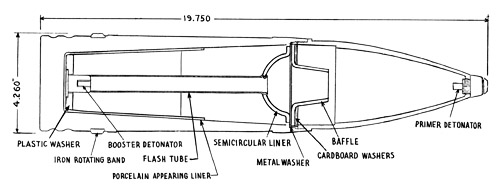
This projectile, which is fired from the German 10.5 cm L.F.H. 18 and L.F.H. 18M, has a steel case with a 1/8 inch cement liner built up on the wall of the filler chamber. This liner extends from the base to about one-half the length of the chamber. The ogive is composed of a metal resembling an aluminum alloy or German light metal. It screws into the projectile, holding all components of the filler in place.
The fuze, AZ 38, is made of aluminum and carries the primer detonator. It is armed by centrifugal force, and contains no other safety features. There are no delay adjustments, all functioning being instantaneous on percussion.
The explosive filler, composed of cyclonite with 5% of montan wax, is pressed into two pellets and enclosed in a waxed paper carton. A central hole is bored through both pellets for the full length of the charge. The forward pellet is hollowed out to accommodate a hemispherical metal liner. The aluminum flash tube, which passes through the hole in the center of the explosive pellets, is attached to the liner by means of a pressed collar. A heavy metal collar or baffle is attached to a washer on the rim of the liner. The purpose of the baffle may be to direct the flame of the primer detonator down through the flash tube, or it may have a use in developing the jet effect of the hollow charge.
A booster pellet of PETN and montan wax is contained in a cylindrical metal cup at the base of the rear pellet; a detonator in an aluminum case is located in the upper portion of this explosive in direct alinement with a flash hole in the bottom of the booster cup. This booster is ignited by the combined flame and blast of the fuze detonator which passes through the flash tube.
SPECIFICATIONS
| Cartridge case, length |
|
6.10 ins. |
| diameter at mouth |
|
4.48 ins. |
| diameter of rim |
|
4.91 ins. |
| Projectile as fired |
|
26 lb., 14 oz. |
| Explosive filler w/o booster |
|
3 lb., 4.58 oz. |
| Primer detonator |
|
.07 oz. |
| Booster explosive w/o detonator |
|
.18 oz. |
| Detonator (in booster pellet) |
|
.03 oz. |
| Wt. of normal propelling charge |
|
5 lb., 3.43 oz. |
German: p. 310
Published on
August 29, 2010 in
German.
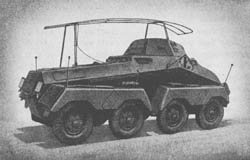
German nomenclature: schwerer Panzerspähwagen (Fu.) (Sd. Kfz. 232) (8 Rad).
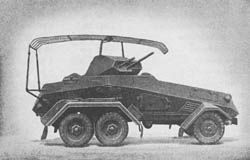
English designation: Heavy armored scout car (8 wheels).
SPECIFICATIONS
| Net weight |
|
7,700 kg |
|
16,975 lb. |
| Pay load |
| Gross weight |
|
8,500 kg |
|
18,739 lb. |
| Weight: Front axle |
|
2,100 kg |
|
4,630 lb. |
| Weight: Rear axle |
|
2,500 kg |
|
5,512 lb. |
| Length (overall) |
|
5,850 mm |
|
19 ft., 2 ins. |
| Width (overall) |
|
2,200 mm |
|
7 ft., 3 ins. |
| Height (overall) |
|
2,900 mm |
|
9 ft., 6 ins. |
| Ground clearance |
|
500 mm |
|
20 ins. |
| Tread centers |
|
1,600 mm |
|
5 ft., 3 ins. |
| Wheelbase |
|
1,350/1,400/1,350 mm |
|
53/55/53 ins. |
| Wheel width |
|
190 mm |
|
7 1/2 ins. |
| Angle of approach |
|
|
|
60° |
| Angle of departure |
|
|
|
60° |
| Seating capacity |
| Fording depth |
|
1,000 mm |
|
39 ins. |
| Climbing ability |
|
|
|
30° |
| Overturn gradient (lengthwise) |
| Overturn gradient (crosswise) |
|
|
|
35° |
| Turning radius |
|
10.5 meters (all wheels) |
|
34 ft., 5 ins. |
| Trailer load |
| Engine horsepower |
|
160 c-v |
|
157.8 hp |
| Piston displacement |
|
8,000 cu cm |
|
480 cu. ins. |
| Fuel tank capacity |
|
180 liters |
|
47.5 gal. |
| Highway fuel consumption |
|
|
|
3.9 m.p.g. |
| Average terrain fuel consumption |
|
|
|
2.2 m.p.g. |
German: p. 74.64
Published on
August 29, 2010 in
German.
German nomenclature: schwerer Panzerspähwagen (Fu.) (Sd. Kfz. 232) mit Fahrgestell des leichter geländegängiger Lastkraftwagen (o).
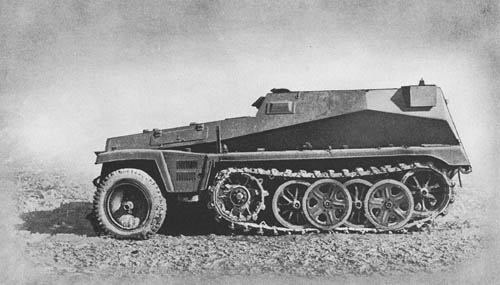
English designation: Heavy armored scout car with special chassis of the light cross-country truck.
SPECIFICATIONS
| Net weight |
|
5,500 kg |
|
12,125 lb. |
| Pay load |
| Gross weight |
|
6,250 kg |
|
13,778 lb. |
| Weight: Front axle |
|
1,900 kg |
|
4,188 lb. |
| Weight: Rear axle |
|
2,175 kg |
|
4,795 lb. |
| Length (overall) |
|
5,600 mm |
|
18 ft., 4 ins. |
| Height (overall) |
|
2,900 mm |
|
9 ft., 6 ins. |
| Ground clearance |
|
240 mm |
|
9 1/2 ins. |
| Tread centers |
|
1,700 mm |
|
5 ft., 7 ins. |
| |
|
1,840 mm |
|
6 ft. |
| Wheelbase |
|
2,500/900 mm |
|
98/35 ins. |
| Wheel width |
|
170/350 mm |
|
6 3/4/13 3/4 ins. |
| Angle of approach |
|
|
|
55° |
| Angle of departure |
|
|
|
40° |
| Seating capacity |
| Fording depth |
|
600 mm |
|
23 ins. |
| Climbing ability |
|
|
|
13° |
| Overturn gradient (lengthwise) |
|
|
|
55° |
| Overturn gradient (crosswise) |
|
|
|
35° |
| Turning radius |
|
16 meters |
|
52 ft., 6 ins. |
| Trailer load |
| Engine horsepower |
|
70 c-v |
|
69 hp |
| Piston displacement |
|
4,600 cu cm |
|
276 cu. ins. |
| Fuel tank capacity |
|
100 liters |
|
26.4 gal. |
| Highway fuel consumption |
|
|
|
5.9 m.p.g. |
| Average terrain fuel consumption |
|
|
|
3.6 m.p.g. |
German: p. 74.64
Published on
August 29, 2010 in
German.

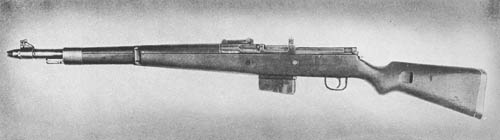
This is the German semi-automatic rifle performing approximately the same tactical mission as the United States, Cal. 30, M1 rifle. It is gas-operated, clip-fed, and air-cooled. It is a shoulder weapon, slightly heavier than the American semi-automatic. Three versions exist, the G 41 (M) which is probably an interim model, the G-41 and the G 41 (W) which are more than likely the final or production types.
The rifle is well made, but quite difficult to manufacture. Stampings are used wherever possible.
In lieu of the customary gas port, a form of gas trap is used, so designed that when attached to the muzzle it makes it necessary for the bullet, after leaving the barrel, to jump a gap and momentarily block the muzzle opening of the cone. The resulting gas pressure then drives a gas piston, in the form of a collar around the barrel, to the rear. The action is imparted to an operating rod the end of which is in contact with the forward end of the retractor slide which is also driven to the rear. A projection on the underside of the retractor slide engages the bolt locking lugs, withdrawing them from the locking recesses in the receiver. The bolt assembly and retractor slide then recoil together for the remainder of the recoil distance. Extraction and ejection are accomplished in the usual manner.
A thorough test at Aberdeen proved the G 41 (W) is much inferior to the U.S. Rifle, Cal. 30, M1, in reliability under severe conditions. It fell down especially in the mud and rain tests, and breakages were very numerous.
SPECIFICATIONS
| Caliber |
|
7.92 mm (.312 in.) |
| Weight of rifle w/o bayonet and sling |
|
10 1/4 lb. |
| Length w/o bayonet |
|
45 ins. |
| Length of barrel |
|
21.6 ins. |
| Principle of operation |
|
Gas—semi-automatic |
| Cooling system |
|
Air |
| Magazine system and capacity |
| Fixed vertical box |
|
10 rds. staggered |
| Method of feed |
|
two 5-round Mauser rifle clips |
| Sight radius |
|
21.2 ins. |
| Sights |
|
Blade front sight with “T” base and tangent leaf rear sight graduated from 100 to 1,200 meters. No windage adjustment. |
| Rifling |
|
4 grooves, uniform right-hand twist |
| Muzzle velocity |
|
2,408 f/s (in a worn barrel) |
| Trigger pull |
|
7-8 lb. |
| Ammunition used |
|
All 7.92 mm Mauser rifle types |
| Total number of parts |
|
102 |
| Number of coil springs |
|
13 |
| Number of flat springs |
|
4 |
| Time to fieldstrip |
|
3 1/4 seconds |
| Time to assemble from fieldstrip |
|
4 3/4 seconds |
| Time to diassemble |
|
3 min., 57 sec. |
| Time to assemble |
|
8 min., 32 sec. |
German: p. 208
Published on
August 29, 2010 in
German.

This vehicle is an armored version of the l. Zg. Kw. 1 ton (Sd. Kfz. 10) used for reconnaissance purposes. In appearance it closely resembles the light armored personnel carrier (Sd. Kfz. 250). There are a number of minor differences in the suspension of the armored versions as compared with the Sd. Kfz. 10, the principal one being one less bogie wheel.
The mechanical components of the chassis are the same as those utilized in the Sd. Kfz. 10, therefore the road performance of the two vehicles is similar.
The net weight of the vehicle ready to drive is 11,022 pounds; the combat weight 12,540 pounds. The weight on the front axle is 2,552 pounds; the weight on the tracks 9,988 pounds.
Its maximum highway range is 198 miles on a fuel tank capacity of 35 gallons. The crew consists of four, including the driver.
This vehicle, like all semitracks, is equipped with a power cable winch having a lifting power of 5,500 pounds. The turning radius measures 35 feet.
SPECIFICATIONS
| Weight |
|
5.5 tons |
| Length |
|
15 ft., 5 ins. |
| Width |
|
6 ft., 4 ins. |
| Height |
|
5 ft., 11 ins. |
| Ground clearance |
|
11 ins. |
| Tread centers |
|
(Wheel, 64 ins.), (Track, 62 ins.) |
| Ground contact |
|
3 ft., 11 ins. |
| Width of track |
|
9.4 ins. (Wheel, 7.5 ins.) |
| Track links |
|
38 |
| Pitch of track |
|
6 5/16 ins. |
| Fording depth |
|
27.5 ins. |
| Theoretical radius of action |
| Roads |
|
198 miles |
| Cross-country |
|
130 miles |
| Speed |
| Roads |
|
40 m.p.h. |
| Cross-country |
|
25 m.p.h. |
| Armor |
| Front plate |
| Sides |
| Armament |
| Ammunition |
| Engine |
|
Maybach 6-cyl. NL 42 TRKM—100 hp. |
| Transmission |
| Steering |
|
Under 15°—normal; over 15° epicyclic |
| Crew |
|
4 |
German: p. 47
Published on
August 29, 2010 in
German.

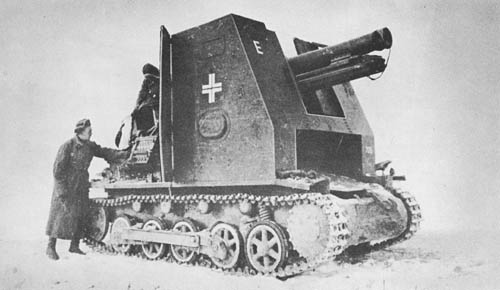
This equipment consists of the 15 cm heavy infantry howitzer mounted on a turretless Pz. Kpfw. I model “B” chassis. This howitzer is also mounted on the Pz. Kpfw. II, and the Pz. Kpfw 38 (t) chassis. Due to the additional weight carried by the chassis, which approximates 3 tons more than its normal Pz. Kpfw. I complement, its road performance does not equal that of the Pz. Kpfw. I tank. The general appearance suggests that the equipment is overloaded.
The howitzer, which probably retains its wheels and trails, in addition to its original shield, traversing and elevating mechanisms, is mounted high in a tall, three-sided shield, and fires forward. The shield is 10 mm thick and is open at the top and rear.
The 15 cm. s.I.G. 33 is a standard German infantry support weapon. It has a length of 64.57 ins. and is used for either high or low trajectory shooting. It has a muzzle velocity of 790 f.s. and a maximum effective range of 5140 yards firing the 83.6 lb. H.E. shell with percussion fuze s.I. gr. Z. 23. The breech mechanism is of standard German type, and is similar to the 10.5 cm. l.F.H. 18 breech mechanism. The elevating gear is operated from the right. It consists of a worm gear, rack, pinion and shafting. The traversing gear is operated from the left by a system of gear wheels and shafting. The recoil system of buffer and recuperator is housed in a casing underneath the barrel.
Two types of ammunition are fired, the 15 cm I. Gr. 33 and the 15 cm I. Gr. 38. The two types of ammunition are for all practical purposes identical except that the former has a screwed-in base plate. The only other shell that this weapon is known to fire is a smoke shell, the 15 cm I. Gr. 38 Nb. The same percussion fuze, s.I. Gr. Z. 23, which weighs 75 lb., is used in each case.
SPECIFICATIONS
| Weight |
|
9 tons |
| Length |
|
14 ft., 6 ins. |
| Width |
|
6 ft., 9 ins. |
| Height (approx.) |
|
11 ft. |
| Ground clearance |
|
11 1/2 ins. |
| Tread centers |
|
5 ft., 5 ins. |
| Ground contact |
|
8 ft. |
| Width of track |
|
11 ins. |
| Pitch of track |
|
3 11/16 ins. |
| Track links |
|
99 |
| Fording depth |
|
2 ft. |
| Theoretical radius of action |
| Roads |
|
87 miles |
| Cross-country |
|
72 miles |
| Speed |
| Roads |
| Cross-country |
| Armor |
| Front plate |
|
15 mm |
| Sides |
|
10 mm |
| Gun shield |
|
10 mm |
| Armament |
|
15 cm S.I.G. 33 |
| Ammunition (rds.) |
| Engine |
|
100 h.p. Maybach Model N.L. 38 T |
| Transmission |
|
5 speeds forward, 1 reverse |
| Steering |
|
Clutch brake |
| Crew |
|
Probably 4 |
German: p. 5
Published on
August 29, 2010 in
German.

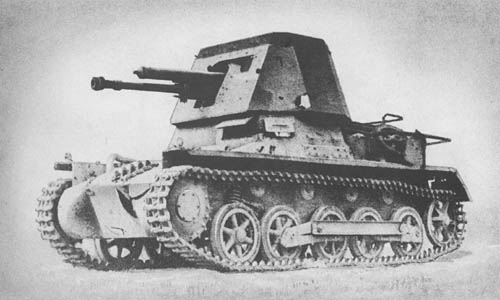
This equipment, which is primarily a tank-hunter, was created by combining the 4.7 cm Czech antitank gun with the chassis of the Pz. Kpfw. I, Model B tank. Consequently its road performance approximates that of the Model B tank.
The turret arrangement consists of a three-sided welded shield, open at the top and rear, bolted to the superstructure by means of internal flanges. The driver’s seat is on the floor to the left rear of the gear box.
The fitting of the gun to the chassis is crude in many respects and not up to the usual standard of German workmanship or design. The gun is mounted on a steel frame, within the shield, in the front half of the vehicle. It is a single shot, high velocity weapon. The barrel is a one-piece forging fitted with a large and heavy muzzle brake and flash eliminator. The breech mechanism is of the vertical sliding block type. The gun is automatically cocked when the breech is opened. The elevating gear is on the left hand side of the gun and is controlled by an elevating wheel with a folding handle. The traversing gear is behind the elevating hand wheel. Traverse is limited by a spring-loaded stop to 15 deg. left or right. The recoil mechanism, which consists of a spring recuperator and liquid buffer, is housed in a cylindrical casing above the piece.
The gun utilizes the following types of ammunition—(1) A.P. tracer shell, (2) H.E. shell. At 300 yards the A.P. projectile effects a penetration of homogeneous armor of 2.3 ins. at 30 deg. obliquity; 3.0 ins. normal, and at 1000 yards will penetrate 1.8 in. at 30 deg. obliquity; 2.4 ins. normal.
SPECIFICATIONS
| Weight |
|
8.4 tons |
| Length |
|
14 ft., 6 ins. |
| Width |
|
6 ft., 9 ins. |
| Height |
|
7 ft. |
| Ground clearance |
|
11 1/2 ins. |
| Tread centers |
|
5 ft., 8 ins. |
| Ground contact |
|
8 ft. |
| Width of track |
|
11 ins. |
| Pitch of track |
|
3 11/16 ins. |
| Track links |
|
99 |
| Fording depth |
|
2 ft. |
| Theoretical radius of action |
| Roads |
|
87 miles |
| Cross-country |
|
72 miles |
| Speed |
| Roads |
|
26 m.p.h. |
| Cross-country |
|
15 m.p.h. |
| Armor |
| Front plate |
|
15 mm |
| Sides |
|
10 mm |
| Shield |
|
15 mm |
| Armament |
|
4.7 cm. Pak (t) |
| Muzzle velocity (AP) |
|
Wt. 3.6 lb.—2540 f.s. (HE) 1300 f.s. |
| Effective range |
|
(HE) 1520 yds. |
| Overall length |
|
187.5 ins. |
| Traverse |
|
30° |
| Elevation |
|
12° |
| Depression |
|
8° |
| Ammunition (rds.) |
|
74 |
| Engine |
|
100 h.p. 6-cyl. Maybach Model NL 38 TR |
| Transmission |
|
5 speeds forward, 1 reverse |
| Steering |
|
Clutch brake |
| Crew |
|
3 |
German: p. 4
Published on
August 29, 2010 in
German.
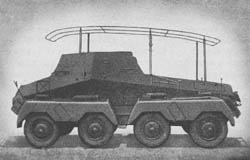
German nomenclature: Panzerfunkwagen (Sd. Kfz. 263) (8 Rad).
English designation: Armored radio car (8 wheels).
SPECIFICATIONS
| Net weight |
|
7,550 kg |
|
16,644 lb. |
| Pay load |
| Gross weight |
|
8,100 kg |
|
17,857 lb. |
| Weight: Front axle |
|
1,950 kg |
|
4,298 lb. |
| Weight: Rear axle |
|
2,100 kg |
|
4,630 lb. |
| Length (overall) |
|
5,850 mm |
|
19 ft., 2 ins. |
| Width (overall) |
|
2,200 mm |
|
7 ft., 3 ins. |
| Height (overall) |
|
2,900 mm |
|
9 ft., 6 ins. |
| Ground clearance |
|
270 mm |
|
101 ins. |
| Tread centers |
|
1,600 mm |
|
5 ft., 3 ins. |
| Wheelbase |
|
1,350/1,400/1,350 mm |
|
53/55/53 ins. |
| Wheel width |
|
190 mm |
|
7 1/2 ins. |
| Tire size |
| Angle of approach |
|
|
|
60° |
| Angle of departure |
|
|
|
60° |
| Seating capacity |
| Fording depth |
|
1,000 mm |
|
39 ins. |
| Climbing ability |
|
|
|
30° |
| Overturn gradient (lengthwise) |
| Overturn gradient (crosswise) |
|
|
|
35° |
| Turning radius |
|
10.5 meters (all wheels) |
|
34 ft., 5 ins. |
| Trailer load |
| Lifting power of winch |
| Engine horsepower |
|
160 c-v |
|
157.8 hp |
| Piston displacement |
|
8,000 cu cm |
|
480 cu. ins. |
| Fuel tank capacity |
|
180 liters |
|
47.5 gal. |
| Highway fuel consumption |
|
|
|
3.9 m.p.g. |
| Average terrain fuel consumption |
|
|
|
2.2 m.p.g. |
German: p. 74.66