
|
|
By Lone_Sentry_Admin, on December 18th, 2010%
Squadron Signal Publications have just announced their newest “In Action” book on the F4U Corsair. This new volume on the F4U Corsair updates Squadron Signal’s previous books on the well-known aircraft.
 F4U Corsair in Action SS1220: F4U Corsair In Actionby Jim Sullivan. From the Squadron Signal Press Release: The Corsair is among the most formidable US fighters of WWII, and maintained a kill ratio of 11:1 according to the US Navy. It went on to serve in Korea, holding its own in the early years of the jet age. The Corsair was first conceived in as a high-speed, high-altitude fighter for the Navy in 1938 when Chance Vought’s design team drew up plans for a fighter with a 1,800 hp engine and a huge 13-foot propeller—the F4U’s famous inverted gull wing was introduced to allow prop clearance. Handling problems delayed the aircraft’s deployment aboard carriers, but Marine Corps pilots quickly took to the powerful, rugged fighter and produced the first Corsair air ace by the summer of 1943. A total of 12,571 Corsairs were built between 1940 and 1952, most by Vought, but hundreds by Goodyear and Brewster as those companies’ assembly lines had to be pressed into service to meet demand for the remarkable aircraft. Surveys the history of the Corsair from its first prototype to the restored war-birds that continue to fly the air show circuit to the present day. Illustrated with 169 photographs (53 in color) plus color profiles and detailed line drawings; 64 pages. $16.95 Retail Price.
By Lone_Sentry_Admin, on December 10th, 2010%
The website Army Book of Memories tells the story of the 143rd AAA Gun Battalion during WWII from training through the fighting in the Ardennes Offensive and on to V-E Day. The website also includes photographs and a copy of the rare 143rd AAA’s unit history booklet which was published in 1945 after the end of the war.
By Lone_Sentry_Admin, on December 4th, 2010%
Canfora will soon be taking preorders on their new book Panther which will combine models and dioramas with historical research and photographs. Panther has an impressive list of contributors including Hilary Doyle, Mirko Bayerl, Phil Stutcinskas, Lester Plaskitt, Gunnar Jansson, Markus Eriksson, Roddy MacDougall, Brian Murdoch, Darren Gawle, Roger Hurkmans, and Toni Canfora.
By Lone_Sentry_Admin, on November 20th, 2010%
The following short remarks on vehicle unit markings and unit uniform markings was printed in “Intelligence Lessons from North Africa, Operation Torch” by the Office of Assistant Chief of Staff, G-2, Allied Force Headquarters, March 1943.
Vehicle Signs and Shoulder Titles
Formations and units should arrive in the theater without vehicle signs and shoulder titles. There has been some evidence that formation moves towards the front have been traced by this means.
It is considered that Army Commanders should be empowered to replace vehicle signs and shoulder titles when considered necessary for the purpose of traffic control or morale. Generally speaking, they can, from a security point of view, be replaced sooner in Army and Corps Troop units, as these cover a wide area.
By Lone_Sentry_Admin, on November 3rd, 2010%
M4 Sherman Tank modification and upgrades from Army Motors, Maintenance Branch, Office of Chief of Ordnance, Vol. 5, No. 1, April 1944:
If it’s a Tank, Medium, M4—here are the visible changes that should have been made by now. Check your score—and chase whatever’s missing.

Sorry our list couldn’t quite Tell All. For details on the above additions, subtractions, and modifications, you’ll have to consult the TB’s and FSMWO’s themselves. There are plenty of other TB’s you should have seen, too—full of fascinating facts on M4 operation, identification, lubrication, adjustments, cautions, and assorted SOP’s.
You’ll find all these cataloged in the latest edition of OFSB 1-1, under “pertinent publications” for the Tank, Medium, M4. Anything else is impertinent, including that remark you just made about having so much to read.
Left, top to bottom: New towing shackle-pins FSMWO-G1-W7; New style combat safety lights. FSMWO G1-W9; Disc type track idler wheel. TB 1700-31; Idler brackets. TB 17538-4; Fuel tank filler necks, FSMWO G104-W63; Crowbar bracket relocation, TB 700-48; Mono-gyro control, FSMWO C56-W1; Turret traversing control cam, FSMWO G104-W55; Turret armor plate, FSMWO G104-W57; Azimuth indicator, FSMWO G104-W74; Ammunition rack protector plate, FSMWO G104-W81; Improved turret master switch, FSMWO G104-W82; Gunner’s periscope sight, FSMWO G104-W91; Combination spot and signal fight, FSMWO G104-W92; Smoke bomb thrower, FSMWO G104-W93; Tank commander’s vane sight, FSMWO G104-W94; Impulse firing solenoid, FSMWO G104-W97; Hydraulic hand turret traverse, TB 1731F-1; Lift hooks on gun shield, TB 1758-2; Propeller shaft U-joint tube. TB ORD 12; Track support roller spacer, FSMWO G1-W2; Bogie lift modification, FSMWO G27-W1; Bogie spring bottom seat, TB 700-32; Cast track support roller, TB 700-46**; Bogie wheel bearings and seats, TB 700-72**; Steel track replacement, TB 700-106; Bogie wheel tire sidewalls, TB 1700-36; Bogie and idler wheels (outside U.S. only) TB ORD 22; Hub sprocket capscrew, TB 700-70**; Latest type blackout driving light, FSMWO G1-W6.
Right, top to bottom: Fuel relief valve, FSMWO G104-W65; New type cam assembly, TB 700-52**; Magneto timing change, TB 700-53**; Oil filter replacement elemerts, TB 700-76; Fire detector system, TB 700-98; Interchanging master clutch, TB 731A-6*; Engine oil tank level gage, TB 731 A-7*; Fuel line and accelerator ccntrol rod, TB 731A-11*; Carburetor dust guard, TB 1700-18; Excessive clutch release pressure, TB 1700-35; Bendix-Stromberg carburetor, TB 1725-16; Carburetor economizer seats, TB 1730-1; Valve and magneto timing, TB 1750D-2; Valve and magneto timing, TB 1750D-3; Carburetcr air horn drain plug screens, TB 1751-1; Piston ring change, TB 1751-11; Sealing of engine shroud, TB 1751-12; Valve rocker arm clamp screw, TB 1751-13; Front main Dearing support, T3 1751-17; Autolite generator regulators, TB 731A-10*; Decontaminating apparatus, TB 700-58; Steering lever parking brake, FSMWO G1-W5; Driver’s and ass’t driver’s door lock, FSMWO G104-W75; Hatch guards, FSMWO G104-W83; Clutch pedal interference, TB 700-49; Instrument panel voltmeter, TB 700-68**; Transmission synchronizer assembly, TB 1700-19; Transmission pinion gear shim, TB 1700-22; Transmission clutch gears, TB 1700-23; Differential compensating pinion, TB 1750-4; Transmission oil pump, TB 1750-5.
*Superseded by TM 9-731A (23 Dec. 43) **Included in TM 9-731A (23 Dec. 43)
By Lone_Sentry_Admin, on October 20th, 2010%
The Hungarian National Film Archive has placed an extenive collection of newsreels from 1931-1943 online at Filmhíradók Online.
In 2005, with support from the Ministry of Information Technology and Telecommunications, the Hungarian National Film Archive digitalised a part of its collection. In addition to 115 feature films, 597 newsreels from the years between 1931 and 1943 were digitalised, including the first talking newsreel from 1931. The films were added to the special collection of the National Audio-Visual Archive (NAVA).
By Lone_Sentry_Admin, on October 12th, 2010%
The following intelligence report on an unusual German remote-controlled machine-gun position encountered by U.S. troops in Normandy was published in the Intelligence Bulletin, Vol. III, No. 4, December 1944.
GERMAN MACHINE-GUN TRICK
A U.S. staff sergeant, who served as an observer for a mortar section in the Normandy campaign, reports an unusual German method of firing a machine gun by remote control. Although this method has not been reported by other U.S. soldiers, and although no concrete evidence as to its effectiveness can be presented, the idea is noted here for what it may be worth as a sample of the German soldier’s ingenuity.
 German Machine-gun Trick. A close-up of the machine gun, with, its pulleys. Riflemen-observers whistle signals to the gunner, to indicate Allied approach via point A. The gunner zeroes knot A, which trains the muzzle on point A. The cord arrangement for firing is not shown here.
The sergeant tells of inspecting a captured German machine-gun emplacement, which had been prepared in the highly novel manner illustrated in the figure. A rope had been attached to the butt end of the gun. This rope ran through pulleys set up on each side of the rear of the gun, so that movement of the rope would aim the gun in any lateral direction. The gun then was zeroed at certain positions in the field of fire, and these positions were marked by knots in the rope. Thus the gunner could aim the gun, and, by moving the rope back and forth, spray an area with bullets from a position out of the line of fire when the gun was attacked. The gun was fired by a trigger-and-cord arrangement not shown in the original field sketches.
The German machine-gun crew consisted of a gunner and two or three riflemen who served as observers and who reported to the gunner the particular point on the which the gun should be trained.
This machine-gun position appears impractical at best, and may be an incorrect report. The Germans however did produce a special periscopic aiming and firing apparatus for the MG34 and MG42 machine guns. U.S. ordnance reported on this device as the “Deckungszielgerät für le. 34 u. 42 Dezetgerät: Undercover Aiming and Firing Apparatus.”

By Lone_Sentry_Admin, on October 11th, 2010%
From Handbook on German Army Identification, U.S. Military Intelligence Training Center, Camp Ritchie, Maryland, 1943:
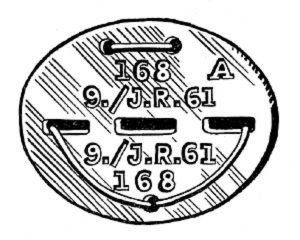
German identification tag (Erkennungsmarke).
a. It is believed that every German officer and soldier carries an identification tag, which is usually worn around the neck. The tag is made of zinc, is oval in shape, and measures about 2 by 2¾ inches. It is divided into an upper and a lower part by perforations. Each half bears identical markings.
b. When a man is killed, the lower half of the tag is broken offand sent back to Germany and the upper half is buried with the body. Identification tags captured up to the present bear only the unit, subunit, and a number. This number is also inscribed on the first page of the pay book (Soldbuch). The tag also bears a letter or two letters indicating to which blood group he belongs (A, B, AB, or O). The identification tag seldom shows the unit in which the man concerned is now serving unless he has lost the original disk issued to him on being assigned to a depot unit and his present unit has issued a replacement. The tag may record the existence of a previously unidentified unit.
c. A report should always be made of the entries on the tags.
 A captured identification tag of the old type. 168 is the personal number. 9th Company of the 61st Infantry Regiment. Blood group "A".
 8 is the personal number. Stb. means Staff. 7 Pz. Abw. means 7th Division Antitank Battalion. Blood group "O".
 83 is the personal number. 1st Company of 111th Infantry Regiment (formerly of 87th Infantry Regiment). Blood group "O".
 The new type identification tag, five-digit serial number indicates field post number which is that of the messing unit. 36 is the personal number.
By Lone_Sentry_Admin, on October 4th, 2010%
Upcoming fall and winter 2010 “In Detail” books from Wings and Wheels Publications covering WWII vehicles, trains, and aircraft.
By Lone_Sentry_Admin, on October 1st, 2010%
The following U.S. intelligence reports on Japanese suicide boats were published in Enemy on Luzon: An Intelligence Summary:
NAVY SUICIDE CRASH BOATS:
Japanese suicide crash boats manned by Naval personnel were found in a tunnel on Corregidor. The boats were loaded on small carts which were mounted on rails running from the tunnel to the beach where they were to be launched.
The Navy Suicide Crash Boat was 16 feet 8 inches long and had a beam of 5 feet 8 inches. The hull was plywood construction throughout and was powered by an automotive type, 6-cylinder, in-line, gasoline engine. The explosive charge was built into the hull of the boat. This last feature was the main difference between the Army and Navy suicide boats.
The Type 98 explosive charge weighed 640 pounds and was located below the deck forward of the cockpit. The charge could be fired by three methods: 1) electrically on impact; 2) electrically by closing a switch; and 3) by use of a pull igniter.
From the disposal point of view, the boat was dangerous to anyone unfamiliar with the circuit and switch details. It would also have been simple to rig this boat as a booby trap either electrically or through the pull igniter.
The boat carried a big charge that would be effective against ships. The only defense that a ship had was, as in the case of the suicide plane, accurate gunfire.
ARMY SUICIDE CRASH BOAT:
Japanese suicide boats, to be manned by Army personnel, were recovered at Lingayen Gulf, Luzon. These craft were the principal weapon of the Japanese Gyoro (“fishing”) battalions.
The army suicide boat was made of plywood with a length of 18½ feet and a beam of 5 feet 10 inches. It was decked with a forward hatch leading to the engine and has a cockpit aft. The boat was powered with a 6-cylinder Chevrolet automotive engine, about 85 horsepower. The maximum speed of the craft was estimated at 35 knots. The fuel capacity was about 56 gallons.
The two 120 kg depth charges were mounted on racks abreast of the cockpit. The charges could be either dropped close aboard or released when the boat crashed into the ship. At least one attack of the former type was made, resulting in damage to a merchant ship during the Luzon campaign.
Although parts of the release mechanism were not available, the operation is believed to have been as follows: the charges were fitted in the racks and held by an arrangement of slings and bars. Rods fitted to extend beyond the bow would be driven back releasing the charges during a collision with another ship. However, the coxwain could place a crossbar forward to release the charges.
|
|
Recent Comments