
Japanese Rockets and Launchers

The following U.S. intelligence report on Japanese spin-stabilized rockets and launchers was published in Enemy on Luzon: An Intelligence Summary:

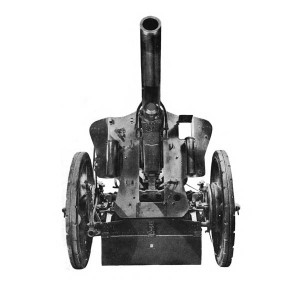
ARMY 20-CM SPIN STABILIZED ROCKET AND TYPE 4 LAUNCHER:

Several of these projectiles, the first Army rockets recovered, and the Type 4 launcher, were used against our troops in the Manila area and east of Manila. The date of manufacture, late 1944, emphasized the trend toward increased use of rockets by the enemy.

In general appearance the launcher was similar to a large trench mortar. It incorporated traversing mechanism in the bipod and employed standard mortar fire-control devices. The tube, 20.3-cm inside diameter and 75 and 5/8 inches long, was open at both ends and contained a hinged opening for insertion of the rocket. It was fired with a 25-foot lanyard attached to a pull igniter.

Japanese WWII Army 20-cm SS Rocket and Type 4 Launcher

Army 20-cm SS Rocket and Type 4 Launcher

The explosive head was a thin-walled tube containing nose fuze, booster and filling of cast TNT. The motor threaded onto the explosive head and was equipped with six nozzles canted 25 degrees. The propellant was ballistite ignited by a black powder charge located just forward of the igniter, which screwed into the motor base plate. Projectile and motor had a combined weight of approximately 185 pounds.

Japanese WW2 Army 20-cm SS Rocket and Type 4 Launcher (Firing)

Army 20-cm SS Rocket and Type 4 Launcher (Firing)

The rocket was stable in flight, exploded high order, and had an approximate range of 3,200 yards at 800 mils.

Continue reading Japanese Rockets and Launchers

Handbook on Japanese Military

The October 1944 version of the U.S. technical manual on the Japanese military, TM-E 30-480: Handbook on Japanese Military Forces has been added to the main LoneSentry website. The complete table of contents are listed below.

Continue reading Handbook on Japanese Military

Japanese Type 98 Halftrack

The following U.S. intelligence report on the Japanese Type 98 halftrack personnel carrier and prime mover was published in Enemy on Luzon: An Intelligence Summary:

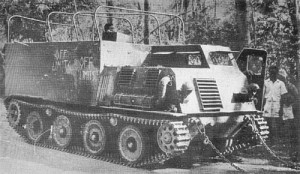
A Japanese combination personnel carrier and prime mover was recovered near Manila, Luzon.

The vehicle was without armor or armament of any kind. It had a folding canvas top and four wide seats providing seating capacity for approximately 16 persons. Storage compartments for equipment and luggage were provided under the seats. The vehicle was equipped with a large winch and towing pintle in the rear.

Japanese Type 98 Halftrack WW2

Halftrack Personnel Carrier and Prime Mover

The engine, a 6-cylinder, in-line, water-cooled diesel type, was connected to a four-speed forward, one-speed reverse, spur-gear transmission. The chassis layout was similar to the German standard half-track, while the suspension and steering followed the Opel truck half-track conversion. The front transverse leaf spring, independent wheel suspension was an original and effective feature. The vehicle was 18 feet 3 inches long, 6 feet 4 inches wide, 7 feet 10 inches high, had a ground clearance of 13 inches, 110 horsepower, and weighed approximately 6 tons.

Performance tests indicated a maximum speed of 25 miles per hour, an estimated radius of action of 125 miles, and proved that the vehicle could manipulate a trench 3 feet wide, a vertical wall 18 inches high, a 50% slope, and a stream 3 feet deep. Ample power and cross-country mobility were provided to allow it to fulfill the functions of a prime mover and personnel carrier.


Japanese Type 1 Ho-Ki Armored Personnel Carrier

The Japanese produced a limited number of the innovative Type 1 Ho-Ki, fully-tracked armored personnel carriers. The Ho-Ki APC was developed in 1941, but full-scale production did not start until 1944. A limited number of Ho-Ki were deployed with Japanese reinforcements to the Philippines in 1944, and several Ho-Ki were captured by the U.S. on Leyte and Luzon.

From Enemy on Luzon: An Intelligence Summary:

Although not encountered before our return to the Philippines, several of these vehicles were captured there by U.S. forces. One was recovered on Leyte, and at least four were found on Luzon.

Japanese Type 1 Ho-Ki APC Armored Personnel Carrier

Full Track Personnel Carrier

The vehicle was full tracked, armored, and powered by a six cylinder air-cooled Diesel engine. The bogie wheels and suspension were similar to those of the Type 95 Light Tank, but the track was both longer and wider than that of the tank. This carrier, 15 feet 9 inches long overall and 6 feet 8 inches wide, was protected with ¼-inch armor on all sides and rear, but was open at the top except for the driver’s compartment. There were doors at the rear and one on each side to permit personnel to leave the carrier rapidly. The driver’s compartment was on the left front of the body and was equipped with metal vision slits for driving under fire. The vehicle had four speeds forward in addition to high and low range transfer case and was equipped with a spring-mounted towing pintle.

Being much lighter than the Type 95 Light Tank, employing an engine of similar power, and having roughly the same track contact, the vehicle gave excellent cross-country performance. The addition of the transfer case increased the range and power as compared with a light tank. U.S. combat troops found these vehicles to be highly satisfactory artillery prime movers.

Continue reading Japanese Type 1 Ho-Ki Armored Personnel Carrier

Ohka Schematic

Schematic of the Baka rocket-propelled piloted aircraft bomb from the U.S. Navy Technical Air Intelligence Center:Baka Ohka Rocket Flying Bomb

See Also: Baka… Flying Warhead
 

Aerial Bombs

WW2 Air Force Tactical IntelligenceThe following tactical intelligence report appeared in “Eastern Air Command Weekly Intelligence Summary”, No. 10, Nov. 3, 1944 published by Headquarters Eastern Air Command, Southeast Asia.

Oscars Drop Aerial Bombs on B-24 Moulmein Mission

22 October Preliminary Report from 356 Squadron (RAF)

Thirteen Liberators (B-24s) dropped bombs on Moulmein between 1159 and 1202 hours from 2000 feet to 2500 feet. Immediately after this attack two enemy aircraft; one Oscar and one Tojo, were sighted at two oclock, 2000 yards away and 500 feet above. One of these rolled off the top and dived through the first formation. (The Liberators were in two formations, 2000 yards apart – ahead and astern.) As it dived, enemy aircraft fired and hitting aircraft “D” inflicted slight damage to that machine’s leading and trailing edges. Enemy aircraft leveled off at 1000 feet.

The second of these two enemy aircraft stood off at 2000 yards then disappeared in the direction of Rangoon, performing aerobatics as it went on it’s way.

Two Oscars (MK II) were sighted 37 minutes after leaving the target area. Standing off, they remained in sight of the squadron for 35 minutes. At 1314 hours in position 1630 N 9500 E these two enemy aircraft split up and attacked simultaneously. The Liberators were now at 10,000 feet.

Attacking from ahead and above, one enemy aircraft dived and dropped what appeared to be aerial bombs which seemed to flutter down slowly in pairs. One bomb burst with a reddish yellow flash in front of and below the Oscar while it was still diving, but no damage was done to our aircraft.

The second Oscar came in level from astern. It closed to 250 yards but did not fire. Two rear gunners and one mid-upper gunner opened lire and tracer from aircraft “J” appeared to enter the Oscar’s wings. Enemy aircraft broke away apparently undamaged….

Jap T/E Fighter Drops Aerial Bomb on Truk Strike

Thirteen B-24s bombed N Moen Airfield, Truk, from 19,500 feet on 19 September 1944. A twin-engine Jap fighter attacked the formation and dropped a phosphorous aerial bomb. (7th AF Intelligence Summary No. 53, 7 October, 1944).

The attack was made at noon and was unescorted. One minute after “bombs away” our planes were intercepted by 3-4 Zekes and one possible Nick. One two-plane coordinated attack was made from one oclock high. Both of these planes dropped aerial bombs, after coming in from out of the sun. This attack was followed by five individual passes from between twelve and two oclock. These fighters also came in high and released three aerial bombs and made two shooting passes. The bombs hit low and wide.

One of our planes had a feathered engine and was subjected to two fairly aggressive attacks from five and eight oclock high. However, the formation protected this plane by slowing down and keeping him well covered.

The twin-engine fighter came in from the nose, high and out of the sun, and pressed his attack to 250 yards. He broke away to the right at two oclock, exposing the belly of the plane. A phosphorous bomb was dropped, bursting approximately 300 yards at three oclock. Although twin-engine fighters have been seen on many previous missions, this aerial bomb attack is the first reported from this type fighter. (Illustration A).

Japanese Aerial Bombs in WW2

Zekes Coordinate on Aerial Bomb Attack

Fifteen more B-24s hit the same target. (See story above). The attacks were coordinated so that after “bombs away” the two formations gave mutual support. Separate bomb runs split the AA defenses.

Interception of this second formation was started just before the bomb run. Three Zekes made a coordinated attack, two coming in trail from 11 oclock high and the third diving steeply from out of the sun. The first pass was a shooting pass, the second was an aerial bomb attack, and the third was an aerial bomb and shooting pass. The first fighter broke away at 500′ rolling down toward 5 oclock. His trailing wingman also broke off the attack at 500 feet and pulled off toward 3 oclock low. The Zeke that dove out of the sun, reached a position about 600′ in front of the formation but then pulled up and rolled into a spiral breakaway above the formation.

Both of the aerial bombs released in this coordinated attack were a new type. (Illustration B). One of the bombs was observed prior to bursting and was described 1½ feet in diameter, 6 feet long and spinning to the left as it fell. The burst was orange-red and shrapnel was thrown out which looked like tracers. Both bombs were accurate as to altitude. One burst to the left and one to the right of the formation. One burst was close enough to No. 2 plane in B-Flight for the blast to jar loose lighting fixtures in the cockpit.

All other passes were very unaggressive. The mission was notable since after leaving the target, all 27 planes offered mutual support instead of the two formations leaving separately. The 431st crew members expressed the opinion that this may have been responsible for the unusually unaggressive tactics on the part of the enemy pilots. No damage to our aircraft resulted from enemy fire.

For additional intelligence reports on German and Japanese use of aerial bombs against Allied bombers, see:


Baka... Flying Warhead

The following intelligence report on the Japanese Yokosuka MXY-7 Ohka (Allied nickname “Baka”) appeared in the June 1945 issue of C.I.C. (Combat Information Center) published by the U.S. Office of the Chief of Naval Operations.


Baka Flying Warhead: Yokosuka MXY-7 Ohka Kamikaze Rocket Plane

…flying warhead

CIC watch officers. FDO’s and radar operators have been given something to remember. The discovery on Okinawa of a number of small Japanese planes specifically dedicated to suicide missions warrants a second, and serious thought. This type of plane appears to be the latest thing in the Japanese technique of suicide air attack. The timely Okinawa discovery should serve to alert CIC personnel to the possibilities, as well as the probabilities, of attacks by these planes.

Diagram: Baka Flying Warhead: Yokosuka MXY-7 Ohka Kamikaze Rocket Plane

Code named “BAKA” ( Japanese for “Fool”) these small planes are carried under the belly of a parent aircraft. Carrying a pilot and minimum of controls they are to be released 20 to 25 miles from their target, which they reach with increased speed by dive angle and jet propulsion. “BAKA” carries a 2645 lb. warhead (filling weight 1165 lbs.) in the nose section of its fuselage. This warhead is semi-armor piercing and probably has good penetration.

The Betty 22 is the only “rocket-jockey” so far identified, but Sally, Peggy, Helen, Rita and Liz must be listed as probables since they can be easily adapted to parent aircraft duty with slight modification. “BAKA” literally hooks a ride with the parent aircraft, being suspended in flight by a single bomb-type lug just forward of the C.G.

It takes a nose down attitude on release. Heavy canvas straps, one forward and one aft, provide balance and absorbs some of the weight. Ten sway brace points keep “BAKA” rigid and parallel to airflow during its transport flight.

It is thought that release is made at about 200 mph. A shallow glide for about two minutes clears the parent aircraft and gains some speed for “BAKA.” The pilot then switches to rocket propulsion, from three rocket tubes in the rear section of the fuselage gaining additional speed and regaining slight altitude. This rocket process is repeated until the target is sighted, whereupon the nose is lowered, a bead is drawn on the target by means of single ring and bead sights located forward of the pilot canopy, and the super-Kamikaze death plunge is on its way.

CIC personnel will be concerned particularly with the following estimates and evaluations of “BAKA” tactics:

1. The most logical approach for the parent plane is at an altitude between its practical service ceiling (for Betty-Ag. 17 to 20) and its theoretical service ceiling (for Betty-Ag. 27). Ceilings of other parent aircraft would not vary appreciably from these normal ceilings. This will permit “BAKA” to reach its target at maximum speed and, it will permit the parent aircraft to retreat without coming too close to our formations.

Baka Flying Warhead: Yokosuka MXY-7 Ohka Kamikaze Rocket Plane

2. The above evaluation does not preclude lower level attacks with points of release nearer our formations, particularly where a land back-drop may be involved. Actual sightings have been reported. One release was made at altitude of 4000 feet, 7 miles from our ships. Another release was made outside visual range.

3. Maximum speed of the parent aircraft, while carrying “BAKA” is reduced approximately 15 to 20 mph.

4. The approximate maximum horizontal range of “BAKA”, after release at service ceiling, is from 20 to 25 miles. This distance is based upon a minimum glide angle of 16°20′. Based upon present available data it is considered to be maximum practical range. At lower launching ceilings, maximum range will be slightly decreased.

5. The overall length of “BAKA” is about 20 feet. It has a wing span of 16 feet. When released from the parent plane it will reflect a small, fast moving pip on the radar screen. It will be difficult to detect.

6. The parent aircraft will undoubtedly reverse course immediately upon releasing “BAKA.” There may be a tendency on the part of radar operators to follow this opening track of the parent plane—overlooking the smaller target echo of the “flying warhead” that will close the ship rapidly.

7. Operators may evaluate the released “BAKA” echo as window on the first sweep, then lose it altogether on succeeding sweeps. Concentrated PPI scanning, with added attention to the A-scope on all raid bearings may become mandatory-particularly when a raid apparently turns away at 20-30 miles.

Baka Flying Warhead: Yokosuka MXY-7 Ohka Kamikaze Rocket Plane

8. Speed, altitude and limited maneuverability of a parent plane pregnant with “BAKA” should provide a set-up for CAP interception prior to release point. Once “BAKA” is released, both CAP and ships AA firepower will be handicapped by the 630 mph. speed of a diving “BAKA.”

Though a potential threat if used to combat our operations in the future, “BAKA” faces several potent obstacles to its successful employment in air-suicide attacks on our ships. To be most effective “BAKA” will approach at high altitudes—such approach being easier to detect at greater ranges and is reminiscent of our earlier fighter direction field days when raids nearly always came in at these angels. Further, the control surfaces on this plane are so small that once its aim has been committed, the tremendous speed of the dive will allow very little course deviation. And, the fact remains that a complete training course for “BAKA” pilots is impossible, for its most important phase upon which depends success or failure of the weapon—the dive onto a pin pointed target—can be accomplished but once.

Notwithstanding the above-mentioned disadvantage, the greatest obstacle to successful “BAKA” operation can and must be—early detection, interception and destruction of the parent aircraft by our radar operator-intercept officer-fighter pilot team before the “BAKA” is near enough to our ships to be released.

Baka Flying Warhead: Yokosuka MXY-7 Ohka Kamikaze Rocket Plane

Baka Flying Warhead: Yokosuka MXY-7 Ohka Kamikaze Rocket Plane


Japanese 150 mm Gun Type 89

U.S. military intelligence report on the Japanese 150mm Type 89 (1929) Gun from Japanese Artillery Weapons, CINCPAC-CINCPOA, Bulletin 152-45, July 1945.

150 MM GUN TYPE 89 (1929)

The Japanese Type 89, 15 cm gun is comparable to the old U.S. M1918 in many respects, but it has a shorter range and is less efficient than similar caliber guns of other nations. Types 45 and 90, 15 cm guns have also been reported.

WW2 Japanese 150 mm Gun Type 89

The Type 89 has a variable hydro-pneumatic recoil system and an interrupted thread breech block; the latter has a mushroom head and stepped-up buttress type screws. Two carriages have been recovered. The only apparent difference is in the two equilibrators. One has spring type and the other hydrospring type. The trail is the split box type with detachable trail spades. The traversing handwheel and scale are located on the left side of the carriage; the scale is graduated up to 350 mils in ten mil increments. The elevation scale, range drum, and sight are on the right side of the carriage; the range scale is graduated up to 42 degrees.

An 8 ton prime mover is used to tow the piece. For traveling, the gun is broken down in two loads, tube and carriage.

Characteristics

Caliber        149.1 mm (5.87 in.)
Weight (firing position) 22,830 lbs.
Length (firing position) 26 ft. 4 in.
Length of bore 18 ft. 10 in.
Muzzle velocity 2,870 ft/sec.
Maximum range 21,800 yds.
Elevation 42 degrees
Depression 5 degrees
Traverse 350 mils R & L
Rate of fire 2 rds/min.
Ammunition HE, APHE, Long pointed HE, Shrap., Illumi.


Japanese Army Uniforms

The February 7, 1944 issue of NEWSMAP illustrated Japanese uniforms, equipment, and insignia:

Japanese Army Uniforms of World War II

Two examples of the detail drawings:


Japanese Private Infantry Rifleman PRIVATE, INFANTRY RIFLEMAN: M1938 BLOUSE, FRONT
Nitohei
Sampachi (Meiji 38) rifle, rubberized fabric or leather cartridge pouches; gas mask carrier under left arm. The chevron worn on right arm is a diligence stripe.


CAMOUFLAGE JUNGLE JACKET
The fibre material of which the jacket is made may vary with the color of the foliage in the area in which jacket is worn.
Japanese Camouflage Jungle Jacket

(For another view of the Japanese camouflage uniform, see Japanese Camouflage Garment, Tactical and Technical Trends, No. 14, Dec. 17, 1942.)

Source: NEWSMAP, Volume II, No. 42F, February 7, 1944 by Army Information Branch.

10 cm Type 98 Dual Purpose Gun

Intelligence report on the Japanese 10 cm Type 98 (1938) Dual Purpose Gun from Japanese Artillery Weapons, CINCPAC-CINCPOA, Bulletin 152-45, July 1945.

10 CM DUAL PURPOSE GUN TYPE 98 (1938)

This twin mount dual purpose gun was encountered for the first time on Iwo Jima. With its high muzzle velocity and long range it is one of the Japs most powerful anti-aircraft and medium caliber coast defense weapons.

Japanese Twin 10 cm Type 98 Dual Purpose Gun WW2

Recognition is made easy by the extreme length of the barrels (65 calibers) and the two symmetrical horizontal sliding type breech blocks. Ammunition loading trays are provided on either side of the breech blocks to aid in loading. The Navy type riveted shield revolves around a steel base.

A four meter rangefinder was found with the battery on Iwo, and although no director was recovered, Types 94, 2 and 4 directors may be used with these weapons.

With the electric motor provided to facilitate elevation and traverse, a speed of over 16 feet per second for each is possible. A rate of fire (firing both barrels) of 456 rounds per hour (8 rds per minute) is allegedly possible.

Characteristics

Caliber        100 mm (3.93 in.)
Length of bore 65 calibers
Muzzle velocity 3,280 ft/sec.
Maximum range (horizontal) 20,400 yds.
Maximum range (vertical) 44,300 yds.
Effective range (vertical) 34,400 ft.
Rate of fire 15 rds/min.
Elevation 90 degrees
Depression 10 degrees
Weight of projectile 28.7 pounds